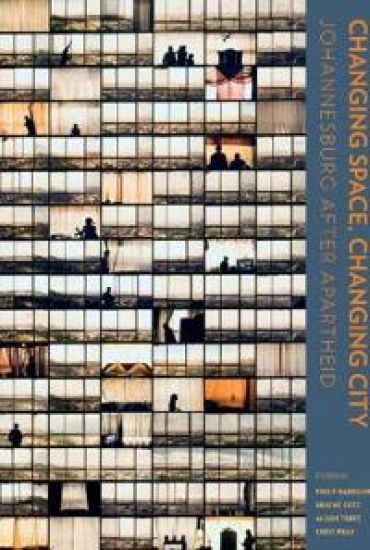
Changing Space, Changing City
Peter Ahmad; Badenhorst Willem; Beavon Keith; Claire Bénit-Gbaffou; Charlton Sarah; Yasmeen Dinath; Teresa Dirsuweit; Everatt David; Gotz Graeme; Kirsten Harrison; Harrison Philip; Huchzermeyer Marie; Hilton Judin; Karam Aly; Kihato Caroline; Neil Klug; Kuljian Christa; Karina Landman; Pauline Larsen; Hannah le Roux; Mabin Alan; Miriam Maina; Puleng Makhetha; Malaza Nqobile; Adrian Masson; Mathetha Mokonyama; Khangelani Moyo; Brian Mubiwa; Yusuf Patel; Herman Pienaar; Naomi Roux; Margot Rubin; Samadia Sadouni; Rashid Seedat
Wits University Press
2014
sidottu
As the dynamo of South Africa’s economy, Johannesburg commands a central position in the nation’s imagination, and scholars throughout the world monitor the city as an exemplar of urbanity in the global South. This richly illustrated study offers detailed empirical analyses of changes in the city’s physical space, as well as a host of chapters on the character of specific neighbourhoods and the social identities being forged within them. Informing all of these is a consideration of underlying economic, social and political processes shaping the wider Gauteng region. A mix of respected academics, practising urban planners and experienced policymakers offer compelling overviews of the rapid and complex spatial developments that have taken place in Johannesburg since the end of apartheid, along with tantalising glimpses into life on the streets and behind the high walls of this diverse city. The book has three sections. Section A provides an overview of macro spatial trends and the policies that have infl uenced them. Section B explores the shaping of the city at district and suburban level, revealing the peculiarity of processes in different areas. This analysis elucidates thelarger trends, while identifying shifts that are not easily detected at the macro level. Section C is an assembly of chapters and short vignettes that focus on the interweaving of place and identity at a micro level. With empirical data supported by new data sets including the 2011 Census, the city’s Development Planning and Urban Management Department’s information system, and Gauteng City-Region Observatory’s substantial archive, the book is an essential reference for planning practitioners, urban geographers, sociologists, and social anthropologists, among others.