Kirjojen hintavertailu – 12 859 828 kirjaa ja 27 kauppaa

Kirjailija

Samuel Beckett

Kirjat ja teokset yhdessä paikassa: 161 kirjaa, julkaisuja vuosilta 1974–2027, suosituimpiin kuuluu Novels I of Samuel Beckett. Vertaile teosten hintoja ja tarkista saatavuus suomalaisista kirjakaupoista.

161 kirjaa

Kirjojen julkaisuvuodet: 1974–2027.

Novels I of Samuel Beckett

Novels I of Samuel Beckett

Samuel Beckett

Grove Press / Atlantic Monthly Press
2006
sidottu
Edited by Paul Auster, this four?volume set of Beckett's canon has been designed by award-winner Laura Lindgren. Available individually, as well as in a boxed set, the four hardcover volumes have been specially bound with covers featuring images central to Beckett's works. Typographical errors that remained uncorrected in the various prior editions have now been corrected in consultation with Beckett scholars C. J. Ackerley and S. E. Gontarski. Beckett was interested in consciousness as a form of comedy close to tragedy and logic as a crime. He loved the tension in 'cogito ergo sum' and took a dim view of the connecting word, the 'ergo' in the equation. Cogitating was the nightmare from which his characters were trying to awake. Being was a sour trick played on them by some force with whom they were trying desperately not to reckon. Beckett produced infinite amounts of comedy about the business of thinking as boring, invalid, and quite unnecessary. His characters did not need to think in order to be, or be in order to think. They knew they existed because of the odd habits and deep discomforts of their bodies. I itch therefore I am." ? Colm Toibin, from his Introduction

Novels II of Samuel Beckett

Novels II of Samuel Beckett

Samuel Beckett

Grove Press / Atlantic Monthly Press
2006
sidottu
Edited by Paul Auster, this four?volume set of Beckett's canon has been designed by award-winner Laura Lindgren. Available individually, as well as in a boxed set, the four hardcover volumes have been specially bound with covers featuring images central to Beckett's works. Typographical errors that remained uncorrected in the various prior editions have now been corrected in consultation with Beckett scholars C. J. Ackerley and S. E. Gontarski. "A man speaking English beautifully chooses to speak in French, which he speaks with greater difficulty, so that he is obliged to choose his words carefully, forced to give up fluency and to find the hard words that come with difficulty, and then after all that finding he puts it all back into English, a new English containing all the difficulty of the French, of the coining of thought in a second language, a new English with the power to change English forever. This is Samuel Beckett. This is his great work. It is the thing that speaks. Surrender." ? Salman Rushdie, from his Introduction

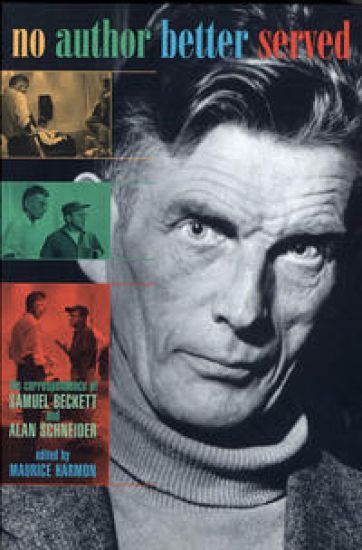
No Author Better Served

No Author Better Served

Samuel Beckett; Alan Schneider

Harvard University Press
2000
nidottu
For Alan Schneider, directing Endgame, Samuel Beckett lays out the play’s philosophy, then adds: “Don’t mention any of this to your actors!” He claimed he couldn’t talk about his work, but Beckett proves remarkably forthcoming in these pages, which document the thirty-year working relationship between the playwright and his principal producer in the United States. The correspondence between Beckett and Schneider offers an unparalleled picture of the art and craft of theater in the hands of two masters. It is also an endlessly enlightening look into the playwright’s ideas and methods, his remarks a virtual crib sheet for his brilliant, eccentric plays. Alan Schneider premiered five of Beckett’s plays in the United States, including Waiting for Godot, Krapp’s Last Tape, and Endgame, and directed a number of revivals. Preparing for each new production, the two wrote extensive letters—about intended tone, conception of characters, irony and verbal echoes, staging details for scenes, delivery of individual lines. From such details a remarkable sense of the playwright’s vision emerges, as well as a feel for the director’s task. Of Godot, Beckett wrote to Schneider, “I feel my monster is in safe keeping.” His confidence in the director, and Schneider’s persistent probing for a surer understanding of each play, have produced a marvelous resource: a detailed map of Beckett’s work in conception and in production. The correspondence starts in December 1955, shortly after their first meeting, and continues to Schneider’s accidental death in March 1984 (when crossing a street to mail a letter to Beckett). The 500 letters capture the world of theater as well as the personalities of their authors. Maurice Harmon’s thorough notes provide a helpful guide to people and events mentioned throughout.
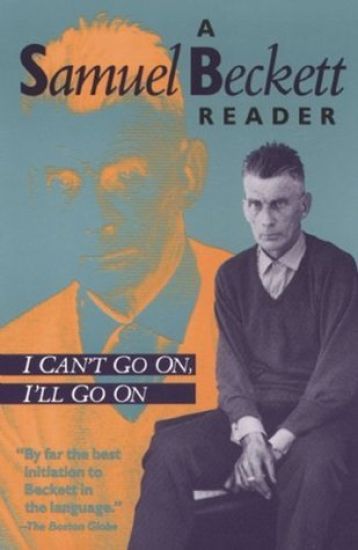
I Can't Go on, I'LL Go on: a Selection from Samuel Beckett's Work

I Can't Go on, I'LL Go on: a Selection from Samuel Beckett's Work

Samuel Beckett

Grove Press / Atlantic Monthly Press
1994
nidottu
Winner of the Nobel Prize for literature and acknowledged as one of the greatest writers of our time, Samuel Beckett has had a profound impact upon the literary landscape of the twentieth century. In this one-volume collection of his fiction, drama, poetry, and critical writings, we get an unsurpassed look at his work. Included, among others, are: - The complete plays Waiting for Godot, Krapp's Last Tape, Cascando, Eh Joe, Not I, and That Time- Selections from his novels Murphy, Watt, Mercier and Camier, Molloy, and The Unnamable- The shorter works "Dante and the Lobster," "The Expelled," Imagination Dead Imagine, and Lessness- A selection of Beckett's poetry and critical writings With an indispensable introduction by editor and Beckett intimate Richard Seaver, and featuring a useful select bibliography, I Can't Go On, I'll Go On is indeed an invaluable introduction to a writer who has changed the face of modern literature.
Proust

Proust

Samuel Beckett

FABER FABER
2026
nidottu
An electrifying analysis of one legendary giant of twentieth-century literature by another: Beckett on Proust. The whole of Proust's world comes out of a teacup . . . When he was only 25, Samuel Beckett published his first ever book: an electrifying dissection of Marcel Proust's masterpiece À la recherche du temps perdu. Habit, memory and time: Beckett argues that these are the defining characteristics of the human condition. Involuntary memories - like those prompted by Proust's famous madeleine - are radical moments that pierce the veil of habit, and offer inspiration that soothes the existential anguish of time passing. Through analysing Proust's technique, the young Beckett puts forth a blazing artistic manifesto for his own future works, such as Waiting for Godot, Molloy, Malone Dies and The Unnamable. The result is a totemic meeting of literary minds that illuminates the philosophies of two creative geniuses. *Read in a new audiobook edition by Eimear McBride*
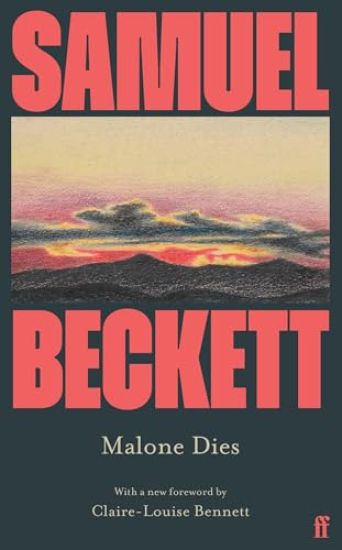
Malone Dies

Malone Dies

Samuel Beckett

FABER FABER
2025
pokkari

Halvin toimitettuna 17,90 €

The second of the three greatest novels by the era-defining Nobel laureate, reissued for a new generation. Nothing is more real than nothing. Malone, a decrepit old man, lies naked in his bed, scrawling bitter observations in an exercise book. He is fed on a bed-table, his chamber pot is emptied, he hooks items with his stick, he looks out of the window. He tells the story of a man, looked after by nurses, taken for an ill-fated picnic on an island in the sea. As his mind disintegrates, so does the novel . . . Malone Dies is the second of the three great novels Samuel Beckett produced during his 'frenzy of writing' in the late 1940s. The others are Molloy and The Unnamable.