Kirjojen hintavertailu – 12 903 725 kirjaa ja 27 kauppaa

Kirjailija

Samuel Bowles

Kirjat ja teokset yhdessä paikassa: 54 kirjaa, julkaisuja vuosilta 1984–2025, suosituimpiin kuuluu Beyond the Wasteland. Vertaile teosten hintoja ja tarkista saatavuus suomalaisista kirjakaupoista.

54 kirjaa

Kirjojen julkaisuvuodet: 1984–2025.

Democracy and Capitalism

Democracy and Capitalism

Samuel Bowles; Herbert Gintis

Routledge
2010
sidottu
Originally published in 1986, Bowles and Gintis present a critique of contemporary Marxian and liberal political theory. They show that 'capitalism' and 'democracy' - although widely held jointly to characterize Western society - are sharply contrasting systems regulating both the process of human development and the historical evolution of whole societies. They examine in detail the relationship between political theory and economics, and explore the multifaceted character of power in modern societies.
Microeconomics

Microeconomics

Samuel Bowles

Princeton University Press
2006
pokkari
In this novel introduction to modern microeconomic theory, Samuel Bowles returns to the classical economists' interest in the wealth and poverty of nations and people, the workings of the institutions of capitalist economies, and the coevolution of individual preferences and the structures of markets, firms, and other institutions. Using recent advances in evolutionary game theory, contract theory, behavioral experiments, and the modeling of dynamic processes, he develops a theory of how economic institutions shape individual behavior, and how institutions evolve due to individual actions, technological change, and chance events. Topics addressed include institutional innovation, social preferences, nonmarket social interactions, social capital, equilibrium unemployment, credit constraints, economic power, generalized increasing returns, disequilibrium outcomes, and path dependency. Each chapter is introduced by empirical puzzles or historical episodes illuminated by the modeling that follows, and the book closes with sets of problems to be solved by readers seeking to improve their mathematical modeling skills. Complementing standard mathematical analysis are agent-based computer simulations of complex evolving systems that are available online so that readers can experiment with the models. Bowles concludes with the time-honored challenge of "getting the rules right," providing an evaluation of markets, states, and communities as contrasting and yet sometimes synergistic structures of governance. Must reading for students and scholars not only in economics but across the behavioral sciences, this engagingly written and compelling exposition of the new microeconomics moves the field beyond the conventional models of prices and markets toward a more accurate and policy-relevant portrayal of human social behavior.

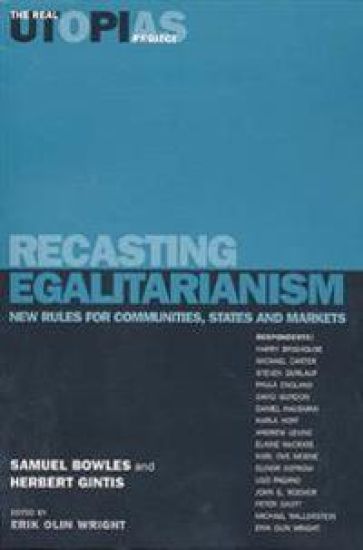
Recasting Egalitarianism

Recasting Egalitarianism

Herbert Gintis; Samuel Bowles

Verso Books
1999
sidottu
In Recasting Egailtarianism, part of Verso's Real Utopias series, economists Samuel Bowles and Herbert Gintis diagnose the current malaise of the Left as a result of the obsolescence of its traditional economic models. They propose an egalitarian redistribution of assets-land, capital and housing-and draw in novel ways on markets, competition, state regulation and community governance. The lead essay in the book lays out the underlying logic of this proposal in some detail. In the series of critiques which follow it, a range of distinguished thinkers engage in lively polemic concerning the practicality and effectiveness of the authors' scheme.
Recasting Egalitarianism

Recasting Egalitarianism

Herbert Gintis; Samuel Bowles

Verso Books
1999
nidottu
In Recasting Egalitarianism, part of Verso's Real Utopias series, economists Samuel Bowles and Herbert Gintis diagnose the current malaise of the Left as a result of the obsolescence of its traditional economic models. They propose to rejuvenate the egalitarian project through a strategy of asset-based redistribution, drawing in novel ways on markets, competition, state regulation and community governance. In this major work on economic and social policy, the authors address the twin challenges posed by a globally integrated economy and the key economic roles now played by information, motivation, and other intangibles. They propose an egalitarian redistribution of assets-land, capital, and housing-and argue for the beneficial disciplining effects of competition both in markets and among publicly-funded service providers, pointing out that the injustices commonly associated with markets can be avoided if assets are more equally distributed. The lead essay in the book lays out the underlying logic of this proposal in some detail. This is followed by responses by critics and supporters.
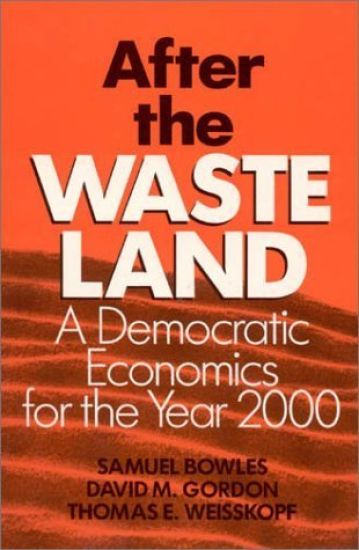
After the Waste Land

After the Waste Land

Samuel Bowles; David M. Gordon; Thomas E. Weisskopf

M.E. Sharpe
1990
nidottu
This critique of Reaganomics attempts to provide alternatives to both the supply experiments of the 1980s and neoliberal strategies of austerity. It presents arguments for economic democracy with a worker-oriented blueprint for improving productivity, growth, employment and economic justice.
After the Waste Land

After the Waste Land

Samuel Bowles; David M. Gordon; Thomas E. Weisskopf

M.E. Sharpe
1990
sidottu
This critique of Reaganomics attempts to provide alternatives to both the supply experiments of the 1980s and neoliberal strategies of austerity. It presents arguments for economic democracy with a worker-oriented blueprint for improving productivity, growth, employment and economic justice.