Kirjojen hintavertailu – 12 876 746 kirjaa ja 26 kauppaa

Kirjailija

Samuel Gregg

Kirjat ja teokset yhdessä paikassa: 18 kirjaa, julkaisuja vuosilta 2001–2025, suosituimpiin kuuluu Fur Gott Und Den Profit: Eine Ethik Des Finanzwesens. Christlich - Marktliberal. Vertaile teosten hintoja ja tarkista saatavuus suomalaisista kirjakaupoista.

18 kirjaa

Kirjojen julkaisuvuodet: 2001–2025.

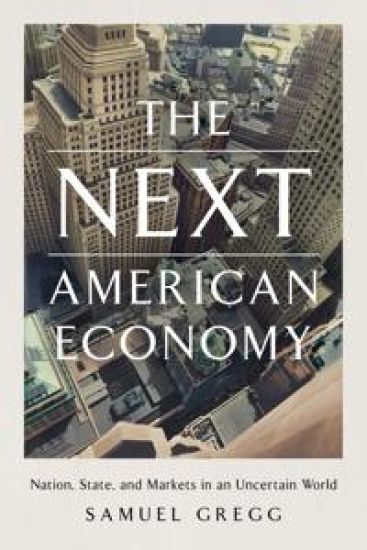
The Next American Economy

The Next American Economy

Samuel Gregg

ENCOUNTER BOOKS,USA
2022
sidottu
Americans across the political spectrum have turned away from free market capitalism, calling for more government intervention into the economy. This optimistic book explains how a dynamic, Commercial Republic that benefits all Americans is still possible." Will someone intent on changing the direction of America’s economy seize on this text and send it far and wide?”—Hugh Hewitt, author, attorney, and national host of The Hugh Hewitt Show“Markets grounded in a commercial republic are what America needs. Gregg shows why.” —Vernon L. Smith, 2002 Nobel Laureate in Economics, Professor of Business Economics and Law at Chapman UniversityOne of America’s greatest success stories is its economy. For over a century, it has been the envy of the world. The opportunity it generates has inspired millions of people to want to become American. Today, however, America’s economy is at a crossroads. Many have lost confidence in the country’s commitment to economic liberty. Across the political spectrum, many want the government to play an even greater role in the economy via protectionism, industrial policy, stakeholder capitalism, or even quasi-socialist policies. Numerous American political and business leaders are embracing these ideas, and traditional defenders of markets have struggled to respond to these challenges in fresh ways. Then there is a resurgent China bent on eclipsing the United States’s place in the world. At stake is not only the future of the world’s biggest economy, but the economic liberty that remains central to America’s identity as a nation. But managed decline and creeping statism do not have to be America’s only choices, let alone its destiny. For this book insists that there is an alternative. And that is a vibrant market economy grounded on entrepreneurship, competition, and trade openness, but embedded in what America’s founding generation envisaged as the United States’s future: a dynamic Commercial Republic that takes freedom, commerce, and the common good of all Americans seriously, and allows America as a sovereign-nation to pursue and defend its interests in a dangerous world without compromising its belief in the power of economic freedom.

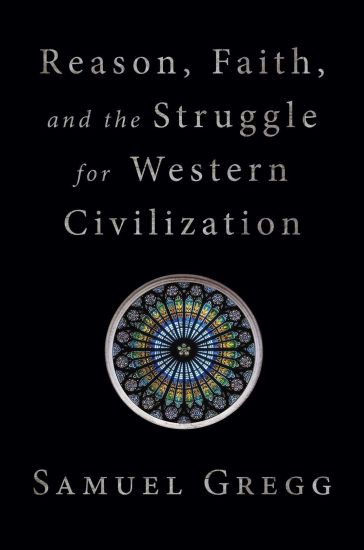
Reason, Faith, and the Struggle for Western Civilization
Western civilization’s genius is in its synthesis of reason and faith. These foundations are under assault today from Islamists and radical secularists. Unless Western society recovers its confidence in this synthesis and its capacity to magnify human freedom and achievement, our future is limited. This sharp commentary on the rise and current decline of Western Civilization touches on historical moments—including the building of early universities in the Middle Ages and the American Revolution—and figures—including Augustine, Acquinas, Edmund Burke, and Adam Smith—that exemplify the faith-reason synthesis at the heart of Western Civilization, as well as the modern villains that threaten to destroy it.
Fur Gott Und Den Profit: Eine Ethik Des Finanzwesens. Christlich - Marktliberal
Samuel Gregg erzahlt die faszinierende Geschichte eines allmahlich sich entwickelnden Verstandnisses der produktiven und wohlstandschaffenden Funktion des Geldes - der Einsicht also, wie Geld zu Kapital wird. Sie ist auch die Geschichte der allmahlichen Uberwindung des ursprunglich vorchristlich-antiken Misstrauens gegenuber Geldverleih, Spekulation und Handel und deren Versohnung mit der Aufgabe des Schutzes und der Fursorge fur die Armsten und Schwachsten. Der Autor hebt einen Schatz, der fur eine Ethik des Finanzwesens aus christlicher Sicht neue und uberraschende Perspektiven eroffnet sowie manche kritische Anfragen an heutige Praktiken der Finanzwirtschaft in einem neuen Licht erscheinen lasst. Insbesondere auch die oft problematische Rolle des Staates und gesetzlicher Regulierungen. Ein besonderes Anliegen des Buches ist es, die aktuelle Relevanz zentraler Prinzipien der christlichen Soziallehre wie des Gemeinwohlprinzips und des Prinzips der allgemeinen Bestimmung der Guter mit dem ebenso von der christlichen Tradition hochgehaltenen Prinzip des Privateigentums als Grundlage einer humanen Gesellschaft und einer funktionierenden, fur alle Wohlstand schaffenden Okonomie herauszuarbeiten. Auch hier gelangt Samuel Gregg zu Aussagen, die manchen vielleicht uberraschen werden. Er zeigt, weshalb gerade heutige Geld- und Kapitalmarkte, trotz Missbrauchen und menschlichen Fehlverhaltens, das effizienteste Instrument sind, um die Guter dieser Erde fur alle Menschen nutzbar zu machen - insbesondere und gerade fur die Armsten dieser Welt, und dass genau darin fur Christen, die in der Finanzwirtschaft tatig sind, auch die eigentliche und positive Herausforderung liegt. Dieses packend geschriebene Buch zwingt dazu, manches Vorurteil zu revidieren und neu daruber nachzudenken, was im konkreten Fall richtig oder falsch, gut oder bose ist.
The Modern Papacy

The Modern Papacy

Samuel Gregg

Bloomsbury Academic USA
2013
nidottu
Since the dawn of the Enlightenment, modernity and the Papacy have experienced a difficult though never severed relationship. The Modern Papacy goes beyond the caricatures to demonstrate how the popes - specifically John Paul II and Benedict XVI - have articulated a sophisticated critique of the post-Enlightenment world, one that acknowledges the real progress made in modernity while simultaneously highlighting its political and philosophical shortcomings. Far from falling on deaf ears, the nature of their engagement with the modern world has sparked criticism and praise from Catholics and non-Catholics alike - sometimes in surprising ways. Whether the subject is faith and reason, religion and the modern sciences, the roots and future of Europe, or the origin and ends of human freedom, John Paul II and Benedict XVI pose questions that simply cannot be ignored, regardless of whether one likes their answers.
Natural Law, Economics and the Common Good

Natural Law, Economics and the Common Good

Samuel Gregg; Harold James

Imprint Academic
2012
sidottu
In the wake of the financial crisis of 2008 and ongoing debt-related troubles there have been widespread calls to put banking and economic activity on a secure ethical foundation, either by regulation or through voluntary reform. In this volume a distinguished set of authors explore various economic, philosophical, and ethical ideas from historical, contemporary, and future-looking perspectives. At the core are two related ideas much mentioned but far more rarely examined: the idea of natural law and that of the common good. In these essays the foundations and meaning of these notions are carefully studied and put to work in examining the nature and scope of ethics in relation to global economics.
Natural Law, Economics and the Common Good

Natural Law, Economics and the Common Good

Samuel Gregg; Harold James

Imprint Academic
2012
pokkari
In the wake of the financial crisis of 2008 and ongoing debt-related troubles there have been widespread calls to put banking and economic activity on a secure ethical foundation, either by regulation or through voluntary reform. In this volume a distinguished set of authors explore various economic, philosophical, and ethical ideas from historical, contemporary, and future-looking perspectives. At the core are two related ideas much mentioned but far more rarely examined: the idea of natural law and that of the common good. In these essays the foundations and meaning of these notions are carefully studied and put to work in examining the nature and scope of ethics in relation to global economics.
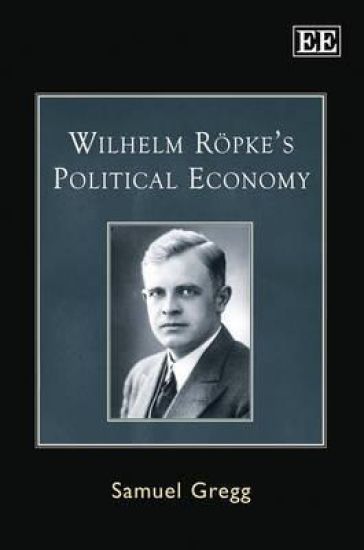
Wilhelm Röpke’s Political Economy

Wilhelm Röpke’s Political Economy

Samuel Gregg

Edward Elgar Publishing Ltd
2010
sidottu
Wilhelm Ropke's Political Economy is the story of one man's efforts to rehabilitate a Smithian approach to political economy in ways that met the economic and political challenges of the twentieth century. Wilhelm Ropke is best known for his decisive intellectual contributions to the economic reforms that took post-war West Germany from ruin to riches within a decade. In this informative book, Samuel Gregg presents Ropke as a sophisticated economiste-philosophe in the tradition of Adam Smith, who was as much concerned with exploring and reforming the moral, social and intellectual foundations of the market economy, as he was in examining subjects such as business-cycles, trade-policy, inflation, employment, and the welfare state. By situating Ropke's ideas in the history of modern Western economic thought, Samuel Gregg illustrates that while Ropke's `neoliberalism' departed from much nineteenth-century classical liberal thought, it was also profoundly anti-Keynesian and contested key aspects of the post-war Keynesian economic consensus. This book challenges many contemporary interpretations of Wilhelm Ropke's economic thought, and will therefore be an invaluable resource for scholars, graduate students, and researchers with an interest in economics, history of economic thought, political philosophy, economic philosophy, and international trade. Policymakers will also find much to interest them in this captivating book.
The Modern Papacy

The Modern Papacy

Samuel Gregg

Continuum International Publishing Group Ltd.
2009
sidottu
This is the fifth volume in the "Major Conservative and Libertarian Thinkers Series". Since the dawn of the Enlightenment, modernity and the Papacy have experienced a difficult though never severed relationship. "Modern Papacy" goes beyond the caricatures to demonstrate how the popes - specifically John Paul II and Benedict XVI - have articulated a sophisticated critique of the post-Enlightenment world, one that acknowledges the real progress made in modernity while simultaneously highlighting its political and philosophical shortcomings. Far from falling on deaf ears, the nature of their engagement with the modern world has sparked criticism and praise from Catholics and non-Catholics alike - sometimes in surprising ways. Whether the subject is faith and reason, religion and the modern sciences, the roots and future of Europe, or the origin and ends of human freedom, John Paul II and Benedict XVI pose questions that simply cannot be ignored, regardless of whether one likes their answers. "Major Conservative and Libertarian Thinkers" provides comprehensive accounts of the works of seminal conservative thinkers from a variety of periods, disciplines and traditions - the first series of its kind. Even the selection of thinkers adds another aspect to conservative thinking, including not only theorists but also thinkers in literary forms and those who are also practitioners. The series comprises twenty volumes, each including an intellectual biography, historical context, critical exposition of the thinker's work, reception and influence, contemporary relevance, bibliography including references to electronic resources and an index.
The Commercial Society

The Commercial Society

Samuel Gregg

Lexington Books
2007
sidottu
Once relatively confined to parts of Europe and North America, commercial societies are now found in many other cultures and continents. Yet despite the international spread and growth of commercial order, the moral, economic, and legal foundations of commercial society remain poorly understood, especially in those countries where it first took root. Guided by the thoughts of Alexis de Tocqueville, Samuel Gregg's The Commercial Society identifies and explores the key foundational elements that must exist within a society for commercial order to take root and flourish. Gregg studies the challenges that have consistently impeded and occasionally undermined commercial order, including the persistence of "corporatist" values and political movements seeking to equalize social conditions. This book offers a historically-grounded analysis for modern audiences interested in philosophy or the history of economics.
The Commercial Society

The Commercial Society

Samuel Gregg

Lexington Books
2006
nidottu
Once relatively confined to parts of Europe and North America, commercial societies are now found in many other cultures and continents. Yet despite the international spread and growth of commercial order, the moral, economic, and legal foundations of commercial society remain poorly understood, especially in those countries where it first took root. Guided by the thoughts of Alexis de Tocqueville, Samuel Gregg's The Commercial Society identifies and explores the key foundational elements that must exist within a society for commercial order to take root and flourish. Gregg studies the challenges that have consistently impeded and occasionally undermined commercial order, including the persistence of 'corporatist' values and political movements seeking to equalize social conditions. This book offers a historically-grounded analysis for modern audiences interested in philosophy or the history of economics.
On Ordered Liberty

On Ordered Liberty

Samuel Gregg

Lexington Books
2003
nidottu
Perhaps no issue is more divisive among philosophers, jurists and theologians than the nature of human liberty. Liberty is central to the claims of the Christian Gospel, the Glorious Revolution of 1688 and the American Revolution. But discussions about the nature of freedom have been characterized by profound disagreement and unsettling questions. What does it mean to be free? Is freedom worth more than mens' lives? Why should man be free? What, if any, legitmate responsibilities accompany freedom? These subjects are that the heart of Samuel Gregg's new book On Ordered Liberty. Beginning with the insights of Alexis de Tocqueville and some natural law theorists, Gregg suggests that something which he terms 'integral law' must be distinguished from most contemporary visions of freedom. He argues that this new arrangement requires a complete repudiation of utilitarian ideas on the grounds that they are incompatable with human nature. He also recommends a new and more rigorous focus on the basic but often neglected-question: what is man? On Ordered Liberty goes beyond the liberal and conservative divide, asking its readers to think about the proper ends of human choice and actions in a free society.
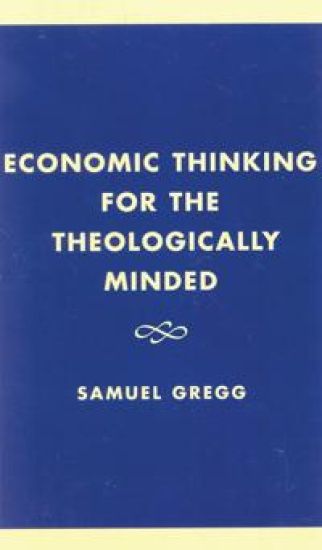
Economic Thinking for the Theologically Minded

Economic Thinking for the Theologically Minded

Samuel Gregg

University Press of America
2002
sidottu
Economic Thinking for the Theologically Minded provides an introduction to what has been called "the economic way of thinking," which explains some of the critical concepts and foundational assumptions employed in economics. To communicate these ideas effectively to those engaged in theological studies, this book avoids using unnecessary technical terminology. These concepts are then subject to analysis from the standpoint of Christian ethics, with emphasis placed upon the often-unsuspected degree of agreement between economics and Christian belief about the nature of the person. The second half of the book consists of a collection of selections from classical economic texts, representing a range of authors from a variety of schools of thought. These selections have been arranged around ten key concepts, each of which attempts to deepen understanding of various ideas presented in the book's first half.
Economic Thinking for the Theologically Minded

Economic Thinking for the Theologically Minded

Samuel Gregg

University Press of America
2001
nidottu
Economic Thinking for the Theologically Minded provides an introduction to what has been called 'the economic way of thinking,' which explains some of the critical concepts and foundational assumptions employed in economics. To communicate these ideas effectively to those engaged in theological studies, this book avoids using unnecessary technical terminology. These concepts are then subject to analysis from the standpoint of Christian ethics, with emphasis placed upon the often-unsuspected degree of agreement between economics and Christian belief about the nature of the person. The second half of the book consists of a collection of selections from classical economic texts, representing a range of authors from a variety of schools of thought. These selections have been arranged around ten key concepts, each of which attempts to deepen understanding of various ideas presented in the book's first half.