
Kirjailija
Samuel Sharpe
Kirjat ja teokset yhdessä paikassa: 115 kirjaa, julkaisuja vuosilta 1992–2025, suosituimpiin kuuluu Egyptian Antiquities in the British Museum. Vertaile teosten hintoja ja tarkista saatavuus suomalaisista kirjakaupoista.
115 kirjaa
Kirjojen julkaisuvuodet: 1992–2025.

The Holy Bible is an unchanged, high-quality reprint of the original edition of 1883. Hansebooks is editor of the literature on different topic areas such as research and science, travel and expeditions, cooking and nutrition, medicine, and other genres. As a publisher we focus on the preservation of historical literature. Many works of historical writers and scientists are available today as antiques only. Hansebooks newly publishes these books and contributes to the preservation of literature which has become rare and historical knowledge for the future.
The History of Egypt from the Earliest Times till the Conquest by the Arabs
Samuel Sharpe
Hansebooks
2017
pokkari

Geschichte des hebräischen Volkes und seiner Literatur
Heymann Jolowicz; Samuel Sharpe
Hansebooks
2017
pokkari

This 1836 work by Samuel Sharpe (1799–1881) is the first of two volumes on the history of ancient Egypt; the second, dealing with the Ptolemaic period, is also reissued in this series. From a banking family, Sharpe was fascinated by Thomas Young's and Champollion's work in deciphering the hieroglyphs. He taught himself Coptic, and compiled his own hieroglyphic vocabulary lists. His facility for decipherment was assisted by a natural gift for solving cryptograms, but his inferences sometimes led him into error. His objective in this book is 'to collect out of the writings of the ancients every particular relating to the History of Egypt', marshalling ancient authorities including the Old Testament, Herodotus, Diodorus Siculus and the Ptolemaic priest Manetho, whose division of the rulers into dynasties is still relied on. The second part of the book uses this evidence to discuss Egyptian life, language, beliefs and customs.
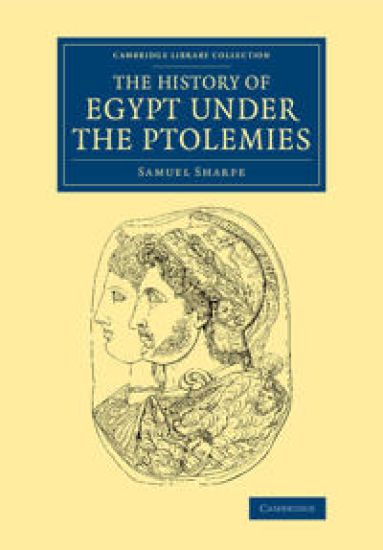
This 1838 work by Samuel Sharpe (1799–1881) is the second of two volumes on the history of ancient Egypt; the first, dealing with the earlier period, is also reissued in this series. From a banking family, Sharpe was fascinated by Young's and Champollion's work in deciphering the hieroglyphs. He taught himself Coptic, and compiled his own hieroglyphic vocabulary lists. His facility for decipherment was assisted by a natural gift for solving cryptograms, but his inferences sometimes led him into error. This book, in which Sharpe follows his earlier technique of using inscriptions as well as historical works as sources, begins with a survey of the history of Egypt up to the time of Alexander the Great; the interested reader is referred to Sharpe's earlier volume for more details. He then surveys the Ptolemaic era by reigns, ending with the battle of Actium and the conquest of Egypt by Augustus.
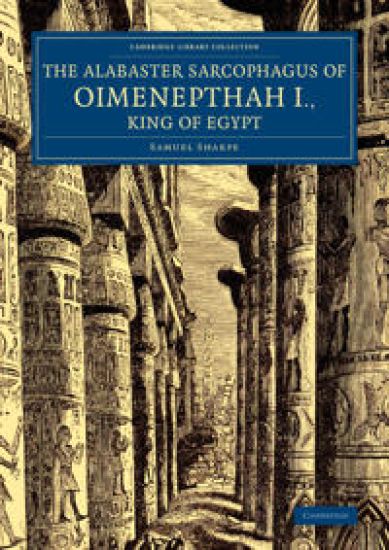
The Alabaster Sarcophagus of Oimenepthah I., King of Egypt
Samuel Sharpe
Cambridge University Press
2014
pokkari
Oimenepthah I, better known to us as Seti I, was regarded as a great pharaoh by his contemporaries, although his son Ramesses II would claim greater renown. Seti's tomb was discovered by Belzoni in 1817 and was the first to be found to have extensive decorations throughout. The huge alabaster coffin found in the tomb was sold to Sir John Soane, who held a three-day party upon its arrival at his London house, where it can still be seen. Written by the noted Egyptologist Samuel Sharpe (1799–1881), this illustrated description of the intricately decorated sarcophagus was published in 1864. By the time of his death, Sharpe was regarded in Britain as one of the most important figures in helping to popularise all things Egyptian. With the artist and sculptor Joseph Bonomi (1796–1878), who provided the drawings here, he collaborated in organising the Egyptian court at the Crystal Palace in 1854.
Egyptian Mythology and Egyptian Christianity is a book written by Samuel Sharpe that explores the relationship between ancient Egyptian mythology and the development of Christianity in Egypt. The book delves into the origins of Egyptian mythology and the ways in which it influenced the beliefs and practices of early Christians in Egypt. It also examines the similarities and differences between the two religions, including their creation stories, beliefs about the afterlife, and the role of gods and goddesses. Sharpe draws on a variety of sources, including ancient Egyptian texts and Christian scriptures, to provide a comprehensive overview of the subject. The book is a valuable resource for anyone interested in the history of religion and the ways in which different belief systems have influenced each other throughout history. This Is A New Release Of The Original 1863 Edition. This scarce antiquarian book is a facsimile reprint of the old original and may contain some imperfections such as library marks and notations. Because we believe this work is culturally important, we have made it available as part of our commitment for protecting, preserving, and promoting the world's literature in affordable, high quality, modern editions, that are true to their original work.
The Epistle of Barnabas from the Sinaitic Manuscript of the Bible
Samuel Sharpe
Literary Licensing, LLC
2014
nidottu
Egyptian Mythology and Egyptian Christianity with Their Influence on the Opinions of Modern Christendom
Samuel Sharpe
Literary Licensing, LLC
2014
nidottu
The Early History Of Egypt, From The Old Testament, Herodotus, Manetho, And The Hieroglyphical Inscriptions
Samuel Sharpe
READ BOOKS
2011
pokkari