Kirjojen hintavertailu – 12 903 724 kirjaa ja 27 kauppaa
Kirjailija
Sandeep Kumar Shukla
Kirjat ja teokset yhdessä paikassa: 8 kirjaa, julkaisuja vuosilta 2004–2014, suosituimpiin kuuluu Ingredients for Successful System Level Design Methodology. Vertaile teosten hintoja ja tarkista saatavuus suomalaisista kirjakaupoista.
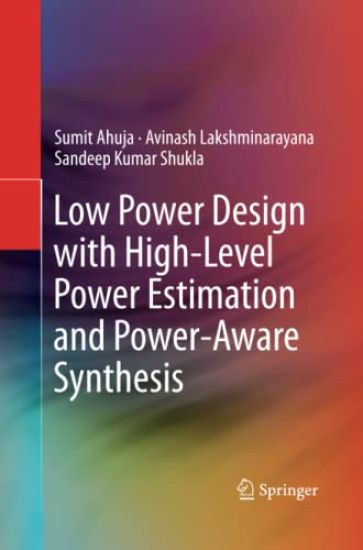
This book presents novel research techniques, algorithms, methodologies and experimental results for high level power estimation and power aware high-level synthesis. Readers will learn to apply such techniques to enable design flows resulting in shorter time to market and successful low power ASIC/FPGA design.
Human lives are getting increasingly entangled with technology, especially comp- ing and electronics. At each step we take, especially in a developing world, we are dependent on various gadgets such as cell phones, handheld PDAs, netbooks, me- cal prosthetic devices, and medical measurement devices (e.g., blood pressure m- itors, glucometers). Two important design constraints for such consumer electronics are their form factor and battery life. This translates to the requirements of reduction in the die area and reduced power consumption for the semiconductor chips that go inside these gadgets. Performance is also important, as increasingly sophisticated applications run on these devices, and many of them require fast response time. The form factor of such electronics goods depends not only on the overall area of the chips inside them but also on the packaging, which depends on thermal ch- acteristics. Thermal characteristics in turn depend on peak power signature of the chips. As a result, while the overall energy usage reduction increases battery life, peak power reduction in?uences the form factor. One more important aspect of these electronic equipments is that every 6 months or so, a newer feature needs to be added to keep ahead of the market competition, and hence new designs have to be completed with these new features, better form factor, battery life, and performance every few months. This extreme pressure on the time to market is another force that drives the innovations in design automation of semiconductor chips.
This book presents novel research techniques, algorithms, methodologies and experimental results for high level power estimation and power aware high-level synthesis. Readers will learn to apply such techniques to enable design flows resulting in shorter time to market and successful low power ASIC/FPGA design.
SystemC Kernel Extensions for Heterogeneous System Modeling is a result of an almost two year endeavour on our part to understand how SystemC can be made useful for system level modeling at higher levels of abstraction. Making it a truly heterogeneous modeling language and platform, for hardware/software co-design as well as complex embedded hardware designs has been our focus in the work reported in this book.
ESL or “Electronic System Level” is a buzz word these days, in the electronic design automation (EDA) industry, in design houses, and in the academia. Even though numerous trade magazine articles have been written, quite a few books have been published that have attempted to de?ne ESL, it is still not clear what exactly it entails. However, what seems clear to every one is that the “Register Transfer Level” (RTL) languages are not adequate any more to be the design entry point for today’s and tomorrow’s complex electronic system design. There are multiple reasons for such thoughts. First, the c- tinued progression of the miniaturization of the silicon technology has led to the ability of putting almost a billion transistors on a single chip. Second, applications are becoming more and more complex, and integrated with c- munication, control, ubiquitous and pervasive computing, and hence the need for ever faster, ever more reliable, and more robust electronic systems is pu- ing designers towards a productivity demand that is not sustainable without a fundamental change in the design methodologies. Also, the hardware and software functionalities are getting interchangeable and ability to model and design both in the same manner is gaining importance. Given this context, we assume that any methodology that allows us to model an entire electronic system from a system perspective, rather than just hardware with discrete-event or cycle based semantics is an ESL method- ogy of some kind.
Human lives are getting increasingly entangled with technology, especially comp- ing and electronics. At each step we take, especially in a developing world, we are dependent on various gadgets such as cell phones, handheld PDAs, netbooks, me- cal prosthetic devices, and medical measurement devices (e.g., blood pressure m- itors, glucometers). Two important design constraints for such consumer electronics are their form factor and battery life. This translates to the requirements of reduction in the die area and reduced power consumption for the semiconductor chips that go inside these gadgets. Performance is also important, as increasingly sophisticated applications run on these devices, and many of them require fast response time. The form factor of such electronics goods depends not only on the overall area of the chips inside them but also on the packaging, which depends on thermal ch- acteristics. Thermal characteristics in turn depend on peak power signature of the chips. As a result, while the overall energy usage reduction increases battery life, peak power reduction in?uences the form factor. One more important aspect of these electronic equipments is that every 6 months or so, a newer feature needs to be added to keep ahead of the market competition, and hence new designs have to be completed with these new features, better form factor, battery life, and performance every few months. This extreme pressure on the time to market is another force that drives the innovations in design automation of semiconductor chips.
ESL or “Electronic System Level” is a buzz word these days, in the electronic design automation (EDA) industry, in design houses, and in the academia. Even though numerous trade magazine articles have been written, quite a few books have been published that have attempted to de?ne ESL, it is still not clear what exactly it entails. However, what seems clear to every one is that the “Register Transfer Level” (RTL) languages are not adequate any more to be the design entry point for today’s and tomorrow’s complex electronic system design. There are multiple reasons for such thoughts. First, the c- tinued progression of the miniaturization of the silicon technology has led to the ability of putting almost a billion transistors on a single chip. Second, applications are becoming more and more complex, and integrated with c- munication, control, ubiquitous and pervasive computing, and hence the need for ever faster, ever more reliable, and more robust electronic systems is pu- ing designers towards a productivity demand that is not sustainable without a fundamental change in the design methodologies. Also, the hardware and software functionalities are getting interchangeable and ability to model and design both in the same manner is gaining importance. Given this context, we assume that any methodology that allows us to model an entire electronic system from a system perspective, rather than just hardware with discrete-event or cycle based semantics is an ESL method- ogy of some kind.
SystemC Kernel Extensions for Heterogeneous System Modeling is a result of an almost two year endeavour on our part to understand how SystemC can be made useful for system level modeling at higher levels of abstraction. Making it a truly heterogeneous modeling language and platform, for hardware/software co-design as well as complex embedded hardware designs has been our focus in the work reported in this book.