Kirjojen hintavertailu – 12 903 725 kirjaa ja 27 kauppaa

Kirjailija

Sandro Pignatti

Kirjat ja teokset yhdessä paikassa: 10 kirjaa, julkaisuja vuosilta 2013–2022, suosituimpiin kuuluu Plant Life of the Dolomites. Vertaile teosten hintoja ja tarkista saatavuus suomalaisista kirjakaupoista.

10 kirjaa

Kirjojen julkaisuvuodet: 2013–2022.

Botanical Journeys into the Western Australian Deserts

Botanical Journeys into the Western Australian Deserts

Sandro Pignatti; Erika Pignatti Wikus

Springer Nature Switzerland AG
2022
nidottu
The book contains detailed descriptions of the unique desert environment with particular emphasis on vegetation and survival strategies of plants. Nine expeditions through the Southwest of Western Australia over a period of 15 years triggered the interest of the authors to explore also some deserts in the region, which leads to three further excursions into the sandy dunes of the desert. Observations of plant life in the deserts focused not only on identifying plants, but also on gaining some understanding of the aboriginal desert people of centuries past, and their own survival strategies in such extreme conditions. Also part of the Canning Stock Route was followed and explored, but the most rewarding and interesting finds were done criss-crossing the desert away from highways, tracks, and paths. The most remote areas showed species richness and surviving strategies which by far exceeded expectations.
Botanical Journeys into the Western Australian Deserts

Botanical Journeys into the Western Australian Deserts

Sandro Pignatti; Erika Pignatti Wikus

Springer Nature Switzerland AG
2021
sidottu
The book contains detailed descriptions of the unique desert environment with particular emphasis on vegetation and survival strategies of plants. Nine expeditions through the Southwest of Western Australia over a period of 15 years triggered the interest of the authors to explore also some deserts in the region, which leads to three further excursions into the sandy dunes of the desert. Observations of plant life in the deserts focused not only on identifying plants, but also on gaining some understanding of the aboriginal desert people of centuries past, and their own survival strategies in such extreme conditions. Also part of the Canning Stock Route was followed and explored, but the most rewarding and interesting finds were done criss-crossing the desert away from highways, tracks, and paths. The most remote areas showed species richness and surviving strategies which by far exceeded expectations.
Plant Life of the Dolomites

Plant Life of the Dolomites

Erika Pignatti; Sandro Pignatti

Springer-Verlag Berlin and Heidelberg GmbH Co. K
2019
nidottu
This volume provides an in-depth analysis of over 100 plant communities of the Dolomite vegetation. The data is based on the phytosociological relevés, which have been collected by the authors in nearly 2000 surveys. The key part consists of approx. 130 association tables presenting plant sociological data for the respective plant communities. Thus, this volume perfectly complements the successful main volume “Plant Life of the Dolomites: Vegetation Structure and Ecology,” which features summarized, synoptic association tables of the twelve habitats. In addition, geo-referenced locations of relevés and detailed ecological measures are provided. A further part describes the individual components of the fascinating dolomitic landscape (Heritage of all Humanity) and presents tables of vegetation complexes, which summarize the more than 400 surveys carried out in the Dolomites. The structure of this supplementary volume corresponds to that of the main volume with a key part consisting of twelve chapters, each describing a specific habitat, and a total of 106 associations. Several topics covered in the main volume, such as the exploration of the flora, ecological factors and syntaxonomy are discussed further here.
Plant Life of the Dolomites

Plant Life of the Dolomites

Erika Pignatti; Sandro Pignatti

Springer-Verlag Berlin and Heidelberg GmbH Co. K
2018
nidottu
This volume offers distribution maps of over 2200 individual species living in the Dolomite area, presenting detailed records on the local range of every species growing in the area studied, from the Puster Valley to the Piave River. The data was collected on the basis of a multiple field observations carried out over several decades. After dividing the area into approx. 200 quadrants, a nearly complete census of the species present was obtained for each quadrant. The evaluation and synopsis of this extensive set of data, which is presented in the form of a chorological atlas in keeping with international standard methods, allows the area to be accurately compared with other parts of the Alps. In addition to the chorological atlas and floristic inventory, a list of synonyms and toponyms of the three languages used in the analyzed territory, an expanded list of updated scientific names, and some helpful remarks on various Dolomites species are included. Lastly, the book explores howspecies can be considered as landscape bioindicators. This third volume of the work Plant Life of the Dolomites complements the main volume Vegetation Structure and Ecology and the volume Vegetation Tables, which presents essential data at the plant association level.
Plant Life of the Dolomites

Plant Life of the Dolomites

Erika Pignatti; Sandro Pignatti

Springer-Verlag Berlin and Heidelberg GmbH Co. K
2016
sidottu
This volume offers distribution maps of over 2200 individual species living in the Dolomite area, presenting detailed records on the local range of every species growing in the area studied, from the Puster Valley to the Piave River. The data was collected on the basis of a multiple field observations carried out over several decades. After dividing the area into approx. 200 quadrants, a nearly complete census of the species present was obtained for each quadrant. The evaluation and synopsis of this extensive set of data, which is presented in the form of a chorological atlas in keeping with international standard methods, allows the area to be accurately compared with other parts of the Alps. In addition to the chorological atlas and floristic inventory, a list of synonyms and toponyms of the three languages used in the analyzed territory, an expanded list of updated scientific names, and some helpful remarks on various Dolomites species are included. Lastly, the book explores howspecies can be considered as landscape bioindicators. This third volume of the work Plant Life of the Dolomites complements the main volume Vegetation Structure and Ecology and the volume Vegetation Tables, which presents essential data at the plant association level.
Plant Life of the Dolomites

Plant Life of the Dolomites

Erika Pignatti; Sandro Pignatti

Springer-Verlag Berlin and Heidelberg GmbH Co. K
2016
nidottu
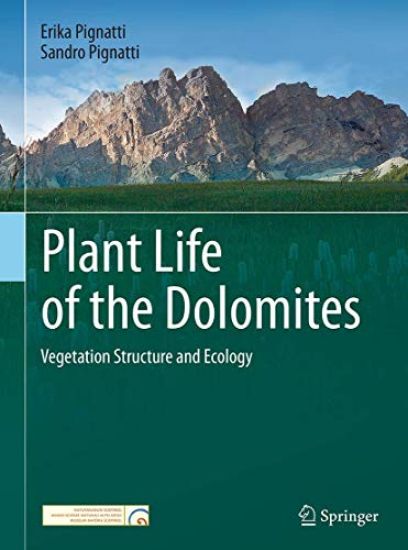
The landscape and vegetation of the Dolomites have characteristics that are very particular. Some 2300 species live here, about a fifth of the flora in Europe as a whole. This book depicts what the plant cover of the Dolomites is composed of, how it was formed, and what future evolution may bring. The data presented is based on the authors’ combined botanical research, which consists of thousands of surveys throughout the entire region of the Dolomites. To explain the vegetation, 106 plant communities are described in detailed datasheets. Biological, geological, climatic and physical-chemical parameters are given for each plant community, including a description of the habitat, the indicator species, the floristic composition, distribution, conservation, and alteration risks, as well as a distribution map and a photo of the association. The associations are grouped into habitats, such as the human habitat, natural forests and meadows on the valley floor, the coniferous forestbelt, screes, alpine vegetation on granite, porphyry, and volcanic rock, as well as on dolomite and limestones. In closing, the authors make a case for using the scientific information provided in the book for the conservation of the Dolomites, the heritage of all humanity. Additional in-depth analysis will be presented in the supplementary volumes “Plant Life of the Dolomites: Vegetation Tables” and “Plant Life of the Dolomites: Atlas of Flora.”
Plant Life of the Dolomites

Plant Life of the Dolomites

Erika Pignatti; Sandro Pignatti

Springer-Verlag Berlin and Heidelberg GmbH Co. K
2015
sidottu
This volume provides an in-depth analysis of over 100 plant communities of the Dolomite vegetation. The data is based on the phytosociological relevés, which have been collected by the authors in nearly 2000 surveys. The key part consists of approx. 130 association tables presenting plant sociological data for the respective plant communities. Thus, this volume perfectly complements the successful main volume “Plant Life of the Dolomites: Vegetation Structure and Ecology,” which features summarized, synoptic association tables of the twelve habitats. In addition, geo-referenced locations of relevés and detailed ecological measures are provided. A further part describes the individual components of the fascinating dolomitic landscape (Heritage of all Humanity) and presents tables of vegetation complexes, which summarize the more than 400 surveys carried out in the Dolomites. The structure of this supplementary volume corresponds to that of the main volume with a key part consisting of twelve chapters, each describing a specific habitat, and a total of 106 associations. Several topics covered in the main volume, such as the exploration of the flora, ecological factors and syntaxonomy are discussed further here.
Phytosociology of the Beech (Fagus) Forests in East Asia

Phytosociology of the Beech (Fagus) Forests in East Asia

Tukasa Hukusima; Tetsuya Matsui; Takayoshi Nishio; Sandro Pignatti; Liang YANG; Sheng-You Lu; Moon-Hong Kim; Masato Yoshikawa; Hidekazu Honma; Yuehua Wang

Springer-Verlag Berlin and Heidelberg GmbH Co. K
2015
nidottu
This book describes the mountain forests of East Asia (Korea, Japan, China and Taiwan), the tree layers of which contain different species of the genus Fagus. The vegetation is primarily deciduous in the northern regions, whereas in South China evergreen trees can also be found: a total of 21 plant communities are described, with data on species composition, dominance, geographical distribution and ecology. A general comparison is provided by synoptic Table 1, which details the frequencies of ca. 1500 species growing in the Fagus forests; biodiversity and evolution are discussed. The book, which is the fruit of a major international collaboration, presents a synthesis of extended original investigations by the authors and hardly accessible specialist literature.
Philosophy and botany : essays on Ivar Segelberg

Philosophy and botany : essays on Ivar Segelberg

Jan Almäng; Dick A. R. Haglund; Herbert Hochberg; Ingvar Johansson; Helge Malmgren; Anna-Sofia Maurin; Torgny Nordin; Sandro Pignatti; Ivar Segelberg; Christer Svennerlind; Thomas Wetterström; Erika Pignatti Wikus

Bokförlaget Thales
2014
sidottu
Ivar Segelberg (19141987), between 1951 and 1979 professor of philosophy in Gothenburg, is an important figure in Swedish philosophy but still only known within a rather narrow circle. Trained in both phenomenology and analytical philosophy, Segelberg developed highly original theories about time con­sciousness, the unity of consciousness, and general ontology. He published his three main works in Swedish, and only in 1999 were they (collectively) made available in English. The present volume will hopefully help make Segelbergs work more widely known. It is partly based on a 2008 symposium in Gothenburg, also called Philosophy and Botany, but contains several independent contributions including a newly written biography.
Phytosociology of the Beech (Fagus) Forests in East Asia

Phytosociology of the Beech (Fagus) Forests in East Asia

Tukasa Hukusima; Tetsuya Matsui; Takayoshi Nishio; Sandro Pignatti; Liang YANG; Sheng-You Lu; Moon-Hong Kim; Masato Yoshikawa; Hidekazu Honma; Yuehua Wang

Springer-Verlag Berlin and Heidelberg GmbH Co. K
2013
sidottu
This book describes the mountain forests of East Asia (Korea, Japan, China and Taiwan), the tree layers of which contain different species of the genus Fagus. The vegetation is primarily deciduous in the northern regions, whereas in South China evergreen trees can also be found: a total of 21 plant communities are described, with data on species composition, dominance, geographical distribution and ecology. A general comparison is provided by synoptic Table 1, which details the frequencies of ca. 1500 species growing in the Fagus forests; biodiversity and evolution are discussed. The book, which is the fruit of a major international collaboration, presents a synthesis of extended original investigations by the authors and hardly accessible specialist literature.