Kirjojen hintavertailu – 12 903 724 kirjaa ja 27 kauppaa

Kirjailija

Sanghamitra Bandyopadhyay

Kirjat ja teokset yhdessä paikassa: 11 kirjaa, julkaisuja vuosilta 2007–2026, suosituimpiin kuuluu Multiobjective Genetic Algorithms for Clustering. Vertaile teosten hintoja ja tarkista saatavuus suomalaisista kirjakaupoista.

11 kirjaa

Kirjojen julkaisuvuodet: 2007–2026.

Multiobjective Genetic Algorithms for Clustering

Multiobjective Genetic Algorithms for Clustering

Ujjwal Maulik; Sanghamitra Bandyopadhyay; Anirban Mukhopadhyay

Springer-Verlag Berlin and Heidelberg GmbH Co. K
2014
nidottu
This is the first book primarily dedicated to clustering using multiobjective genetic algorithms with extensive real-life applications in data mining and bioinformatics. The authors first offer detailed introductions to the relevant techniques – genetic algorithms, multiobjective optimization, soft computing, data mining and bioinformatics. They then demonstrate systematic applications of these techniques to real-world problems in the areas of data mining, bioinformatics and geoscience. The authors offer detailed theoretical and statistical notes, guides to future research, and chapter summaries. The book can be used as a textbook and as a reference book by graduate students and academic and industrial researchers in the areas of soft computing, data mining, bioinformatics and geoscience.
Multiobjective Genetic Algorithms for Clustering

Multiobjective Genetic Algorithms for Clustering

Ujjwal Maulik; Sanghamitra Bandyopadhyay; Anirban Mukhopadhyay

Springer-Verlag Berlin and Heidelberg GmbH Co. K
2011
sidottu
This is the first book primarily dedicated to clustering using multiobjective genetic algorithms with extensive real-life applications in data mining and bioinformatics. The authors first offer detailed introductions to the relevant techniques – genetic algorithms, multiobjective optimization, soft computing, data mining and bioinformatics. They then demonstrate systematic applications of these techniques to real-world problems in the areas of data mining, bioinformatics and geoscience. The authors offer detailed theoretical and statistical notes, guides to future research, and chapter summaries. The book can be used as a textbook and as a reference book by graduate students and academic and industrial researchers in the areas of soft computing, data mining, bioinformatics and geoscience.

Understanding the Dynamics of Inequality for Growth and Development

Understanding the Dynamics of Inequality for Growth and Development

Sanghamitra Bandyopadhyay

Cambridge University Press
2026
sidottu
Inequality and its evolution over time are increasingly important subjects within the social sciences, particularly in the field of political economy. This Element identifies for the first time which inequality measures are best suited to capture the dynamics of inequality. The author generates a dataset of twelve types of inequality measures for 108 years across 34 countries using mortality distributions. When modelling inequality as a fractionally integrated process and using a Vector Autoregression approach, they find that mean-independent inequality measures are more suited to dynamic studies. In contrast, however, mean-dependent measures are unsuitable for dynamic studies. They suggest that no inequality measure should be used for dynamic purposes without rigorously testing its suitability. Tests of temporal normality and volatility serve as excellent "marker" tests of whether a chosen inequality measure is suitable for dynamic contexts. This title is also available as Open Access on Cambridge Core.
Understanding the Dynamics of Inequality for Growth and Development

Understanding the Dynamics of Inequality for Growth and Development

Sanghamitra Bandyopadhyay

Cambridge University Press
2026
pokkari
Inequality and its evolution over time are increasingly important subjects within the social sciences, particularly in the field of political economy. This Element identifies for the first time which inequality measures are best suited to capture the dynamics of inequality. The author generates a dataset of twelve types of inequality measures for 108 years across 34 countries using mortality distributions. When modelling inequality as a fractionally integrated process and using a Vector Autoregression approach, they find that mean-independent inequality measures are more suited to dynamic studies. In contrast, however, mean-dependent measures are unsuitable for dynamic studies. They suggest that no inequality measure should be used for dynamic purposes without rigorously testing its suitability. Tests of temporal normality and volatility serve as excellent "marker" tests of whether a chosen inequality measure is suitable for dynamic contexts. This title is also available as Open Access on Cambridge Core.
Multiobjective Optimization Algorithms for Bioinformatics

Multiobjective Optimization Algorithms for Bioinformatics

Anirban Mukhopadhyay; Sumanta Ray; Ujjwal Maulik; Sanghamitra Bandyopadhyay

Springer
2025
nidottu
This book provides an updated and in-depth introduction to the application of multiobjective optimization techniques in bioinformatics. In particular, it presents multiobjective solutions to a range of complex real-world bioinformatics problems. The authors first provide a comprehensive yet concise and self-contained introduction to relevant preliminary methodical constructions such as genetic algorithms, multiobjective optimization, data mining and several challenges in the bioinformatics domain. This is followed by several systematic applications of these techniques to real-world bioinformatics problems in the areas of gene expression and network biology. The book also features detailed theoretical and mathematical notes to facilitate reader comprehension. The book offers a valuable asset for a broad range of readers - from undergraduate to postgraduate, and as a textbook or reference work. Researchers and professionals can use the book not only to enrich their knowledge of multiobjective optimization and bioinformatics, but also as a comprehensive reference guide to applying and devising novel methods in bioinformatics and related domains.
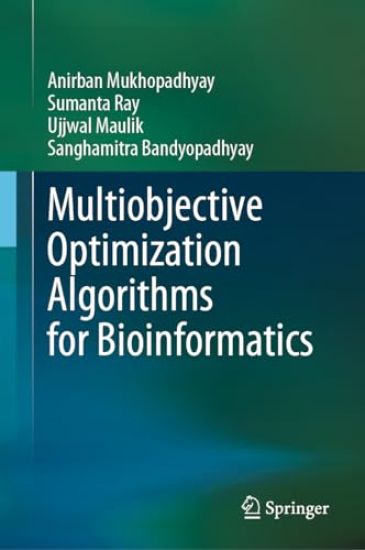
Multiobjective Optimization Algorithms for Bioinformatics

Multiobjective Optimization Algorithms for Bioinformatics

Anirban Mukhopadhyay; Sumanta Ray; Ujjwal Maulik; Sanghamitra Bandyopadhyay

SPRINGER VERLAG, SINGAPORE
2024
sidottu
This book provides an updated and in-depth introduction to the application of multiobjective optimization techniques in bioinformatics. In particular, it presents multiobjective solutions to a range of complex real-world bioinformatics problems. The authors first provide a comprehensive yet concise and self-contained introduction to relevant preliminary methodical constructions such as genetic algorithms, multiobjective optimization, data mining and several challenges in the bioinformatics domain. This is followed by several systematic applications of these techniques to real-world bioinformatics problems in the areas of gene expression and network biology. The book also features detailed theoretical and mathematical notes to facilitate reader comprehension. The book offers a valuable asset for a broad range of readers – from undergraduate to postgraduate, and as a textbook or reference work. Researchers and professionals can use the book not only to enrich their knowledge of multiobjective optimization and bioinformatics, but also as a comprehensive reference guide to applying and devising novel methods in bioinformatics and related domains.
Unsupervised Classification

Unsupervised Classification

Sanghamitra Bandyopadhyay; Sriparna Saha

Springer-Verlag Berlin and Heidelberg GmbH Co. K
2015
nidottu
Clustering is an important unsupervised classification technique where data points are grouped such that points that are similar in some sense belong to the same cluster. Cluster analysis is a complex problem as a variety of similarity and dissimilarity measures exist in the literature. This is the first book focused on clustering with a particular emphasis on symmetry-based measures of similarity and metaheuristic approaches. The aim is to find a suitable grouping of the input data set so that some criteria are optimized, and using this the authors frame the clustering problem as an optimization one where the objectives to be optimized may represent different characteristics such as compactness, symmetrical compactness, separation between clusters, or connectivity within a cluster. They explain the techniques in detail and outline many detailed applications in data mining, remote sensing and brain imaging, gene expression data analysis, and face detection. The book will be useful to graduate students and researchers in computer science, electrical engineering, system science, and information technology, both as a text and as a reference book. It will also be useful to researchers and practitioners in industry working on pattern recognition, data mining, soft computing, metaheuristics, bioinformatics, remote sensing, and brain imaging.
Unsupervised Classification

Unsupervised Classification

Sanghamitra Bandyopadhyay; Sriparna Saha

Springer-Verlag Berlin and Heidelberg GmbH Co. K
2012
sidottu
Clustering is an important unsupervised classification technique where data points are grouped such that points that are similar in some sense belong to the same cluster. Cluster analysis is a complex problem as a variety of similarity and dissimilarity measures exist in the literature. This is the first book focused on clustering with a particular emphasis on symmetry-based measures of similarity and metaheuristic approaches. The aim is to find a suitable grouping of the input data set so that some criteria are optimized, and using this the authors frame the clustering problem as an optimization one where the objectives to be optimized may represent different characteristics such as compactness, symmetrical compactness, separation between clusters, or connectivity within a cluster. They explain the techniques in detail and outline many detailed applications in data mining, remote sensing and brain imaging, gene expression data analysis, and face detection. The book will be useful to graduate students and researchers in computer science, electrical engineering, system science, and information technology, both as a text and as a reference book. It will also be useful to researchers and practitioners in industry working on pattern recognition, data mining, soft computing, metaheuristics, bioinformatics, remote sensing, and brain imaging.
Classification and Learning Using Genetic Algorithms

Classification and Learning Using Genetic Algorithms

Sanghamitra Bandyopadhyay; Sankar Kumar Pal

Springer-Verlag Berlin and Heidelberg GmbH Co. K
2010
nidottu
This book provides a unified framework that describes how genetic learning can be used to design pattern recognition and learning systems. It examines how a search technique, the genetic algorithm, can be used for pattern classification mainly through approximating decision boundaries. Coverage also demonstrates the effectiveness of the genetic classifiers vis-a-vis several widely used classifiers, including neural networks.
Computational Intelligence and Pattern Analysis in Biology Informatics

Computational Intelligence and Pattern Analysis in Biology Informatics

Ujjwal Maulik; Sanghamitra Bandyopadhyay; Jason T. Wang

John Wiley Sons Inc
2010
sidottu
An invaluable tool in Bioinformatics, this unique volume provides both theoretical and experimental results, and describes basic principles of computational intelligence and pattern analysis while deepening the reader's understanding of the ways in which these principles can be used for analyzing biological data in an efficient manner. This book synthesizes current research in the integration of computational intelligence and pattern analysis techniques, either individually or in a hybridized manner. The purpose is to analyze biological data and enable extraction of more meaningful information and insight from it. Biological data for analysis include sequence data, secondary and tertiary structure data, and microarray data. These data types are complex and advanced methods are required, including the use of domain-specific knowledge for reducing search space, dealing with uncertainty, partial truth and imprecision, efficient linear and/or sub-linear scalability, incremental approaches to knowledge discovery, and increased level and intelligence of interactivity with human experts and decision makers Chapters authored by leading researchers in CI in biology informatics. Covers highly relevant topics: rational drug design; analysis of microRNAs and their involvement in human diseases. Supplementary material included: program code and relevant data sets correspond to chapters.
Classification and Learning Using Genetic Algorithms

Classification and Learning Using Genetic Algorithms

Sanghamitra Bandyopadhyay; Sankar Kumar Pal

Springer-Verlag Berlin and Heidelberg GmbH Co. K
2007
sidottu
This book provides a unified framework that describes how genetic learning can be used to design pattern recognition and learning systems. It examines how a search technique, the genetic algorithm, can be used for pattern classification mainly through approximating decision boundaries. Coverage also demonstrates the effectiveness of the genetic classifiers vis-a-vis several widely used classifiers, including neural networks.