Kirjojen hintavertailu – 12 859 829 kirjaa ja 27 kauppaa

Kirjailija

Sanjeev Kulkarni

Kirjat ja teokset yhdessä paikassa: 3 kirjaa, julkaisuja vuosilta 2009–2012, suosituimpiin kuuluu Universal Estimation of Information Measures for Analog Sources. Vertaile teosten hintoja ja tarkista saatavuus suomalaisista kirjakaupoista.

3 kirjaa

Kirjojen julkaisuvuodet: 2009–2012.

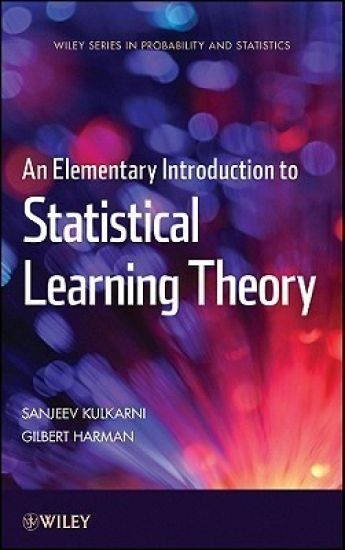
An Elementary Introduction to Statistical Learning Theory

An Elementary Introduction to Statistical Learning Theory

Sanjeev Kulkarni; Gilbert Harman

John Wiley Sons Inc
2011
sidottu
A thought-provoking look at statistical learning theory and its role in understanding human learning and inductive reasoning A joint endeavor from leading researchers in the fields of philosophy and electrical engineering, An Elementary Introduction to Statistical Learning Theory is a comprehensive and accessible primer on the rapidly evolving fields of statistical pattern recognition and statistical learning theory. Explaining these areas at a level and in a way that is not often found in other books on the topic, the authors present the basic theory behind contemporary machine learning and uniquely utilize its foundations as a framework for philosophical thinking about inductive inference. Promoting the fundamental goal of statistical learning, knowing what is achievable and what is not, this book demonstrates the value of a systematic methodology when used along with the needed techniques for evaluating the performance of a learning system. First, an introduction to machine learning is presented that includes brief discussions of applications such as image recognition, speech recognition, medical diagnostics, and statistical arbitrage. To enhance accessibility, two chapters on relevant aspects of probability theory are provided. Subsequent chapters feature coverage of topics such as the pattern recognition problem, optimal Bayes decision rule, the nearest neighbor rule, kernel rules, neural networks, support vector machines, and boosting. Appendices throughout the book explore the relationship between the discussed material and related topics from mathematics, philosophy, psychology, and statistics, drawing insightful connections between problems in these areas and statistical learning theory. All chapters conclude with a summary section, a set of practice questions, and a reference sections that supplies historical notes and additional resources for further study. An Elementary Introduction to Statistical Learning Theory is an excellent book for courses on statistical learning theory, pattern recognition, and machine learning at the upper-undergraduate and graduate levels. It also serves as an introductory reference for researchers and practitioners in the fields of engineering, computer science, philosophy, and cognitive science that would like to further their knowledge of the topic.
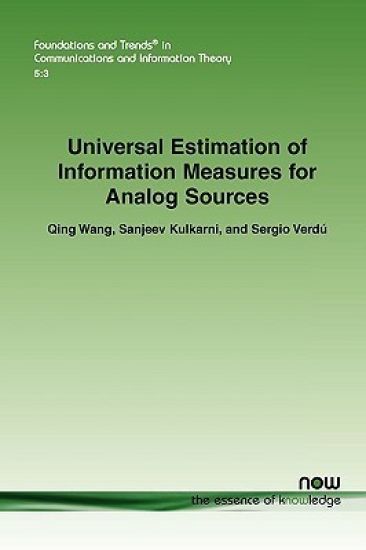
Universal Estimation of Information Measures for Analog Sources

Universal Estimation of Information Measures for Analog Sources

Qing Wang; Sanjeev Kulkarni; Sergio Verdú

now publishers Inc
2009
nidottu
Entropy, mutual information and divergence measure the randomness, dependence and dissimilarity, respectively, of random objects. In addition to their prominent role in information theory, they have found numerous applications, among others, in probability theory statistics, physics, chemistry, molecular biology, ecology, bioinformatics, neuroscience, machine learning, linguistics, and finance. Many of these applications require a universal estimate of information measures which does not assume knowledge of the statistical properties of the observed data. Over the past few decades, several nonparametric algorithms have been proposed to estimate information measures. Universal Estimation of Information Measures for Analog Sources presents a comprehensive survey of universal estimation of information measures for memoryless analog (real-valued or real vector-valued) sources with an emphasis on the estimation of mutual information and divergence and their applications. The book reviews the consistency of the universal algorithms and the corresponding sufficient conditions as well as their speed of convergence. Universal Estimation of Information Measures for Analog Sources provides a comprehensive review of an increasingly important topic in Information Theory. It will be of interest to students, practitioners and researchers working in Information Theory.
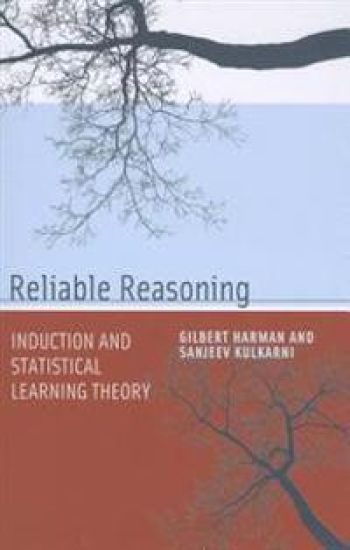
Reliable Reasoning

Reliable Reasoning

Gilbert Harman; Sanjeev Kulkarni

Bradford Books
2012
pokkari
The implications for philosophy and cognitive science of developments in statistical learning theory. In Reliable Reasoning, Gilbert Harman and Sanjeev Kulkarni-a philosopher and an engineer-argue that philosophy and cognitive science can benefit from statistical learning theory (SLT), the theory that lies behind recent advances in machine learning. The philosophical problem of induction, for example, is in part about the reliability of inductive reasoning, where the reliability of a method is measured by its statistically expected percentage of errors-a central topic in SLT. After discussing philosophical attempts to evade the problem of induction, Harman and Kulkarni provide an admirably clear account of the basic framework of SLT and its implications for inductive reasoning. They explain the Vapnik-Chervonenkis (VC) dimension of a set of hypotheses and distinguish two kinds of inductive reasoning. The authors discuss various topics in machine learning, including nearest-neighbor methods, neural networks, and support vector machines. Finally, they describe transductive reasoning and suggest possible new models of human reasoning suggested by developments in SLT.