Kirjojen hintavertailu – 12 859 828 kirjaa ja 27 kauppaa

Kirjailija

Sara Whiteley

Kirjat ja teokset yhdessä paikassa: 5 kirjaa, julkaisuja vuosilta 1998–2018, suosituimpiin kuuluu Living on equal terms. Vertaile teosten hintoja ja tarkista saatavuus suomalaisista kirjakaupoista.

5 kirjaa

Kirjojen julkaisuvuodet: 1998–2018.

Contemporary Stylistics

Contemporary Stylistics

Alison Gibbons; Sara Whiteley

Edinburgh University Press
2018
nidottu
Provides a clear introduction to the key terms and frameworks in cognitive poetics and stylisticsHow do texts create meaning? How do we arrive at our textual interpretations? Why do we become 'lost in a book' or feel deep emotion in response to a literary character? Through close attention to the way texts are written and the language they use, as well as what we know about the human mind, 'Contemporary Stylistics' provides readers with the tools to begin answering these questions. In doing so, it introduces the theoretical principles and practical frameworks of stylistics and cognitive poetics, supplying the practical skills to analyse your own responses to literary texts. Including innovative activities for students and with case studies of work by writers like Dylan Thomas, EL James and Kazuo Ishiguro, this is a detailed analysis of contemporary stylistics that offers both historical contextualization of the discipline and points towards its possible future direction. Key Features:Introduces the key terms for each contemporary stylistic frameworkOutlines the foundations of the discipline and addresses cutting-edge developments such as reader response research, corpus methods, multimodality and reader emotion Contains practical analyses, innovative exercises for students, and further reading suggestions in each chapterAddresses the recent attention to multimodal and digital literature and research into empiricism and emotionEach topic is explored through original analyses of a wide range of texts, including poetry, prose, dialogue, song lyrics, political discourse, and linguistic transcriptsThere are stylistic and cognitive poetic analyses through the book. The key case studies include:'The Canal' Lee Rourke (2010)'Zang Tumb Tumb' by Marinetti (1914)'River in Spate' by Louis MacNeice'Under Milk Wood' by Dylan Thomas (1954)'Space Sonnet & Polyfilla' by Edwin Morgan (1977)'In Defense of Our Overgrown Garden' by Matthea Harvey (2000)'House of Cards''What is the What' by Dave Eggers (2006)'Ash Wednesday' by Ethan Hawke (2002)'Fresh Meat''Fifty Shades of Grey' by E. L. James (2012)'Received Pronunciation' by Sally Goldsmith (2012)'The house is not the same since you left' by Henry Normal (1993)'The Lives of Others' by Neel Mukherjee (2014)'My Name is Lucy Barton' by Elizabeth Stroud (2016)'How to Get Filthy Rich in Rising Asia' by Mohsin Hamid (2013)'The Unconsoled' by Kazuo Ishiguro (2005)'The One Ronnie''The Girl on the Train' by Paula Hawkins (2015)'I Am The Song' by Charles Causley'Hypothetical' by Maria Taylor'This is the Poem in which I Have Not Left You' by Julia Copus (2012)'13, rue Therese' by Elena Mauli Shapiro (2011)'Illuminae' by Amie Kaufman and Jay Kristoff (2015)'Karen' by Blast Theory (2015)'Blood Story' by Melvin Burgess
Contemporary Stylistics

Contemporary Stylistics

Alison Gibbons; Sara Whiteley

Edinburgh University Press
2018
sidottu
Provides a clear introduction to the key terms and frameworks in cognitive poetics and stylisticsHow do texts create meaning? How do we arrive at our textual interpretations? Why do we become 'lost in a book' or feel deep emotion in response to a literary character? Through close attention to the way texts are written and the language they use, as well as what we know about the human mind, 'Contemporary Stylistics' provides readers with the tools to begin answering these questions. In doing so, it introduces the theoretical principles and practical frameworks of stylistics and cognitive poetics, supplying the practical skills to analyse your own responses to literary texts. Including innovative activities for students and with case studies of work by writers like Dylan Thomas, EL James and Kazuo Ishiguro, this is a detailed analysis of contemporary stylistics that offers both historical contextualization of the discipline and points towards its possible future direction. Key Features:Introduces the key terms for each contemporary stylistic frameworkOutlines the foundations of the discipline and addresses cutting-edge developments such as reader response research, corpus methods, multimodality and reader emotion Contains practical analyses, innovative exercises for students, and further reading suggestions in each chapterAddresses the recent attention to multimodal and digital literature and research into empiricism and emotionEach topic is explored through original analyses of a wide range of texts, including poetry, prose, dialogue, song lyrics, political discourse, and linguistic transcriptsThere are stylistic and cognitive poetic analyses through the book. The key case studies include:'The Canal' Lee Rourke (2010)'Zang Tumb Tumb' by Marinetti (1914)'River in Spate' by Louis MacNeice'Under Milk Wood' by Dylan Thomas (1954)'Space Sonnet & Polyfilla' by Edwin Morgan (1977)'In Defense of Our Overgrown Garden' by Matthea Harvey (2000)'House of Cards''What is the What' by Dave Eggers (2006)'Ash Wednesday' by Ethan Hawke (2002)'Fresh Meat''Fifty Shades of Grey' by E. L. James (2012)'Received Pronunciation' by Sally Goldsmith (2012)'The house is not the same since you left' by Henry Normal (1993)'The Lives of Others' by Neel Mukherjee (2014)'My Name is Lucy Barton' by Elizabeth Stroud (2016)'How to Get Filthy Rich in Rising Asia' by Mohsin Hamid (2013)'The Unconsoled' by Kazuo Ishiguro (2005)'The One Ronnie''The Girl on the Train' by Paula Hawkins (2015)'I Am The Song' by Charles Causley'Hypothetical' by Maria Taylor'This is the Poem in which I Have Not Left You' by Julia Copus (2012)'13, rue Therese' by Elena Mauli Shapiro (2011)'Illuminae' by Amie Kaufman and Jay Kristoff (2015)'Karen' by Blast Theory (2015)'Blood Story' by Melvin Burgess
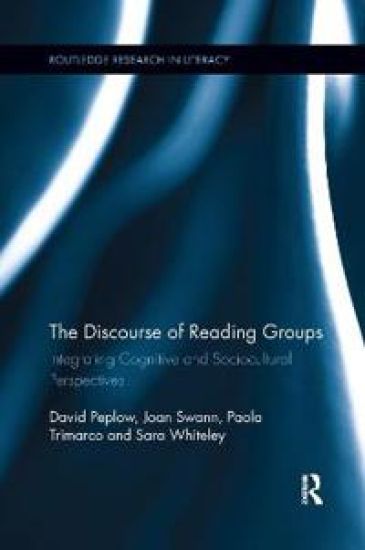
The Discourse of Reading Groups

The Discourse of Reading Groups

David Peplow; Joan Swann; Paola Trimarco; Sara Whiteley

Routledge
2017
nidottu
Of interest in their own terms as a significant cultural practice, reading groups also provide a window on the everyday interpretation of literary texts. While reading is often considered a solitary process, reading groups constitute a form of social reading, where interpretations are produced and displayed in discourse. The Discourse of Reading Groups is a study of such joint conceptual activity, and how this is necessarily embedded in interpersonal activity and the production of reader identities. Uniquely in this context it draws on, and seeks to integrate, ideas from both cognitive and social linguistics. The book will be of interest to scholars in literacy studies as well as cultural and literary studies, the history of reading, applied linguistics and sociolinguistics, digital technologies and educational research.
The Discourse of Reading Groups

The Discourse of Reading Groups

David Peplow; Joan Swann; Paola Trimarco; Sara Whiteley

Routledge
2015
sidottu
Of interest in their own terms as a significant cultural practice, reading groups also provide a window on the everyday interpretation of literary texts. While reading is often considered a solitary process, reading groups constitute a form of social reading, where interpretations are produced and displayed in discourse. The Discourse of Reading Groups is a study of such joint conceptual activity, and how this is necessarily embedded in interpersonal activity and the production of reader identities. Uniquely in this context it draws on, and seeks to integrate, ideas from both cognitive and social linguistics. The book will be of interest to scholars in literacy studies as well as cultural and literary studies, the history of reading, applied linguistics and sociolinguistics, digital technologies and educational research.
Living on equal terms

Living on equal terms

Gail Cunningham; Moira Wilson; Sara Whiteley

Policy Press
1998
nidottu
Brain injury can have a devastating long-term effect and lead to a range of disabilities. Established by Edinvar in 1993, Connections provides flexible support to enable people with acquired brain injury to live in ordinary housing, instead of hospital or supported accommodation, and to develop community links. It was set up in response to a perceived lack of opportunity for people with acquired brain injury to return to the community. This evaluation of the Connections service: establishes whether or not the Connections model satisfactorily supported people to live in the community; identifies the key features of the service; reports on interviews with service users and carers, referring and non-referring agencies and funding agencies; explores the usefulness of the model for replication by other agencies. Edinvar is a group of organisations, including a housing association and a community care charity, which is committed to promoting living on equal terms for all members of the community. It has been in operation for 25 years, providing a number of different services for people with a range of needs - one such service is Connections. This report of the evaluation is essential reading for all those involved in disability issues and community care as it investigates a service which is based on a social model of disability and which uses a person-centred planning approach in practice.