Kirjojen hintavertailu – 12 903 725 kirjaa ja 27 kauppaa

Kirjailija

Sarah Williams

Kirjat ja teokset yhdessä paikassa: 52 kirjaa, julkaisuja vuosilta 2001–2026, suosituimpiin kuuluu The Rude Reindeer. Vertaile teosten hintoja ja tarkista saatavuus suomalaisista kirjakaupoista.

52 kirjaa

Kirjojen julkaisuvuodet: 2001–2026.

Promoting Individual and Organisational Learning in Social Work

Promoting Individual and Organisational Learning in Social Work

Sarah Williams; Lynne Rutter; Ivan Lincoln Gray

Learning Matters Ltd
2012
sidottu
In today's performance driven environment, maintaining service quality in social work is more important than ever. This book will help social work leaders and managers to understand the role that personal and organisational learning plays in the provision of services that are effective and responsive to the needs of service users, carers and the communities. Recent national policy drivers such as the Munro Review into Child Protection (2011) and the recommendations of the Social Work Reform Board (2010) have strengthened the need to embed and enable learning within the workplace. This book is part of a Leadership and Management series which enables managers to understand this need, and respond in a timely and effective way.
Hybrid and Internationalised Criminal Tribunals
In recent years a number of criminal tribunals have been established to investigate, prosecute and try individuals accused of serious violations of international humanitarian law and international human rights law. These tribunals have been described as 'hybrid' or 'internationalised' tribunals as their structure and applicable law consist of both international and national elements. Six such tribunals are currently in operation: the Special Court for Sierra Leone, the Extraordinary Chambers in the Courts of Cambodia, the International Judges and Prosecutors Programme in Kosovo, the War Crimes Chamber for Bosnia and Herzegovina, the Iraqi High Tribunal and the Special Tribunal for Lebanon. The Special Panels for Serious Crimes in East Timor suspended operation in May 2005, although there continues to be some international involvement in investigation and prosecution of serious crimes. Suggestions have also been made that this model of tribunal would be appropriate for the prosecution of atrocities committed in, among others, Burundi, the Sudan, the Democratic Republic of Congo, Kenya and Liberia, as well as for a wider range of international crimes, most recently piracy. The key aims of this book are: to place the model of hybrid and internationalised tribunals in the context of other mechanisms to try international crimes; to examine the increasing demand for the establishment of hybrid and internationalised judicial institutions and the factors driving such demand; to define the category of 'hybrid and internationalised tribunals' by examining the key features of the existing and proposed hybrid or internationalised tribunals, as well as the features of those institutions with international elements that are generally excluded from this category; to determine the legal and jurisdictional bases of existing hybrid and internationalised tribunals; to analyse how the legal and jurisdictional basis of a tribunal affects other issues, such as the applicable law, the application of amnesties and immunities and the relationship of the tribunal with the host state, third states, national courts and other international criminal tribunals. The book concentrates on the definitional, legal and jurisdictional aspects of hybrid and internationalised criminal tribunals as this has been the subject of some confusion in arguments before the tribunals and in the judgments of the tribunals. In its concluding section, the book examines the future role of internationalised and hybrid criminal tribunals, particularly in light of the establishment of the ICC, and the potential use of such tribunals in other contexts. It also assesses how hybrid and internationalised tribunals fit into a 'multi-layered framework' of international criminal law and transitional justice.
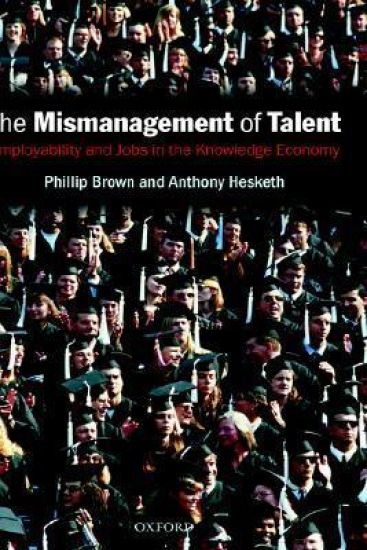
The Mismanagement of Talent

The Mismanagement of Talent

Phillip Brown; Anthony Hesketh; Sarah Williams

Oxford University Press
2004
sidottu
The knowledge economy conjures a world of smart people, in smart jobs, doing smart things, in smart ways, for smart money, a world increasingly open to all rather than a few. Glossy corporate brochures present a future in challenging, exciting and financially rewarding jobs for the winners in the competition for fast track management appointments. They also convey an image of enlightened employers actively seeking to diversify their talent pool, reflected in their approach to identifying, hiring and retaining outstanding talent. We are told that the challenge confronting governments around the world is to enhance the employability of the workforce. Every effort must be made to expand access to higher education, dismantle barriers to talent regardless of social circumstances, gender, or skin colour, and to harness human creativity and enterprise to meet the demands of the new economy. The Mismanagement of Talent comes to a different conclusion. Those leaving the world of mass higher education find themselves in a scramble for jobs with rising stakes for the winners and losers. The Mismanagement of Talent examines what determines the outcome of this race when a degree loses its badge of distinction. It shows how some graduates are playing 'the game' to win a competitive advantage and what really happens in the selection events of leading-edge employers. It also argues that talent is being mismanaged by employers that have yet to come to terms with the realities and possibilities of mass higher education. The Mismanagement of Talent will be thought-provoking and controversial reading for those involved in the recruitment of graduates, and those concerned with the way knowledge-based firms recruit and the impact of higher education policy: Professionals working in university careers services, HRM, training, or recruitment generally; Researchers, academics, or students of Business and Management, Human Resource Management, Public Policy, Education, or Sociology; and Job candidates themselves - the 'players' and 'purists' described in the book.