Kirjojen hintavertailu – 12 859 828 kirjaa ja 27 kauppaa

Kirjailija

Saul Mendoza-Palacios

Kirjat ja teokset yhdessä paikassa: 4 kirjaa, julkaisuja vuosilta 2023–2024, suosituimpiin kuuluu An Introduction to Optimal Control Theory. Vertaile teosten hintoja ja tarkista saatavuus suomalaisista kirjakaupoista.

4 kirjaa

Kirjojen julkaisuvuodet: 2023–2024.

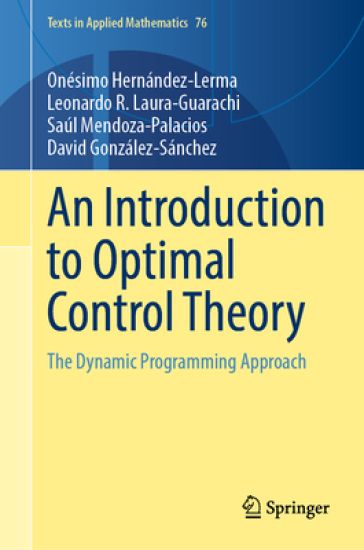
Evolutionary Games and the Replicator Dynamics

Evolutionary Games and the Replicator Dynamics

Saul Mendoza-Palacios; Onésimo Hernández-Lerma

Cambridge University Press
2024
pokkari
This Element introduces the replicator dynamics for symmetric and asymmetric games where the strategy sets are metric spaces. Under this hypothesis the replicator dynamics evolves in a Banach space of finite signed measures. The authors provide a general framework to study the stability of the replicator dynamics for evolutionary games in this Banach space. This allows them to establish a relation between Nash equilibria and the stability of the replicator for normal a form games applicable to oligopoly models, theory of international trade, public good models, the tragedy of commons, and War of attrition game among others. They also provide conditions to approximate the replicator dynamics on a space of measures by means of a finite-dimensional dynamical system and a sequence of measure-valued Markov processes.
Evolutionary Games and the Replicator Dynamics

Evolutionary Games and the Replicator Dynamics

Saul Mendoza-Palacios; Onésimo Hernández-Lerma

Cambridge University Press
2024
sidottu
This Element introduces the replicator dynamics for symmetric and asymmetric games where the strategy sets are metric spaces. Under this hypothesis the replicator dynamics evolves in a Banach space of finite signed measures. The authors provide a general framework to study the stability of the replicator dynamics for evolutionary games in this Banach space. This allows them to establish a relation between Nash equilibria and the stability of the replicator for normal a form games applicable to oligopoly models, theory of international trade, public good models, the tragedy of commons, and War of attrition game among others. They also provide conditions to approximate the replicator dynamics on a space of measures by means of a finite-dimensional dynamical system and a sequence of measure-valued Markov processes.
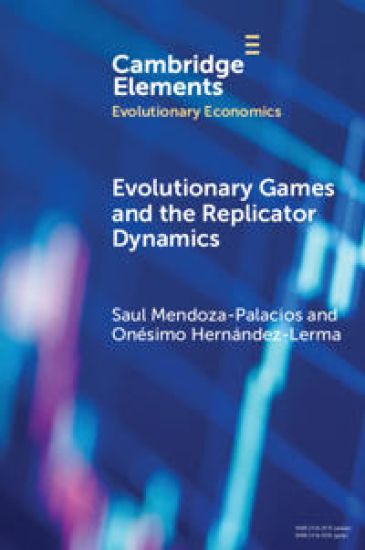
An Introduction to Optimal Control Theory

An Introduction to Optimal Control Theory

Onésimo Hernández-Lerma; Leonardo R. Laura-Guarachi; Saul Mendoza-Palacios; David González-Sánchez

Springer International Publishing AG
2024
nidottu
This book introduces optimal control problems for large families of deterministic and stochastic systems with discrete or continuous time parameter. These families include most of the systems studied in many disciplines, including Economics, Engineering, Operations Research, and Management Science, among many others. The main objective is to give a concise, systematic, and reasonably self contained presentation of some key topics in optimal control theory. To this end, most of the analyses are based on the dynamic programming (DP) technique. This technique is applicable to almost all control problems that appear in theory and applications. They include, for instance, finite and infinite horizon control problems in which the underlying dynamic system follows either a deterministic or stochastic difference or differential equation. In the infinite horizon case, it also uses DP to study undiscounted problems, such as the ergodic or long-run average cost. After a general introduction to control problems, the book covers the topic dividing into four parts with different dynamical systems: control of discrete-time deterministic systems, discrete-time stochastic systems, ordinary differential equations, and finally a general continuous-time MCP with applications for stochastic differential equations. The first and second part should be accessible to undergraduate students with some knowledge of elementary calculus, linear algebra, and some concepts from probability theory (random variables, expectations, and so forth). Whereas the third and fourth part would be appropriate for advanced undergraduates or graduate students who have a working knowledge of mathematical analysis (derivatives, integrals, ...) and stochastic processes.
An Introduction to Optimal Control Theory

An Introduction to Optimal Control Theory

Onésimo Hernández-Lerma; Leonardo R. Laura-Guarachi; Saul Mendoza-Palacios; David González-Sánchez

Springer International Publishing AG
2023
sidottu
This book introduces optimal control problems for large families of deterministic and stochastic systems with discrete or continuous time parameter. These families include most of the systems studied in many disciplines, including Economics, Engineering, Operations Research, and Management Science, among many others. The main objective is to give a concise, systematic, and reasonably self contained presentation of some key topics in optimal control theory. To this end, most of the analyses are based on the dynamic programming (DP) technique. This technique is applicable to almost all control problems that appear in theory and applications. They include, for instance, finite and infinite horizon control problems in which the underlying dynamic system follows either a deterministic or stochastic difference or differential equation. In the infinite horizon case, it also uses DP to study undiscounted problems, such as the ergodic or long-run average cost. After a general introduction to control problems, the book covers the topic dividing into four parts with different dynamical systems: control of discrete-time deterministic systems, discrete-time stochastic systems, ordinary differential equations, and finally a general continuous-time MCP with applications for stochastic differential equations. The first and second part should be accessible to undergraduate students with some knowledge of elementary calculus, linear algebra, and some concepts from probability theory (random variables, expectations, and so forth). Whereas the third and fourth part would be appropriate for advanced undergraduates or graduate students who have a working knowledge of mathematical analysis (derivatives, integrals, ...) and stochastic processes.