

Kirjailija
Saurabh Mittal
Kirjat ja teokset yhdessä paikassa: 5 kirjaa, julkaisuja vuosilta 2013–2025, suosituimpiin kuuluu Netcentric System of Systems Engineering with DEVS Unified Process. Vertaile teosten hintoja ja tarkista saatavuus suomalaisista kirjakaupoista.
5 kirjaa
Kirjojen julkaisuvuodet: 2013–2025.
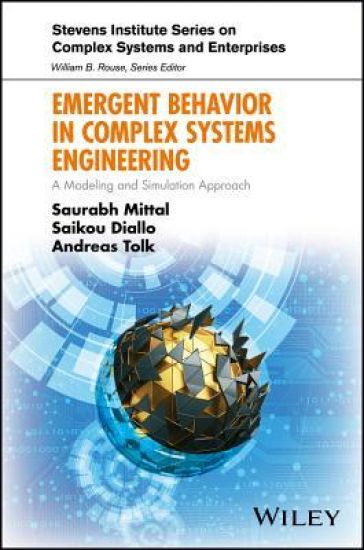
Emergent Behavior in Complex Systems Engineering
Saurabh Mittal; Saikou Diallo; Andreas Tolk
Wiley-Blackwell
2018
sidottu
A comprehensive text that reviews the methods and technologies that explore emergent behavior in complex systems engineering in multidisciplinary fields In Emergent Behavior in Complex Systems Engineering, the authors present the theoretical considerations and the tools required to enable the study of emergent behaviors in manmade systems. Information Technology is key to today’s modern world. Scientific theories introduced in the last five decades can now be realized with the latest computational infrastructure. Modeling and simulation, along with Big Data technologies are at the forefront of such exploration and investigation. The text offers a number of simulation-based methods, technologies, and approaches that are designed to encourage the reader to incorporate simulation technologies to further their understanding of emergent behavior in complex systems. The authors present a resource for those designing, developing, managing, operating, and maintaining systems, including system of systems. The guide is designed to help better detect, analyse, understand, and manage the emergent behaviour inherent in complex systems engineering in order to reap the benefits of innovations and avoid the dangers of unforeseen consequences. This vital resource: Presents coverage of a wide range of simulation technologiesExplores the subject of emergence through the lens of Modeling and Simulation (M&S)Offers contributions from authors at the forefront of various related disciplines such as philosophy, science, engineering, sociology, and economicsContains information on the next generation of complex systems engineering Written for researchers, lecturers, and students, Emergent Behavior in Complex Systems Engineering provides an overview of the current discussions on complexity and emergence, and shows how systems engineering methods in general and simulation methods in particular can help in gaining new insights in complex systems engineering.
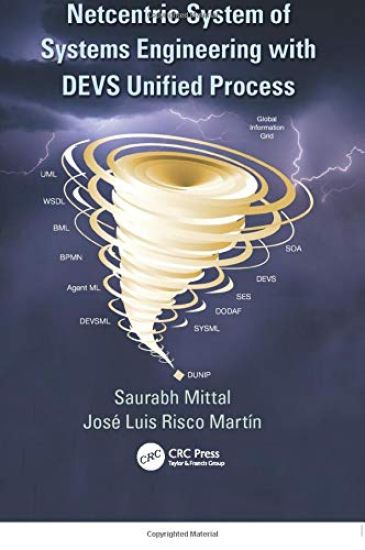
Netcentric System of Systems Engineering with DEVS Unified Process
Saurabh Mittal; José L. Risco Martín
CRC Press
2017
nidottu
In areas such as military, security, aerospace, and disaster management, the need for performance optimization and interoperability among heterogeneous systems is increasingly important. Model-driven engineering, a paradigm in which the model becomes the actual software, offers a promising approach toward systems of systems (SoS) engineering. However, model-driven engineering has largely been unachieved in complex dynamical systems and netcentric SoS, partly because modeling and simulation (M&S) frameworks are stove-piped and not designed for SoS composability. Addressing this gap, Netcentric System of Systems Engineering with DEVS Unified Process presents a methodology for realizing the model-driven engineering vision and netcentric SoS using DEVS Unified Process (DUNIP). The authors draw on their experience with Discrete Event Systems Specification (DEVS) formalism, System Entity Structure (SES) theory, and applying model-driven engineering in the context of a netcentric SoS. They describe formal model-driven engineering methods for netcentric M&S using standards-based approaches to develop and test complex dynamic models with DUNIP. The book is organized into five sections: Section I introduces undergraduate students and novices to the world of DEVS. It covers systems and SoS M&S as well as DEVS formalism, software, modeling language, and DUNIP. It also assesses DUNIP with the requirements of the Department of Defense’s (DoD) Open Unified Technical Framework (OpenUTF) for netcentric Test and Evaluation (T&E). Section II delves into M&S-based systems engineering for graduate students, advanced practitioners, and industry professionals. It provides methodologies to apply M&S principles to SoS design and reviews the development of executable architectures based on a framework such as the Department of Defense Architecture Framework (DoDAF). It also describes an approach for building netcentric knowledge-based contingency-driven systems. Section III guides graduate students, advanced DEVS users, and industry professionals who are interested in building DEVS virtual machines and netcentric SoS. It discusses modeling standardization, the deployment of models and simulators in a netcentric environment, event-driven architectures, and more. Section IV explores real-world case studies that realize many of the concepts defined in the previous chapters. Section V outlines the next steps and looks at how the modeling of netcentric complex adaptive systems can be attempted using DEVS concepts. It touches on the boundaries of DEVS formalism and the future work needed to utilize advanced concepts like weak and strong emergence, self-organization, scale-free systems, run-time modularity, and event interoperability. This groundbreaking work details how DUNIP offers a well-structured, platform-independent methodology for the modeling and simulation of netcentric system of systems.

Molluscs Shell Structures
Saurabh Mittal; Minu Kesheri; Swarna Kanchan
LAP Lambert Academic Publishing
2014
pokkari
Netcentric System of Systems Engineering with DEVS Unified Process
Saurabh Mittal; José L. Risco Martín
CRC Press Inc
2013
sidottu
In areas such as military, security, aerospace, and disaster management, the need for performance optimization and interoperability among heterogeneous systems is increasingly important. Model-driven engineering, a paradigm in which the model becomes the actual software, offers a promising approach toward systems of systems (SoS) engineering. However, model-driven engineering has largely been unachieved in complex dynamical systems and netcentric SoS, partly because modeling and simulation (M&S) frameworks are stove-piped and not designed for SoS composability. Addressing this gap, Netcentric System of Systems Engineering with DEVS Unified Process presents a methodology for realizing the model-driven engineering vision and netcentric SoS using DEVS Unified Process (DUNIP). The authors draw on their experience with Discrete Event Systems Specification (DEVS) formalism, System Entity Structure (SES) theory, and applying model-driven engineering in the context of a netcentric SoS. They describe formal model-driven engineering methods for netcentric M&S using standards-based approaches to develop and test complex dynamic models with DUNIP. The book is organized into five sections: Section I introduces undergraduate students and novices to the world of DEVS. It covers systems and SoS M&S as well as DEVS formalism, software, modeling language, and DUNIP. It also assesses DUNIP with the requirements of the Department of Defense’s (DoD) Open Unified Technical Framework (OpenUTF) for netcentric Test and Evaluation (T&E). Section II delves into M&S-based systems engineering for graduate students, advanced practitioners, and industry professionals. It provides methodologies to apply M&S principles to SoS design and reviews the development of executable architectures based on a framework such as the Department of Defense Architecture Framework (DoDAF). It also describes an approach for building netcentric knowledge-based contingency-driven systems. Section III guides graduate students, advanced DEVS users, and industry professionals who are interested in building DEVS virtual machines and netcentric SoS. It discusses modeling standardization, the deployment of models and simulators in a netcentric environment, event-driven architectures, and more. Section IV explores real-world case studies that realize many of the concepts defined in the previous chapters. Section V outlines the next steps and looks at how the modeling of netcentric complex adaptive systems can be attempted using DEVS concepts. It touches on the boundaries of DEVS formalism and the future work needed to utilize advanced concepts like weak and strong emergence, self-organization, scale-free systems, run-time modularity, and event interoperability. This groundbreaking work details how DUNIP offers a well-structured, platform-independent methodology for the modeling and simulation of netcentric system of systems.