Kirjojen hintavertailu – 12 859 819 kirjaa ja 27 kauppaa

Kirjailija

Scott de Marchi

Kirjat ja teokset yhdessä paikassa: 4 kirjaa, julkaisuja vuosilta 2005–2023, suosituimpiin kuuluu The Governance Cycle in Parliamentary Democracies. Vertaile teosten hintoja ja tarkista saatavuus suomalaisista kirjakaupoista.

4 kirjaa

Kirjojen julkaisuvuodet: 2005–2023.

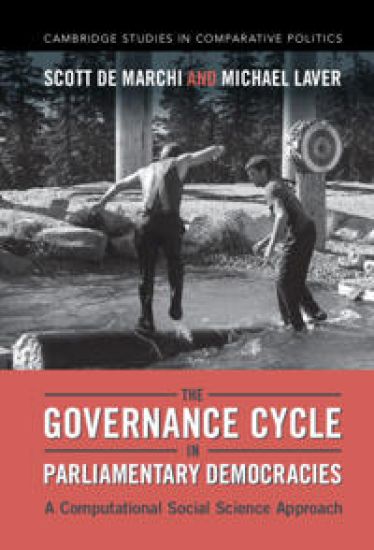
The Governance Cycle in Parliamentary Democracies

The Governance Cycle in Parliamentary Democracies

Scott de Marchi; Michael Laver

Cambridge University Press
2023
sidottu
Parliamentary democracy involves a never-ending cycle of elections, government formations, and the need for governments to survive in potentially hostile environments. These conditions require members of any government to make decisions on a large number of issues, some of which sharply divide them. Officials resolve these divisions by 'logrolling'– conceding on issues they care less about, in exchange for reciprocal concessions on issues to which they attach more importance. Though realistically modeling this 'governance cycle' is beyond the scope of traditional formal analysis, this book attacks the problem computationally in two ways. Firstly, it models the behavior of “functionally rational” senior politicians who use informal decision heuristics to navigate their complex high stakes setting. Secondly, by applying computational methods to traditional game theory, it uses artificial intelligence to model how hyper-rational politicians might find strategies that are close to optimal.
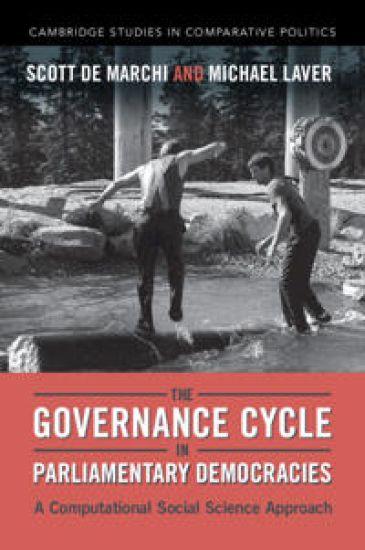
The Governance Cycle in Parliamentary Democracies

The Governance Cycle in Parliamentary Democracies

Scott de Marchi; Michael Laver

Cambridge University Press
2023
pokkari
Parliamentary democracy involves a never-ending cycle of elections, government formations, and the need for governments to survive in potentially hostile environments. These conditions require members of any government to make decisions on a large number of issues, some of which sharply divide them. Officials resolve these divisions by 'logrolling'– conceding on issues they care less about, in exchange for reciprocal concessions on issues to which they attach more importance. Though realistically modeling this 'governance cycle' is beyond the scope of traditional formal analysis, this book attacks the problem computationally in two ways. Firstly, it models the behavior of “functionally rational” senior politicians who use informal decision heuristics to navigate their complex high stakes setting. Secondly, by applying computational methods to traditional game theory, it uses artificial intelligence to model how hyper-rational politicians might find strategies that are close to optimal.

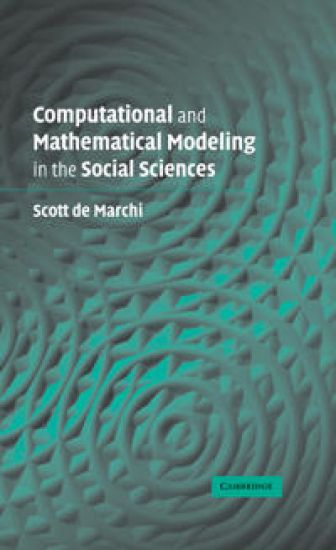
Computational and Mathematical Modeling in the Social Sciences

Computational and Mathematical Modeling in the Social Sciences

Scott de Marchi

Cambridge University Press
2005
pokkari
Mathematical models in the social sciences have become increasingly sophisticated and widespread in the last decade. This period has also seen many critiques, most lamenting the sacrifices incurred in pursuit of mathematical rigor. If, as critics argue, our ability to understand the world has not improved during the mathematization of the social sciences, we might want to adopt a different paradigm. This book examines the three main fields of mathematical modeling - game theory, statistics, and computational methods - and proposes a new framework for modeling. Unlike previous treatments which view each field separately, the treatment provides a framework that spans and incorporates the different methodological approaches. The goal is to arrive at a new vision of modeling that allows researchers to solve more complex problems in the social sciences. Additionally, a special emphasis is placed upon the role of computational modeling in the social sciences.
Computational and Mathematical Modeling in the Social Sciences

Computational and Mathematical Modeling in the Social Sciences

Scott de Marchi

Cambridge University Press
2005
sidottu
Mathematical models in the social sciences have become increasingly sophisticated and widespread in the last decade. This period has also seen many critiques, most lamenting the sacrifices incurred in pursuit of mathematical rigor. If, as critics argue, our ability to understand the world has not improved during the mathematization of the social sciences, we might want to adopt a different paradigm. This book examines the three main fields of mathematical modeling - game theory, statistics, and computational methods - and proposes a new framework for modeling. Unlike previous treatments which view each field separately, the treatment provides a framework that spans and incorporates the different methodological approaches. The goal is to arrive at a new vision of modeling that allows researchers to solve more complex problems in the social sciences. Additionally, a special emphasis is placed upon the role of computational modeling in the social sciences.