Kirjojen hintavertailu – 12 903 724 kirjaa ja 27 kauppaa

Kirjailija

Scott Eacott

Kirjat ja teokset yhdessä paikassa: 4 kirjaa, julkaisuja vuosilta 2017–2025, suosituimpiin kuuluu Beyond Leadership. Vertaile teosten hintoja ja tarkista saatavuus suomalaisista kirjakaupoista.

4 kirjaa

Kirjojen julkaisuvuodet: 2017–2025.

School Autonomy Reform and Social Justice in Australian Public Schooling

School Autonomy Reform and Social Justice in Australian Public Schooling

Amanda Keddie; Katrina MacDonald; Brad Gobby; Jill Blackmore; Jane Wilkinson; Scott Eacott; Richard Niesche

TAYLOR FRANCIS LTD
2025
sidottu
This book explores the social justice implications of school autonomy reform within the context of public education in Australia. It is situated within and framed by global concerns about how public schools are navigating their ‘autonomy’ within increasingly marketised education systems. Drawing on extensive interviews with stakeholders and five in depth case study schools, the book calls attention to the ways in which the intentions of school autonomy reform to offer schools more freedom to make their own decisions and manage their own responsibilities have become increasingly contained by the market imperatives of economic e?ciency, competition and public accountability driving state and national education systems. We build on and enrich existing research in this area that highlights how market imperatives continue to exacerbate inequality within and between schools and their systems. An essential read for researchers and policymakers worldwide, the book provides insight into how education systems can better support public schools to mobilise their autonomy in socially just ways.
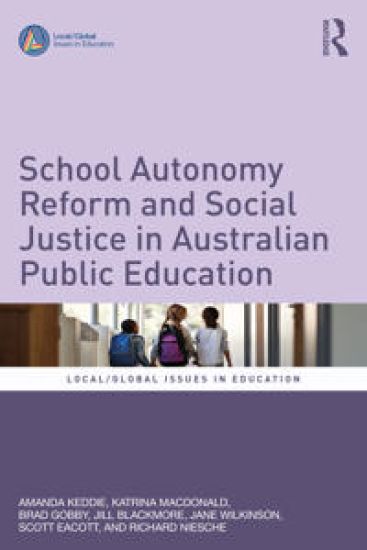
School Autonomy Reform and Social Justice in Australian Public Schooling

School Autonomy Reform and Social Justice in Australian Public Schooling

Amanda Keddie; Katrina MacDonald; Brad Gobby; Jill Blackmore; Jane Wilkinson; Scott Eacott; Richard Niesche

TAYLOR FRANCIS LTD
2025
nidottu
This book explores the social justice implications of school autonomy reform within the context of public education in Australia. It is situated within and framed by global concerns about how public schools are navigating their ‘autonomy’ within increasingly marketised education systems. Drawing on extensive interviews with stakeholders and five in depth case study schools, the book calls attention to the ways in which the intentions of school autonomy reform to offer schools more freedom to make their own decisions and manage their own responsibilities have become increasingly contained by the market imperatives of economic e?ciency, competition and public accountability driving state and national education systems. We build on and enrich existing research in this area that highlights how market imperatives continue to exacerbate inequality within and between schools and their systems. An essential read for researchers and policymakers worldwide, the book provides insight into how education systems can better support public schools to mobilise their autonomy in socially just ways.
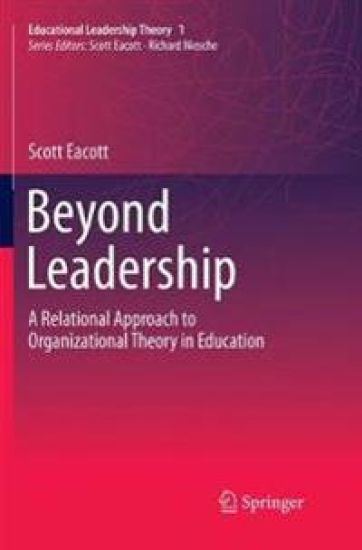
Beyond Leadership

Beyond Leadership

Scott Eacott

Springer Verlag, Singapore
2019
nidottu
This book systematically elaborates Scott Eacott’s “relational” approach to organizational theory in education. Contributing to the relational trend in the social sciences, it first surveys relational scholarship across disciplines before providing a nuanced articulation of the relational research program and key concepts such as organizing activity, auctors, and spatio-temporal conditions. It also includes critical commentaries on the program from key figures such as Tony Bush, Megan Crawford, Fenwick English, Helen Gunter, Izhar Oplatka, Augusto Riveros, and Dawn Wallin. As such, the text models an approach to, or social epistemology for building knowledge claims in relation rather than through parallel monologues. Eacott’s relational approach provides a distinctive, post-Bourdieusian variant of the relational sociological project. Shifting the focus of inquiry from entities (e.g., leaders, organizations) to organizing activity and recognizing how auctors generate – simultaneously emerging from and constitutive of – spatio-temporal conditions unsettles the orthodoxy of organizational theory in educational administration and leadership. By presenting its claims in the context of other approaches, the book stimulates intellectual debate among both relational sociologists and opponents of relational approaches. Beyond Leadership provides significant insights into the organizing of education. As it does not fit neatly into any one field, but instead blends educational administration and leadership, organizational studies, and relational sociology, among others, it charts new territory and promotes important dialogue and debate.
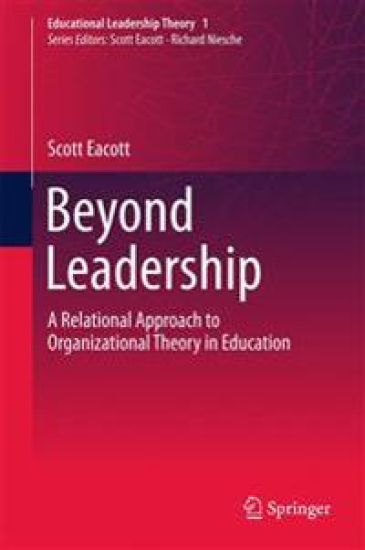
Beyond Leadership

Beyond Leadership

Scott Eacott

Springer Verlag, Singapore
2017
sidottu
This book systematically elaborates Scott Eacott’s “relational” approach to organizational theory in education. Contributing to the relational trend in the social sciences, it first surveys relational scholarship across disciplines before providing a nuanced articulation of the relational research program and key concepts such as organizing activity, auctors, and spatio-temporal conditions. It also includes critical commentaries on the program from key figures such as Tony Bush, Megan Crawford, Fenwick English, Helen Gunter, Izhar Oplatka, Augusto Riveros, and Dawn Wallin. As such, the text models an approach to, or social epistemology for building knowledge claims in relation rather than through parallel monologues. Eacott’s relational approach provides a distinctive, post-Bourdieusian variant of the relational sociological project. Shifting the focus of inquiry from entities (e.g., leaders, organizations) to organizing activity and recognizing how auctors generate – simultaneously emerging from and constitutive of – spatio-temporal conditions unsettles the orthodoxy of organizational theory in educational administration and leadership. By presenting its claims in the context of other approaches, the book stimulates intellectual debate among both relational sociologists and opponents of relational approaches. Beyond Leadership provides significant insights into the organizing of education. As it does not fit neatly into any one field, but instead blends educational administration and leadership, organizational studies, and relational sociology, among others, it charts new territory and promotes important dialogue and debate.