Kirjojen hintavertailu – 12 871 288 kirjaa ja 27 kauppaa

Kirjailija

Scott T. Allison

Kirjat ja teokset yhdessä paikassa: 13 kirjaa, julkaisuja vuosilta 2010–2026, suosituimpiin kuuluu Motional Intelligence. Vertaile teosten hintoja ja tarkista saatavuus suomalaisista kirjakaupoista.

13 kirjaa

Kirjojen julkaisuvuodet: 2010–2026.

Motional Intelligence

Motional Intelligence

Scott T. Allison; George R. Goethals

Emerald Publishing Limited
2026
sidottu
Leadership studies are increasingly emphasizing embodied communication, nonverbal influence, and the physical presence of leaders—especially in diverse, hybrid, and high-stakes social environments. Motional Intelligence advances this shift by introducing a bold new framework for understanding how posture, gesture, rhythm, and bodily timing shape influence, trust, attraction, and power. Drawing on psychology, neuroscience, evolutionary theory, leadership research, film, and everyday social life, the book shows that long before words are processed, people evaluate leaders through movement—reading confidence, warmth, dominance, or threat in the body itself. Across domains ranging from leadership and romance to classrooms, boardrooms, athletics, and popular culture, the authors demonstrate how movement operates as a deeply social form of intelligence—one that is expressive (how leaders signal), perceptive (how they read others), and regulative (how they adapt in real time). The book also reveals how identical movements can be interpreted differently depending on gender, status, and context, shaping credibility and opportunity in subtle but powerful ways. Accessible yet rigorous, Motional Intelligence reframes leadership as an embodied practice and argues that ethical responsibility begins not only with what leaders think or say, but with how they move.

Heroic Leadership

Heroic Leadership

Scott T. Allison; George R. Goethals

TAYLOR FRANCIS LTD
2024
sidottu
Heroic Leadership is a celebration of our greatest heroes, from well-known legends to the legions of unsung heroes who transform our world quietly behind the scenes. Now in its second edition, this book offers a compelling conceptual framework for understanding heroism and heroic leadership, drawing from theories of great leadership and heroic action. With over 50 revised heroic leader profiles, and 30 new profiles of individuals that have transformed the world, the book explores the many counterintuitive ways that heroes lead, shape, and mobilize their followers. The authors offer a definition of heroic leadership that explains how people easily misconstrue both leadership and heroism, and provide an innovative take on why people are drawn to heroic leaders, and why this can be considered a “fatal attraction”. Incorporating the latest theory and research, the authors unpack the following ten categories of heroism: Trending Heroes, Transitory Heroes, Transparent Heroes, Transitional Heroes, Tragic Heroes, Transposed Heroes, Transitional Heroes, Traditional Heroes, Transforming Heroes, and Transcendent Heroes. From within these categories, the authors identify 100 exceptional individuals, describing their lives and how they exemplify the characteristics of the category they have been assigned. Suggesting that our most cherished heroes make for our most transforming leaders, this is a vital resource for students and scholars of leadership studies, organizational behaviour and social psychology. Presenting valuable insights into the lives of both historical and modern leaders, the book is also a fascinating read for casual readers.
Heroic Leadership

Heroic Leadership

Scott T. Allison; George R. Goethals

TAYLOR FRANCIS LTD
2024
nidottu
Heroic Leadership is a celebration of our greatest heroes, from well-known legends to the legions of unsung heroes who transform our world quietly behind the scenes. Now in its second edition, this book offers a compelling conceptual framework for understanding heroism and heroic leadership, drawing from theories of great leadership and heroic action. With over 50 revised heroic leader profiles, and 30 new profiles of individuals that have transformed the world, the book explores the many counterintuitive ways that heroes lead, shape, and mobilize their followers. The authors offer a definition of heroic leadership that explains how people easily misconstrue both leadership and heroism, and provide an innovative take on why people are drawn to heroic leaders, and why this can be considered a “fatal attraction”. Incorporating the latest theory and research, the authors unpack the following ten categories of heroism: Trending Heroes, Transitory Heroes, Transparent Heroes, Transitional Heroes, Tragic Heroes, Transposed Heroes, Transitional Heroes, Traditional Heroes, Transforming Heroes, and Transcendent Heroes. From within these categories, the authors identify 100 exceptional individuals, describing their lives and how they exemplify the characteristics of the category they have been assigned. Suggesting that our most cherished heroes make for our most transforming leaders, this is a vital resource for students and scholars of leadership studies, organizational behaviour and social psychology. Presenting valuable insights into the lives of both historical and modern leaders, the book is also a fascinating read for casual readers.
The Hazards of Great Leadership

The Hazards of Great Leadership

James K. Beggan; Scott T. Allison; George R. Goethals

Cambridge University Press
2023
pokkari
The value of great leaders seems to be an unquestioned assumption. The goal of this Element is to explore the counterintuitive idea that great leaders can pose a hazard to themselves and their followers. Great leadership, which accomplishes morally commendable and difficult objectives by leaders and followers, requires competence, morality, and charisma. A hazard is a condition or event that leads to human loss, such as injury, death, or economic misfortune. A leader can become a hazard through social psychological processes, which operate through the metaphor of Seven Deadly Sins, to create negative consequences. Great leaders can undermine their own success and accomplishments, as well as their followers. They can become a threat to the organization in which they are employed. Finally, great leaders can become a danger to the larger society. The damage great leaders can create can be reduced by applying the corresponding virtue.
The Heroic Leadership Imperative

The Heroic Leadership Imperative

Scott T. Allison; George R. Goethals

Emerald Publishing Limited
2020
nidottu
Leaders are expected to be heroic. That is, they are expected to serve three needs of their followers: (1) basic individual needs; (2) group and collective identity needs; and (3) transcendent needs. The Heroic Leadership Imperative illustrates how leaders who fulfill these expectations succeed attracting followers and initiating social change. Here Scott T. Allison and George R. Goethals identify leaders who have succeeded in meeting all three categories of needs—individuals such as Winston Churchill, Abraham Lincoln, Donald Trump, as well as cult leaders such as Jim Jones—and they discuss such leaders' appeal by way of a unique integration of classic and contemporary psychology relevant to understanding all facets of heroism and heroic leadership. In so doing, the authors explore how heroes and villains have used this leadership imperative to fulfill their ambitions, and provide valuable insights into how societies can avoid falling under the spell of charismatic leaders who misuse the leadership imperative. For its broad historical coverage, interdisciplinary approach, and relevance to current events, this book is a must-read for scholars and students of leadership studies, and it is of interest to anyone concerned with the political and social upheavals of the past five years.
The Romance of Heroism and Heroic Leadership

The Romance of Heroism and Heroic Leadership

George R. Goethals; Scott T. Allison

Emerald Publishing Limited
2019
nidottu
Heroes permeate our culture. From superheroes on screen to the everyday heroics of our public services, the word 'hero' is a familiar descriptor in every form of media. But what makes a hero? And what makes heroes 'heroic'? Leadership experts George R. Goethals and Scott T. Allison explore how the romantic conceptions of heroes and heroic leaders are constructed, both in real life and in our heads. Looking at the dichotomy of heroism and villainy, they offer insights into Donald Trump's ascension to the US presidency, particularly detailing the correspondence between the needs of the US public and the promises the former reality TV star made in reply. They also consider how three highly charismatic men dramatically and fundamentally changed American society in the mid-twentieth century - Martin Luther King (1929-1968), Elvis Presley (1935-1977), and Muhammad Ali (1942-2016), called here the "Three Kings" of the US. This exciting and innovative study explores how charisma and human needs create images of individuals as heroes and villains. For researchers and students of psychology and leadership, this is a fundamental text on the creation of both genuine heroes, and false idols.
Heroic Transformation: How Heroes Change Themselves and the World
The human journey is brimming with opportunities for growth and development. This volume, crafted superbly by a talented group of young student-scholars at the University of Richmond, explores the myriad ways that human beings have undergone dramatic metamorphosis to become extraordinary heroes. The heroes profiled in this book include Audrey Hepburn, Susan B. Anthony, Thurgood Marshall, Muhammad Ali, Eleanor Roosevelt, Daenerys Targaryen, Dexter Morgan, Frodo Baggins, Bruce Wayne, and many more.
Heroic Humility

Heroic Humility

Jr. Worthington; Scott T. Allison

American Psychological Association
2018
sidottu
In this age of selfies, instant celebrity, and corporate scandals, the need for greater humility is pressing. This book synthesizes both research and theory relevant to humility and heroism, articulating a vision of heroic humility-humility of such great depth that it inspires others. Fortunately, humility can be learned. It has three parts: an honest self-appraisal (including an attitude that one is teachable), modest self-presentation, and an orientation toward building others up rather than putting them down. People who embody heroic humility not only demonstrate instances of great humility, but practice it throughout their lives, even when severely tested. Thus, this book likens the formation of a humble character to a hero amp rsquo s journey, with a amp ldquo call, amp rdquo a passage through challenges and temptations, a descent into abyss, and redemption. An impressive array of examples-such as Mother Teresa, Malala Yousafzai, and Abraham Lincoln-illustrates that no two heroic journeys are identical. This insightful volume challenges readers to embark on their own journey of heroic humility in their work, service, and personal lives.
Conceptions of Leadership

Conceptions of Leadership

Scott T. Allison; David M. Messick

Palgrave Macmillan
2014
nidottu
An exploration of both classic and contemporary conceptions of leadership, focusing on social psychological approaches to central questions such as the way people think about leaders and leadership, the personality attributes of leaders, power and influence, trust, and the qualities that sustain positive relationships between leaders and followers.
Conceptions of Leadership

Conceptions of Leadership

Scott T. Allison; David M. Messick

Palgrave Macmillan
2014
sidottu
An exploration of both classic and contemporary conceptions of leadership, focusing on social psychological approaches to central questions such as the way people think about leaders and leadership, the personality attributes of leaders, power and influence, trust, and the qualities that sustain positive relationships between leaders and followers.
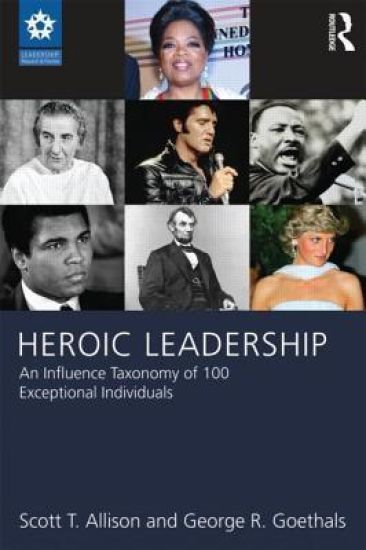
Heroic Leadership

Heroic Leadership

Scott T. Allison; George R. Goethals

Routledge
2013
sidottu
Heroic Leadership is a celebration of our greatest heroes, from legends such as Mahatma Gandhi to the legions of unsung heroes who transform our world quietly behind the scenes. The authors argue that all great heroes are also great leaders. The term ‘heroic leadership’ is coined to describe how heroism and leadership are intertwined, and how our most cherished heroes are also our most transforming leaders. This book offers a new conceptual framework for understanding heroism and heroic leadership, drawing from theories of great leadership and heroic action. Ten categories of heroism are described: Trending Heroes, Transitory Heroes, Transparent Heroes, Transitional Heroes, Tragic Heroes, Transposed Heroes, Transitional Heroes, Traditional Heroes, Transforming Heroes, and Transcendent Heroes. The authors describe the lives of 100 exceptional individuals whose accomplishments place them into one of these ten hero categories. These 100 hero profiles offer supporting evidence for a new integration of theories of leadership and theories of heroism.
Heroic Leadership

Heroic Leadership

Scott T. Allison; George R. Goethals

Routledge
2013
nidottu
Heroic Leadership is a celebration of our greatest heroes, from legends such as Mahatma Gandhi to the legions of unsung heroes who transform our world quietly behind the scenes. The authors argue that all great heroes are also great leaders. The term ‘heroic leadership’ is coined to describe how heroism and leadership are intertwined, and how our most cherished heroes are also our most transforming leaders. This book offers a new conceptual framework for understanding heroism and heroic leadership, drawing from theories of great leadership and heroic action. Ten categories of heroism are described: Trending Heroes, Transitory Heroes, Transparent Heroes, Transitional Heroes, Tragic Heroes, Transposed Heroes, Transitional Heroes, Traditional Heroes, Transforming Heroes, and Transcendent Heroes. The authors describe the lives of 100 exceptional individuals whose accomplishments place them into one of these ten hero categories. These 100 hero profiles offer supporting evidence for a new integration of theories of leadership and theories of heroism.
Heroes

Heroes

Scott T. Allison; George R. Goethals

Oxford University Press Inc
2010
sidottu
Abraham Lincoln, Princess Diana, Rick in Casablanca--why do we perceive certain people as heroes? What qualities do we see in them? What must they do to win our admiration? In Heroes, Scott T. Allison and George R. Goethals offer a stimulating tour of the psychology of heroism, shedding light on what heroism and villainy mean to most people and why heroes--both real people and fictional characters--are so vital to our lives. The book discusses a broad range of heroes, including Eleanor Roosevelt, Walt Kowalski in Gran Torino, Senator Ted Kennedy, and explorer Ernest Shackleton, plus villains such as Shakespeare's Iago. The authors highlight the Great Eight traits of heroes (smart, strong, selfless, caring, charismatic, resilient, reliable, and inspiring) and outline the mental models that we have of how people become heroes, from the underdog who defies great odds (David vs. Goliath) to the heroes who redeem themselves or who overcome adversity. Brimming with psychological insight, Heroes provides an illuminating look at heroes--and into our own minds as well.