Kirjojen hintavertailu – 12 903 725 kirjaa ja 27 kauppaa

Kirjailija

Sekhar Bandyopadhyay

Kirjat ja teokset yhdessä paikassa: 7 kirjaa, julkaisuja vuosilta 2009–2025, suosituimpiin kuuluu Caste, Culture and Hegemony. Vertaile teosten hintoja ja tarkista saatavuus suomalaisista kirjakaupoista.

7 kirjaa

Kirjojen julkaisuvuodet: 2009–2025.

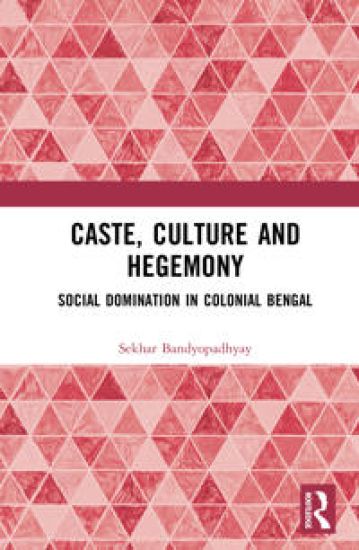
Caste, Culture and Hegemony

Caste, Culture and Hegemony

Sekhar Bandyopadhyay

TAYLOR FRANCIS LTD
2025
sidottu
This book looks at how the caste system has withstood resistance from below and survived the challenge of colonial modernity. By using empirical data from Bengal, it explores how Hindu caste society has sought to maintain its cultural hegemony and structural cohesion by frustrating reformist endeavours, by co-opting challenges by the Dalit and by marginalizing internal dissidence during the colonial period. It draws on case studies of early cultural encounters between 'high' Brahmanical tradition and the more egalitarian 'popular' religious cults of the lower castes It also examines the Hindu 'Partition' campaign, which tended to appropriate dalit autonomous politics and made Hinduism the foundation of an emergent Indian national identity. The book will be of use to scholars and researchers of history, political science, religion, minority studies, gender studies and South Asian studies.
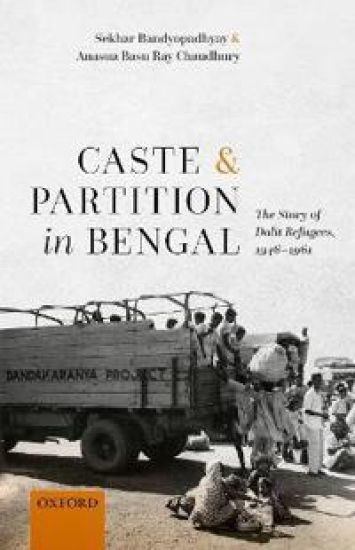
Caste and Partition in Bengal

Caste and Partition in Bengal

Sekhar Bandyopadhyay; Anasua Basu Ray Chaudhury

Oxford University Press
2022
sidottu
The book seeks to situate caste as a discursive category in the discussion of Partition in Bengal. In conventional narratives of Partition, the role of the Dalit or the Scheduled Castes is either completely ignored or mentioned in passing. The authors addresse this discursive absence and argues that in Bengal the Dalits were neither passive onlookers nor accidental victims of Partition politics and violence, which ruptured their unity and weakened their political autonomy. They were the worst victims of Partition. When the Dalit peasants of Eastern Bengal began to migrate to India after 1950, they were seen as the 'burden' of a frail economy of West Bengal, and the Indian state did not provide them with a proper rehabilitation package. They were first segregated in fenced refugee camps where life was unbearable, and then dispersed to other parts of India - first to the Andaman Islands and the neighbouring states, and then to the inhospitable terrains of Dandakaranya, where they could be used as cheap labour for various development projects. This book looks critically at their participation in Partition politics, the reasons for their migration three years after Partition, their insufferable life and struggles in the refugee camps, their negotiations with caste and gender identities in these new environments, their organized protests against camp maladministration, and finally their satyagraha campaigns against the Indian state's refugee dispersal policy. This book looks at how refugee politics impacted Dalit identity and protest movements in post-Partition West Bengal.
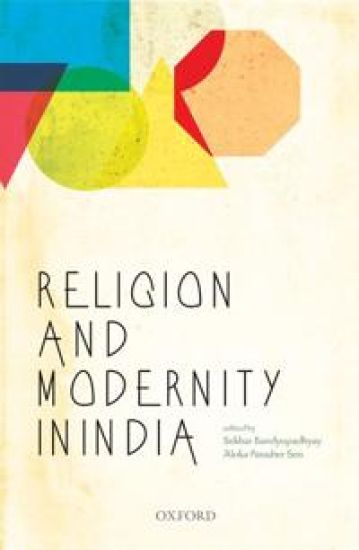
Religion and Modernity in India

Religion and Modernity in India

Sekhar Bandyopadhyay

OUP India
2017
sidottu
Modernity, which emphasizes the relegation of religion firmly to an individual's private life, is a challenging idea for any culture. In India it faces a particularly unusual problem: the persistence of numerous traditional and religious practices means that religion and modernity co-habit here in a complex, plural, transient, and historically evolving relationship. Religion and Modernity in India explores this complex relationship through a series of case studies on the quotidian experiences of people practising a variety of religions. It presents the dynamically interacting textures of society engaging with modernity in divergent ways, both historically and in contemporary times. The essays in this collection consciously bring in the idea of inclusivity by factoring in the small and local contexts. They raise important questions about marginality and sexuality, and discuss the oral and cultural traditions of both mainstream and marginal communities such as tribal communities and women. In doing so, they put forward the perspectives of groups that represent difference but at the same time are linked to a larger whole.
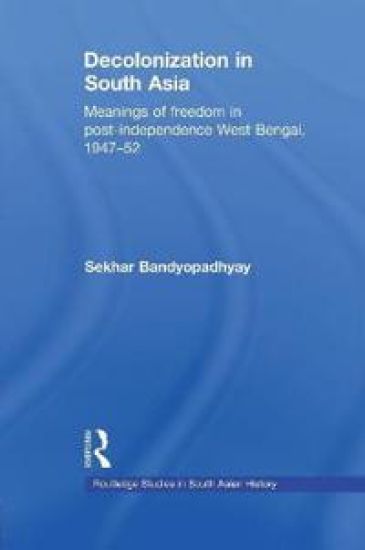
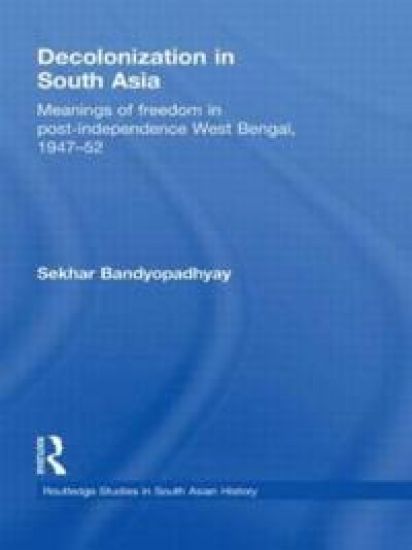
Decolonization in South Asia

Decolonization in South Asia

Sekhar Bandyopadhyay

Routledge
2012
nidottu
This book explores the meanings and complexities of India’s experience of transition from colonial to the post-colonial period. It focuses on the first five years – from independence on 15th August 1947 to the first general election in January 1952 – in the politics of West Bengal, the new Indian province that was created as a result of the Partition. The author, a specialist on the history of modern India, discusses what freedom actually meant to various individuals, communities and political parties, how they responded to it, how they extended its meaning and how in their anxiety to confront the realities of free India, they began to invent new enemies of their newly acquired freedom. By emphasising the representations of popular mentality rather than the institutional changes brought in by the process of decolonization, he draws attention to other concerns and anxieties that were related to the problems of coming to terms with the newly achieved freedom and the responsibility of devising independent rules of governance that would suit the historic needs of a pluralist nation. Decolonization in South Asia analyses the transitional politics of West Bengal in light of recent developments in postcolonial theory on nationalism, treating the ‘nation’ as a space for contestation, rather than a natural breeding ground for homogeneity in the complex political scenario of post-independence India. It will appeal to academics interested in political science, sociology, social anthropology and cultural and Asian studies.
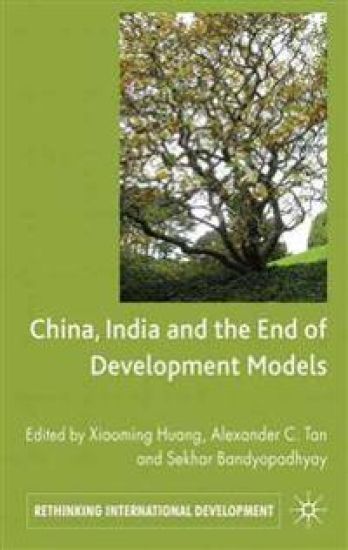
China, India and the End of Development Models Indian Edition

China, India and the End of Development Models Indian Edition

Xiaoming Huang; Alex C. Tan; Sekhar Bandyopadhyay

Palgrave Macmillan
2011
sidottu
Promoting the understanding of the impressive economic growth and social transformation in China and India, the authors demonstrate the diverse economic, political, social, cultural, international and historical conditions in these two developing countries and point out the theoretical problems of comparative development models in particular.
Decolonization in South Asia

Decolonization in South Asia

Sekhar Bandyopadhyay

Routledge
2009
sidottu
This book explores the meanings and complexities of India’s experience of transition from colonial to the post-colonial period. It focuses on the first five years – from independence on 15th August 1947 to the first general election in January 1952 – in the politics of West Bengal, the new Indian province that was created as a result of the Partition. The author, a specialist on the history of modern India, discusses what freedom actually meant to various individuals, communities and political parties, how they responded to it, how they extended its meaning and how in their anxiety to confront the realities of free India, they began to invent new enemies of their newly acquired freedom. By emphasising the representations of popular mentality rather than the institutional changes brought in by the process of decolonization, he draws attention to other concerns and anxieties that were related to the problems of coming to terms with the newly achieved freedom and the responsibility of devising independent rules of governance that would suit the historic needs of a pluralist nation. Decolonization in South Asia analyses the transitional politics of West Bengal in light of recent developments in postcolonial theory on nationalism, treating the ‘nation’ as a space for contestation, rather than a natural breeding ground for homogeneity in the complex political scenario of post-independence India. It will appeal to academics interested in political science, sociology, social anthropology and cultural and Asian studies.