Kirjojen hintavertailu – 12 859 828 kirjaa ja 27 kauppaa

Kirjailija

Serdar Yüksel

Kirjat ja teokset yhdessä paikassa: 6 kirjaa, julkaisuja vuosilta 2013–2025, suosituimpiin kuuluu Stochastic Networked Control Systems. Vertaile teosten hintoja ja tarkista saatavuus suomalaisista kirjakaupoista.

6 kirjaa

Kirjojen julkaisuvuodet: 2013–2025.

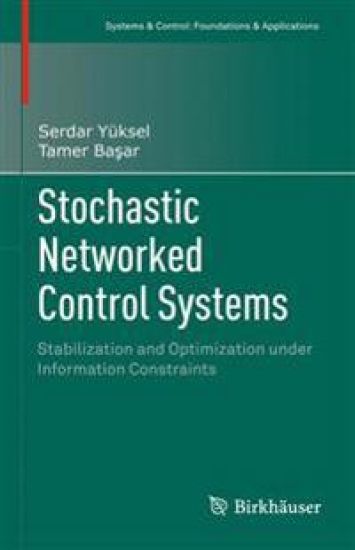
Stochastic Networked Control Systems

Stochastic Networked Control Systems

Serdar Yüksel; Tamer Basar

Birkhauser Boston Inc
2015
nidottu
Networked control systems are increasingly ubiquitous today, with applications ranging from vehicle communication and adaptive power grids to space exploration and economics. The optimal design of such systems presents major challenges, requiring tools from various disciplines within applied mathematics such as decentralized control, stochastic control, information theory, and quantization. A thorough, self-contained book, Stochastic Networked Control Systems: Stabilization and Optimization under Information Constraints aims to connect these diverse disciplines with precision and rigor, while conveying design guidelines to controller architects. Unique in the literature, it lays a comprehensive theoretical foundation for the study of networked control systems, and introduces an array of concrete tools for work in the field. Salient features included: · Characterization, comparison and optimal design of information structures in static and dynamic teams. Operational, structural and topological properties of information structures in optimal decision making, with a systematic program for generating optimal encoding and control policies. The notion of signaling, and its utilization in stabilization and optimization of decentralized control systems. · Presentation of mathematical methods for stochastic stability of networked control systems using random-time, state-dependent drift conditions and martingale methods. · Characterization and study of information channels leading to various forms of stochastic stability such as stationarity, ergodicity, and quadratic stability; and connections with information and quantization theories. Analysis of various classes of centralized and decentralized control systems. · Jointly optimal design of encoding and control policies over various information channels and under general optimization criteria, including a detailed coverage of linear-quadratic-Gaussian models. · Decentralized agreement and dynamic optimization under information constraints. This monograph is geared toward a broad audience of academic and industrial researchers interested in control theory, information theory, optimization, economics, and applied mathematics. It could likewise serve as a supplemental graduate text. The reader is expected to have some familiarity with linear systems, stochastic processes, and Markov chains, but the necessary background can also be acquired in part through the four appendices included at the end. · Characterization, comparison and optimal design of information structures in static and dynamic teams. Operational, structural and topological properties of informationstructures in optimal decision making, with a systematic program for generating optimal encoding and control policies. The notion of signaling, and its utilization in stabilization and optimization of decentralized control systems. · Presentation of mathematical methods for stochastic stability of networked control systems using random-time, state-dependent drift conditions and martingale methods. · Characterization and study of information channels leading to various forms of stochastic stability such as stationarity, ergodicity, and quadratic stability; and connections with information and quantization theories. Analysis of various classes of centralized and decentralized control systems. · Jointly optimal design of encoding and control policies over various information channels and under general optimization criteria, including a detailed coverage of linear-quadratic-Gaussian models. · Decentralized agreement and dynamic optimization under information constraints. This monograph is geared toward a broad audience of academic and industrial researchers interested in control theory, information theory, optimization, economics, and applied mathematics. It could likewiseserve as a supplemental graduate text. The reader is expected to have some familiarity with linear systems, stochastic processes, and Markov chains, but the necessary background can also be acquired in part through the four appendices included at the end.
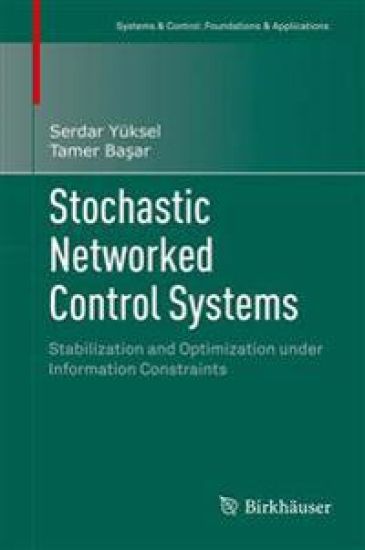
Stochastic Networked Control Systems

Stochastic Networked Control Systems

Serdar Yüksel; Tamer Basar

Birkhauser Boston Inc
2013
sidottu
Networked control systems are increasingly ubiquitous today, with applications ranging from vehicle communication and adaptive power grids to space exploration and economics. The optimal design of such systems presents major challenges, requiring tools from various disciplines within applied mathematics such as decentralized control, stochastic control, information theory, and quantization. A thorough, self-contained book, Stochastic Networked Control Systems: Stabilization and Optimization under Information Constraints aims to connect these diverse disciplines with precision and rigor, while conveying design guidelines to controller architects. Unique in the literature, it lays a comprehensive theoretical foundation for the study of networked control systems, and introduces an array of concrete tools for work in the field. Salient features included: · Characterization, comparison and optimal design of information structures in static and dynamic teams. Operational, structural and topological properties of information structures in optimal decision making, with a systematic program for generating optimal encoding and control policies. The notion of signaling, and its utilization in stabilization and optimization of decentralized control systems. · Presentation of mathematical methods for stochastic stability of networked control systems using random-time, state-dependent drift conditions and martingale methods. · Characterization and study of information channels leading to various forms of stochastic stability such as stationarity, ergodicity, and quadratic stability; and connections with information and quantization theories. Analysis of various classes of centralized and decentralized control systems. · Jointly optimal design of encoding and control policies over various information channels and under general optimization criteria, including a detailed coverage of linear-quadratic-Gaussian models. · Decentralized agreement and dynamic optimization under information constraints. This monograph is geared toward a broad audience of academic and industrial researchers interested in control theory, information theory, optimization, economics, and applied mathematics. It could likewise serve as a supplemental graduate text. The reader is expected to have some familiarity with linear systems, stochastic processes, and Markov chains, but the necessary background can also be acquired in part through the four appendices included at the end. · Characterization, comparison and optimal design of information structures in static and dynamic teams. Operational, structural and topological properties of informationstructures in optimal decision making, with a systematic program for generating optimal encoding and control policies. The notion of signaling, and its utilization in stabilization and optimization of decentralized control systems. · Presentation of mathematical methods for stochastic stability of networked control systems using random-time, state-dependent drift conditions and martingale methods. · Characterization and study of information channels leading to various forms of stochastic stability such as stationarity, ergodicity, and quadratic stability; and connections with information and quantization theories. Analysis of various classes of centralized and decentralized control systems. · Jointly optimal design of encoding and control policies over various information channels and under general optimization criteria, including a detailed coverage of linear-quadratic-Gaussian models. · Decentralized agreement and dynamic optimization under information constraints. This monograph is geared toward a broad audience of academic and industrial researchers interested in control theory, information theory, optimization, economics, and applied mathematics. It could likewiseserve as a supplemental graduate text. The reader is expected to have some familiarity with linear systems, stochastic processes, and Markov chains, but the necessary background can also be acquired in part through the four appendices included at the end.
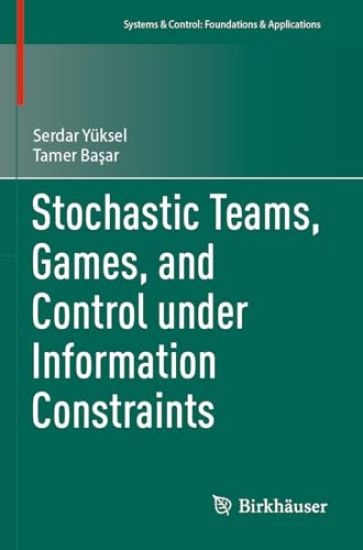
Stochastic Teams, Games, and Control under Information Constraints

Stochastic Teams, Games, and Control under Information Constraints

Serdar Yüksel; Tamer Basar

BIRKHAUSER VERLAG AG
2025
nidottu
This monograph presents a mathematically rigorous and accessible treatment of the interaction between information, decision, control, and probability in single-agent and multi-agent systems. The book provides a comprehensive and unified theory of information structures for stochastic control, stochastic teams, stochastic games, and networked control systems. Part I of the text is concerned with a general mathematical theory of information structures for stochastic teams, leading to systematic characterizations and classifications, geometric and topological properties, implications on existence, approximations and relaxations, their comparison, and regularity of optimal solutions in information. Information structures in stochastic games are then considered in Part II, and the dependence of equilibrium solutions and behavior on information is demonstrated. Part III studies information design through information theory in networked control systems - both linear and nonlinear - and discusses optimality and stability criteria. Finally, Part IV introduces information and signaling games under several solution concepts, with applications to prior mismatch, cost mismatch and privacy, reputation games and jamming. This text will be a valuable resource for researchers and graduate students interested in control theory, information theory, statistics, game theory, and applied mathematics. Readers should be familiar with the basics of linear systems theory, stochastic processes, and Markov chains.
Stochastic Teams, Games, and Control under Information Constraints

Stochastic Teams, Games, and Control under Information Constraints

Serdar Yüksel; Tamer Basar

BIRKHAUSER VERLAG AG
2024
sidottu
This monograph presents a mathematically rigorous and accessible treatment of the interaction between information, decision, control, and probability in single-agent and multi-agent systems. The book provides a comprehensive and unified theory of information structures for stochastic control, stochastic teams, stochastic games, and networked control systems. Part I of the text is concerned with a general mathematical theory of information structures for stochastic teams, leading to systematic characterizations and classifications, geometric and topological properties, implications on existence, approximations and relaxations, their comparison, and regularity of optimal solutions in information. Information structures in stochastic games are then considered in Part II, and the dependence of equilibrium solutions and behavior on information is demonstrated. Part III studies information design through information theory in networked control systems – both linear and nonlinear – and discusses optimality and stability criteria. Finally, Part IV introduces information and signaling games under several solution concepts, with applications to prior mismatch, cost mismatch and privacy, reputation games and jamming. This text will be a valuable resource for researchers and graduate students interested in control theory, information theory, statistics, game theory, and applied mathematics. Readers should be familiar with the basics of linear systems theory, stochastic processes, and Markov chains.
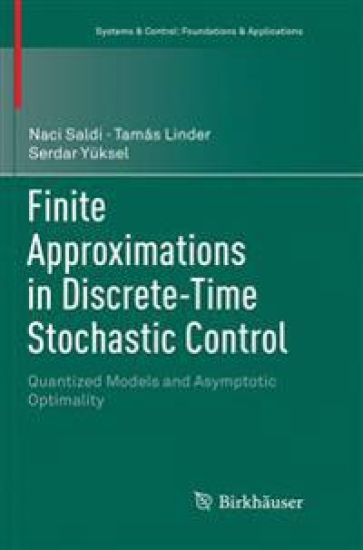
Finite Approximations in Discrete-Time Stochastic Control

Finite Approximations in Discrete-Time Stochastic Control

Naci Saldi; Tamás Linder; Serdar Yüksel

Springer Nature Switzerland AG
2019
nidottu
In a unified form, this monograph presents fundamental results on the approximation of centralized and decentralized stochastic control problems, with uncountable state, measurement, and action spaces. It demonstrates how quantization provides a system-independent and constructive method for the reduction of a system with Borel spaces to one with finite state, measurement, and action spaces. In addition to this constructive view, the book considers both the information transmission approach for discretization of actions, and the computational approach for discretization of states and actions. Part I of the text discusses Markov decision processes and their finite-state or finite-action approximations, while Part II builds from there to finite approximations in decentralized stochastic control problems. This volume is perfect for researchers and graduate students interested in stochastic controls. With the tools presented, readers will be able to establish the convergence of approximation models to original models and the methods are general enough that researchers can build corresponding approximation results, typically with no additional assumptions.
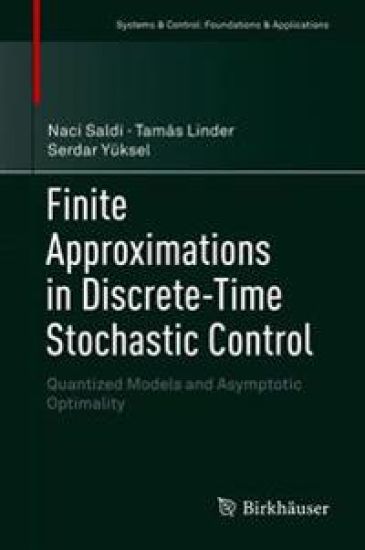
Finite Approximations in Discrete-Time Stochastic Control

Finite Approximations in Discrete-Time Stochastic Control

Naci Saldi; Tamás Linder; Serdar Yüksel

Birkhauser Verlag AG
2018
sidottu
In a unified form, this monograph presents fundamental results on the approximation of centralized and decentralized stochastic control problems, with uncountable state, measurement, and action spaces. It demonstrates how quantization provides a system-independent and constructive method for the reduction of a system with Borel spaces to one with finite state, measurement, and action spaces. In addition to this constructive view, the book considers both the information transmission approach for discretization of actions, and the computational approach for discretization of states and actions. Part I of the text discusses Markov decision processes and their finite-state or finite-action approximations, while Part II builds from there to finite approximations in decentralized stochastic control problems. This volume is perfect for researchers and graduate students interested in stochastic controls. With the tools presented, readers will be able to establish the convergence of approximation models to original models and the methods are general enough that researchers can build corresponding approximation results, typically with no additional assumptions.