Kirjojen hintavertailu – 12 859 818 kirjaa ja 27 kauppaa

Kirjailija

Serge Alinhac

Kirjat ja teokset yhdessä paikassa: 3 kirjaa, julkaisuja vuosilta 2007–2011, suosituimpiin kuuluu Hyperbolic Partial Differential Equations. Vertaile teosten hintoja ja tarkista saatavuus suomalaisista kirjakaupoista.

3 kirjaa

Kirjojen julkaisuvuodet: 2007–2011.

Blowup for Nonlinear Hyperbolic Equations

Blowup for Nonlinear Hyperbolic Equations

Serge Alinhac

Springer-Verlag New York Inc.
2011
nidottu
The content of this book corresponds to a one-semester course taught at the University of Paris-Sud (Orsay) in the spring 1994. It is accessible to students or researchers with a basic elementary knowledge of Partial Dif- ferential Equations, especially of hyperbolic PDE (Cauchy problem, wave operator, energy inequality, finite speed of propagation, symmetric systems, etc.). This course is not some final encyclopedic reference gathering all avail- able results. We tried instead to provide a short synthetic view of what we believe are the main results obtained so far, with self-contained proofs. In fact, many of the most important questions in the field are still completely open, and we hope that this monograph will give young mathe- maticians the desire to perform further research. The bibliography, restricted to papers where blowup is explicitly dis- cussed, is the only part we tried to make as complete as possible (despite the new preprints circulating everyday) j the references are generally not mentioned in the text, but in the Notes at the end of each chapter. Basic references corresponding best to the content of these Notes are the books by Courant and Friedrichs [CFr], Hormander [HoI] and [Ho2], Majda [Ma] and Smoller [Sm], and the survey papers by John [J06], Strauss [St] and Zuily [Zu].
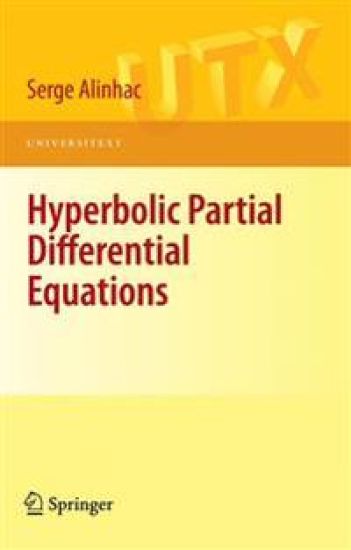
Hyperbolic Partial Differential Equations

Hyperbolic Partial Differential Equations

Serge Alinhac

Springer-Verlag New York Inc.
2009
nidottu
The aim of this book is to present hyperbolic partial di?erential equations at an elementary level. In fact, the required mathematical background is only a third year university course on di?erential calculus for functions of several variables. No functional analysis knowledge is needed, nor any distribution theory (with the exception of shock waves mentioned below). k All solutions appearing in the text are piecewise classical C solutions. Beyond the simpli?cations it allows, there are several reasons for this choice: First, we believe that all main features of hyperbolic partial d- ferential equations (PDE) (well-posedness of the Cauchy problem, ?nite speed of propagation, domains of determination, energy inequalities, etc. ) canbedisplayedinthiscontext. Wehopethatthisbookitselfwillproveour belief. Second,allproperties,solutionformulas,andinequalitiesestablished here in the context of smooth functions can be readily extended to more general situations (solutions in Sobolev spaces or temperate distributions, etc. ) by simple standard procedures of functional analysis or distribution theory, which are “external” to the theory of hyperbolic equations: The deep mathematical content of the theorems is already to be found in the statements and proofs of this book. The last reason is this: We do hope that many readers of this book will eventually do research in the ?eld that seems to us the natural continuation of the subject: nonlinear hyp- bolic systems (compressible ?uids, general relativity theory, etc. ).
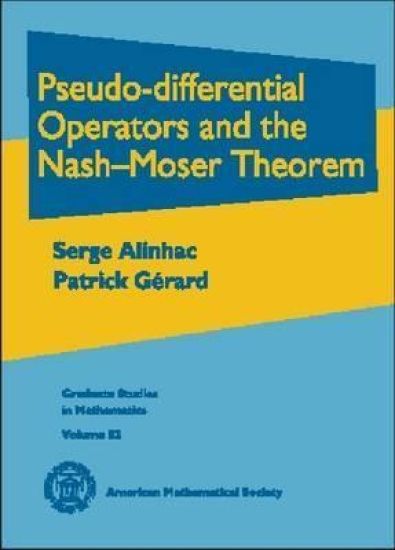
Pseudo-differential Operators and the Nash-Moser Theorem

Pseudo-differential Operators and the Nash-Moser Theorem

Serge Alinhac; Patrick Gerard; Stephen S. (TRN) Wilson

Amer Mathematical Society
2007
sidottu
This book presents two essential and apparently unrelated subjects. The first, microlocal analysis and the theory of pseudo-differential operators, is a basic tool in the study of partial differential equations and in analysis on manifolds. The second, the Nash-Moser theorem, continues to be fundamentally important in geometry, dynamical systems and nonlinear PDE. Each of the subjects, which are of interest in their own right as well as for applications, can be learned separately. But the book shows the deep connections between the two themes, particularly in the middle part, which is devoted to Littlewood-Paley theory, dyadic analysis, and the paradifferential calculus and its application to interpolation inequalities. An important feature is the elementary and self-contained character of the text, to which many exercises and an introductory Chapter $0$ with basic material have been added. This makes the book readable by graduate students or researchers from one subject who are interested in becoming familiar with the other. It can also be used as a textbook for a graduate course on nonlinear PDE or geometry.