Kirjojen hintavertailu – 12 859 818 kirjaa ja 27 kauppaa

Kirjailija

Serge Lang

Kirjat ja teokset yhdessä paikassa: 79 kirjaa, julkaisuja vuosilta 1976–2019, suosituimpiin kuuluu Undergraduate Algebra. Vertaile teosten hintoja ja tarkista saatavuus suomalaisista kirjakaupoista.

79 kirjaa

Kirjojen julkaisuvuodet: 1976–2019.

Calculus of Several Variables

Calculus of Several Variables

Serge Lang

Springer-Verlag New York Inc.
1987
sidottu
This is a new, revised edition of this widely known text. All of the basic topics in calculus of several variables are covered. The presentation is self-contained, assuming only a knowledge of basic calculus in one variable. Many completely worked-out problems have been included.
Linear Algebra

Linear Algebra

Serge Lang

Springer-Verlag New York Inc.
1987
sidottu

Halvin toimitettuna 46,50 €

Linear Algebra is intended for a one-term course at the junior or senior level. It begins with an exposition of the basic theory of vector spaces and proceeds to explain the fundamental structure theorems for linear maps, including eigenvectors and eigenvalues, quadric and hermitian forms, diagonalization of symmetric, hermitian, and unitary linear maps and matrices, triangulation, and Jordan canonical form. The book also includes a useful chapter on convex sets and the finite-dimensional Krein-Milman theorem. The presentation is aimed at the student who has already had some exposure to the elementary theory of matrices, determinants, and linear maps. However, the book is logically self-contained. In this new edition, many parts of the book have been rewritten and reorganized, and new exercises have been added.
A First Course in Calculus

A First Course in Calculus

Serge Lang

Springer-Verlag New York Inc.
1986
sidottu
This fifth edition of Lang's caclulus book covers all of the topics traditionally taught in the first-year calculus sequence. Each section contains examples and applications of the topic covered and the back of the book contains detailed solutions to a large number of the exercises which constitutes one of the main changes from previous editions.
Introduction to Linear Algebra

Introduction to Linear Algebra

Serge Lang

Springer-Verlag New York Inc.
1985
sidottu

Halvin toimitettuna 52,70 €

This is a short text in linear algebra, intended for a one-term course. In the first chapter, Lang discusses the relation between the geometry and the algebra underlying the subject, and gives concrete examples of the notions which appear later in the book. He then starts with a discussion of linear equations, matrices and Gaussian elimination, and proceeds to discuss vector spaces, linear maps, scalar products, determinants, and eigenvalues. The book contains a large number of exercises, some of the routine computational type, while others are conceptual.
Math!

Math!

Serge Lang

Springer-Verlag New York Inc.
1985
nidottu
Dieses Buch enthalt eine Sammlung von Dialogen des bekannten Mathematikers Serge Lang mit Schulern. Serge Lang behandelt die Schuler als seinesgleichen und zeigt ihnen mit dem ihm eigenen lebendigen Stil etwas vom Wesen des mathematischen Denkens. Die Begegnungen zwischen Lang und den Schulern sind nach Bandaufnahmen aufgezeichnet worden und daher authentisch und lebendig. Das Buch stellt einen frischen und neuartigen Ansatz fur Lehren, Lernen und Genuss von Mathematik vor. Das Buch ist von grossem Interesse fur Lehrer und Schule
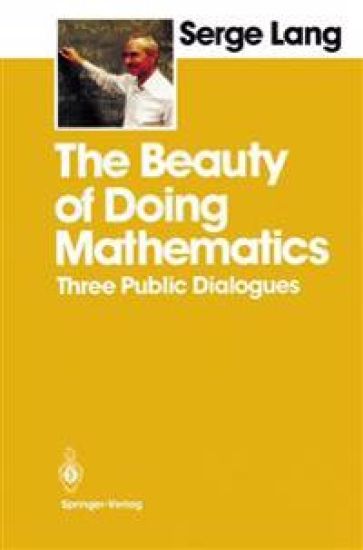
The Beauty of Doing Mathematics

The Beauty of Doing Mathematics

Serge Lang

Springer-Verlag New York Inc.
1985
nidottu
If someone told you that mathematics is quite beautiful, you might be surprised. But you should know that some people do mathematics all their lives, and create mathematics, just as a composer creates music. Usually, every time a mathematician solves a problem, this gives rise to many oth­ ers, new and just as beautiful as the one which was solved. Of course, often these problems are quite difficult, and as in other disciplines can be understood only by those who have studied the subject with some depth, and know the subject well. In 1981, Jean Brette, who is responsible for the Mathematics Section of the Palais de la Decouverte (Science Museum) in Paris, invited me to give a conference at the Palais. I had never given such a conference before, to a non-mathematical public. Here was a challenge: could I communicate to such a Saturday afternoon audience what it means to do mathematics, and why one does mathematics? By "mathematics" I mean pure mathematics. This doesn't mean that pure math is better than other types of math, but I and a number of others do pure mathematics, and it's about them that I am now concerned. Math has a bad reputation, stemming from the most elementary levels. The word is in fact used in many different contexts. First, I had to explain briefly these possible contexts, and the one with which I wanted to deal.
Introduction to Algebraic and Abelian Functions

Introduction to Algebraic and Abelian Functions

Serge Lang

Springer-Verlag New York Inc.
1982
sidottu
Introduction to Algebraic and Abelian Functions is a self-contained presentation of a fundamental subject in algebraic geometry and number theory. For this revised edition, the material on theta functions has been expanded, and the example of the Fermat curves is carried throughout the text. This volume is geared toward a second-year graduate course, but it leads naturally to the study of more advanced books listed in the bibliography.
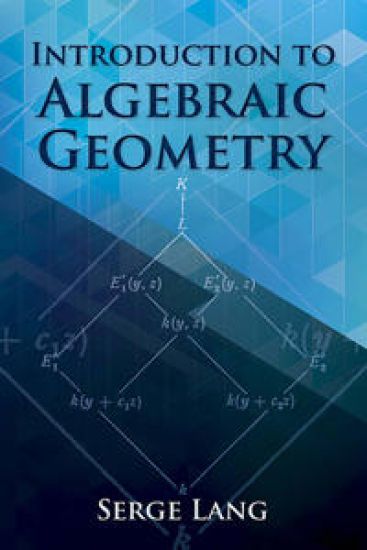
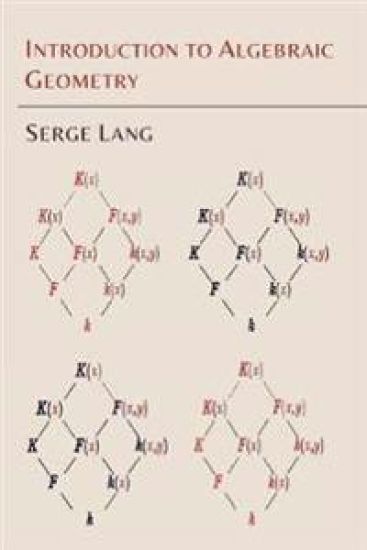
Introduction to Algebraic Geometry

Introduction to Algebraic Geometry

Serge Lang

Dover Publications Inc.
2019
nidottu
Author Serge Lang defines algebraic geometry as the study of systems of algebraic equations in several variables and of the structure that one can give to the solutions of such equations. The study can be carried out in four ways: analytical, topological, algebraico-geometric, and arithmetic. This volume offers a rapid, concise, and self-contained introductory approach to the algebraic aspects of the third method, the algebraico-geometric. The treatment assumes only familiarity with elementary algebra up to the level of Galois theory. Starting with an opening chapter on the general theory of places, the author advances to examinations of algebraic varieties, the absolute theory of varieties, and products, projections, and correspondences. Subsequent chapters explore normal varieties, divisors and linear systems, differential forms, the theory of simple points, and algebraic groups, concluding with a focus on the Riemann-Roch theorem. All the theorems of a general nature related to the foundations of the theory of algebraic groups are featured.
Abelian Varieties

Abelian Varieties

Serge Lang

Dover Publications Inc.
2019
nidottu
Referring to the work of the Norwegian mathematician Niels Henrik Abel (1802-29) in algebraic geometry, this monograph for advanced undergraduates and graduate students in mathematics requires some background in elementary qualitative algebraic geometry and the elementary theory of algebraic groups. First published in 1959 and reprinted later in the author's career without revision, it remains a basic advanced text in its field.
Algebraic Number Theory

Algebraic Number Theory

Serge Lang

Springer-Verlag New York Inc.
2013
nidottu
The present book gives an exposition of the classical basic algebraic and analytic number theory and supersedes my Algebraic Numbers, including much more material, e. g. the class field theory on which 1 make further comments at the appropriate place later. For different points of view, the reader is encouraged to read the collec­ tion of papers from the Brighton Symposium (edited by Cassels-Frohlich), the Artin-Tate notes on class field theory, Weil's book on Basic Number Theory, Borevich-Shafarevich's Number Theory, and also older books like those of W eber, Hasse, Hecke, and Hilbert's Zahlbericht. It seems that over the years, everything that has been done has proved useful, theo­ retically or as examples, for the further development of the theory. Old, and seemingly isolated special cases have continuously acquired renewed significance, often after half a century or more. The point of view taken here is principally global, and we deal with local fields only incidentally. For a more complete treatment of these, cf. Serre's book Corps Locaux. There is much to be said for a direct global approach to number fields. Stylistically, 1 have intermingled the ideal and idelic approaches without prejudice for either. 1 also include two proofs of the functional equation for the zeta function, to acquaint the reader with different techniques (in some sense equivalent, but in another sense, suggestive of very different moods).
Topics in Analytic Number Theory

Topics in Analytic Number Theory

Serge Lang

Literary Licensing, LLC
2013
sidottu
Topics in Analytic Number Theory is a comprehensive book written by Serge Lang, a renowned mathematician, that covers a wide range of topics in the field of analytic number theory. The book is divided into five parts and includes 18 chapters, each of which provides a detailed explanation of a specific topic in the field. Part I of the book covers the basic principles of analytic number theory, including the Riemann zeta function, prime numbers, and the distribution of primes. Part II delves deeper into the theory of the Riemann zeta function and its applications, including the prime number theorem and the Riemann hypothesis. Part III of the book focuses on modular forms and their applications in number theory, including the theory of elliptic curves and the Langlands program. Part IV covers topics related to automorphic forms and their connections to number theory, including the Selberg trace formula and the theory of L-functions. Finally, Part V of the book explores various topics related to algebraic number theory, including the theory of number fields, class field theory, and the Brauer-Siegel theorem. Overall, Topics in Analytic Number Theory is a highly informative and comprehensive book that provides a thorough introduction to the field of analytic number theory. It is an essential resource for mathematicians and researchers studying number theory, as well as advanced students looking to deepen their understanding of this fascinating subject. This scarce antiquarian book is a facsimile reprint of the old original and may contain some imperfections such as library marks and notations. Because we believe this work is culturally important, we have made it available as part of our commitment for protecting, preserving, and promoting the world's literature in affordable, high quality, modern editions, that are true to their original work.

Introduction to Algebraic Geometry: Interscience Tracts in Pure and Applied Mathematics, No. 5
Introduction to Algebraic Geometry is a comprehensive textbook written by Serge Lang that explores the fundamental concepts of algebraic geometry. The book is part of the Interscience Tracts in Pure and Applied Mathematics series and is the fifth volume in the series. The book is divided into three parts: the first part provides an introduction to the basic concepts of algebraic geometry, including algebraic sets, varieties, and morphisms. The second part delves deeper into the theory of algebraic curves, covering topics such as intersection theory, Riemann-Roch theorem, and Abel's theorem. The third part covers the theory of algebraic surfaces, including the classification of surfaces, the Hodge index theorem, and the Enriques-Kodaira classification. Throughout the book, Lang emphasizes the importance of understanding the geometric intuition behind the algebraic concepts. The book is written in a clear and concise manner, making it accessible to both graduate students and researchers in the field of mathematics. It also includes numerous examples and exercises to reinforce the concepts covered in each chapter. Overall, Introduction to Algebraic Geometry is an essential resource for anyone interested in learning about the theory of algebraic geometry. It provides a solid foundation for further study in the field and is a valuable reference for researchers working in related areas of mathematics. Additional Editor Is J. J. Stoker. This scarce antiquarian book is a facsimile reprint of the old original and may contain some imperfections such as library marks and notations. Because we believe this work is culturally important, we have made it available as part of our commitment for protecting, preserving, and promoting the world's literature in affordable, high quality, modern editions, that are true to their original work.
Introduction to Linear Algebra

Introduction to Linear Algebra

Serge Lang

Springer-Verlag New York Inc.
2012
nidottu

Halvin toimitettuna 71,90 €

This is a short text in linear algebra, intended for a one-term course. In the first chapter, Lang discusses the relation between the geometry and the algebra underlying the subject, and gives concrete examples of the notions which appear later in the book. He then starts with a discussion of linear equations, matrices and Gaussian elimination, and proceeds to discuss vector spaces, linear maps, scalar products, determinants, and eigenvalues. The book contains a large number of exercises, some of the routine computational type, while others are conceptual.
Algebra

Algebra

Serge Lang

Springer-Verlag New York Inc.
2012
nidottu
From April 1999 Notices of the AMS, announcing that the author was awarded the Leroy P. Steele Prize for Mathematical Exposition for his many mathematics books: "Lang's Algebra changed the way graduate algebra is taught, retaining classical topics but introducing language and ways of thinking from category theory and homological algebra. It has affected all subsequent graduate-level algebra books." From MathSciNet's review of the first edition:"The author has an impressive knack for presenting the important and interesting ideas of algebra in just the "right" way, and he never gets bogged down in the dry formalism which pervades some parts of algebra." This book is intended as a basic text for a one-year course in Algebra at the graduate level, or as a useful reference for mathematicians and professionals who use higher-level algebra. This book successfully addresses all of the basic concepts of algebra. For the new edition, the author has added exercises and made numerous corrections to the text.
Real and Functional Analysis

Real and Functional Analysis

Serge Lang

Springer-Verlag New York Inc.
2012
nidottu
This book is meant as a text for a first year graduate course in analysis. Any standard course in undergraduate analysis will constitute sufficient preparation for its understanding, for instance, my Undergraduate Anal­ ysis. I assume that the reader is acquainted with notions of uniform con­ vergence and the like. In this third edition, I have reorganized the book by covering inte­ gration before functional analysis. Such a rearrangement fits the way courses are taught in all the places I know of. I have added a number of examples and exercises, as well as some material about integration on the real line (e.g. on Dirac sequence approximation and on Fourier analysis), and some material on functional analysis (e.g. the theory of the Gelfand transform in Chapter XVI). These upgrade previous exercises to sections in the text. In a sense, the subject matter covers the same topics as elementary calculus, viz. linear algebra, differentiation and integration. This time, however, these subjects are treated in a manner suitable for the training of professionals, i.e. people who will use the tools in further investiga­ tions, be it in mathematics, or physics, or what have you. In the first part, we begin with point set topology, essential for all analysis, and we cover the most important results.
Calculus of Several Variables

Calculus of Several Variables

Serge Lang

Springer-Verlag New York Inc.
2012
nidottu
The present course on calculus of several variables is meant as a text, either for one semester following A First Course in Calculus, or for a year if the calculus sequence is so structured. For a one-semester course, no matter what, one should cover the first four chapters, up to the law of conservation of energy, which provides a beautiful application of the chain rule in a physical context, and ties up the mathematics of this course with standard material from courses on physics. Then there are roughly two possibilities: One is to cover Chapters V and VI on maxima and minima, quadratic forms, critical points, and Taylor's formula. One can then finish with Chapter IX on double integration to round off the one-term course. The other is to go into curve integrals, double integration, and Green's theorem, that is Chapters VII, VIII, IX, and X, §1. This forms a coherent whole.