Kirjojen hintavertailu – 12 903 724 kirjaa ja 27 kauppaa

Kirjailija

Sergei V. Petrovskii

Kirjat ja teokset yhdessä paikassa: 6 kirjaa, julkaisuja vuosilta 2005–2019, suosituimpiin kuuluu Spatiotemporal Patterns in Ecology and Epidemiology. Vertaile teosten hintoja ja tarkista saatavuus suomalaisista kirjakaupoista.

6 kirjaa

Kirjojen julkaisuvuodet: 2005–2019.

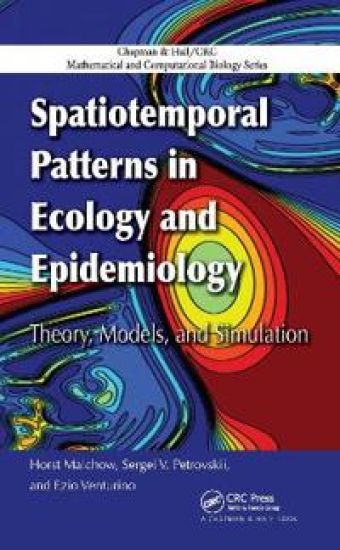
Spatiotemporal Patterns in Ecology and Epidemiology

Spatiotemporal Patterns in Ecology and Epidemiology

Horst Malchow; Sergei V. Petrovskii; Ezio Venturino

CRC Press
2019
nidottu
Although the spatial dimension of ecosystem dynamics is now widely recognized, the specific mechanisms behind species patterning in space are still poorly understood and the corresponding theoretical framework is underdeveloped. Going beyond the classical Turing scenario of pattern formation, Spatiotemporal Patterns in Ecology and Epidemiology: Theory, Models, and Simulation illustrates how mathematical modeling and numerical simulations can lead to greater understanding of these issues. It takes a unified approach to population dynamics and epidemiology by presenting several ecoepidemiological models where both the basic interspecies interactions of population dynamics and the impact of an infectious disease are explicitly considered. The book first describes relevant phenomena in ecology and epidemiology, provides examples of pattern formation in natural systems, and summarizes existing modeling approaches. The authors then explore nonspatial models of population dynamics and epidemiology. They present the main scenarios of spatial and spatiotemporal pattern formation in deterministic models of population dynamics. The book also addresses the interaction between deterministic and stochastic processes in ecosystem and epidemic dynamics, discusses the corresponding modeling approaches, and examines how noise and stochasticity affect pattern formation. Reviewing the significant progress made in understanding spatiotemporal patterning in ecological and epidemiological systems, this resource shows that mathematical modeling and numerical simulations are effective tools in the study of population ecology and epidemiology.
Exactly Solvable Models of Biological Invasion

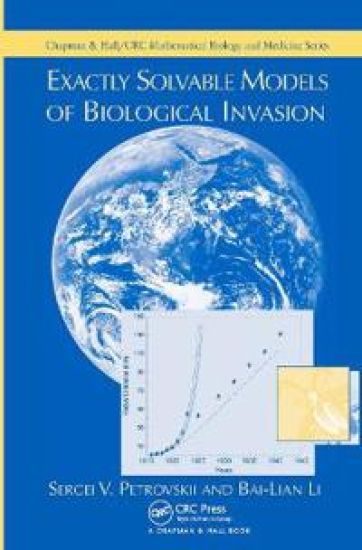
Exactly Solvable Models of Biological Invasion

Sergei V. Petrovskii; Bai-Lian Li

CRC Press
2019
nidottu
Much of our current knowledge on biological invasion was derived from field studies, but many recent advances relied heavily on mathematics and computing, particularly mathematical modeling. While numerical simulations are clearly a useful approach, they have some serious drawbacks. Approximations errors and the number of parameter values can have a significant impact on the simulation results, the extent of which often remains obscure. Such difficulties do not arise, however, when the problem can be solved analytically. Exactly Solvable Models of Biological Invasion demonstrates the advantages and methods of obtaining exact solutions of partial differential equations that describe nonlinear problems encountered in the study of invasive species spread. With emphasis on PDEs of diffusion-reaction type, the authors present a comprehensive collection of exactly solvable models and a unified, self-contained description of the relevant mathematical methods. In doing so, they also provide new insight into important issues such as the impact of the Allee effect, the impact of predation, and the interplay between different modes of species dispersal. Full calculation details make this presentation accessible to biologists as well as applied mathematicians, and a range of ecological examples and applications demonstrate the utility of exact methods in practice. Exact solutions provide an immediate, complete description of system dynamics for a wide class of initial conditions and serve as a convenient tool for testing numerical algorithms and codes used in more specialized studies. This book lays the groundwork for bringing the power of exactly solvable models to bear on real-world ecological problems.
The Mathematics Behind Biological Invasions

The Mathematics Behind Biological Invasions

Mark A. Lewis; Sergei V. Petrovskii; Jonathan R. Potts

Springer International Publishing AG
2018
nidottu
This book investigates the mathematical analysis of biological invasions. Unlike purely qualitative treatments of ecology, it draws on mathematical theory and methods, equipping the reader with sharp tools and rigorous methodology. Subjects include invasion dynamics, species interactions, population spread, long-distance dispersal, stochastic effects, risk analysis, and optimal responses to invaders. While based on the theory of dynamical systems, including partial differential equations and integrodifference equations, the book also draws on information theory, machine learning, Monte Carlo methods, optimal control, statistics, and stochastic processes. Applications to real biological invasions are included throughout. Ultimately, the book imparts a powerful principle: that by bringing ecology and mathematics together, researchers can uncover new understanding of, and effective response strategies to, biological invasions. It is suitable for graduate students and established researchers in mathematical ecology.
The Mathematics Behind Biological Invasions

The Mathematics Behind Biological Invasions

Mark A. Lewis; Sergei V. Petrovskii; Jonathan R. Potts

Springer International Publishing AG
2016
sidottu
This book investigates the mathematical analysis of biological invasions. Unlike purely qualitative treatments of ecology, it draws on mathematical theory and methods, equipping the reader with sharp tools and rigorous methodology. Subjects include invasion dynamics, species interactions, population spread, long-distance dispersal, stochastic effects, risk analysis, and optimal responses to invaders. While based on the theory of dynamical systems, including partial differential equations and integrodifference equations, the book also draws on information theory, machine learning, Monte Carlo methods, optimal control, statistics, and stochastic processes. Applications to real biological invasions are included throughout. Ultimately, the book imparts a powerful principle: that by bringing ecology and mathematics together, researchers can uncover new understanding of, and effective response strategies to, biological invasions. It is suitable for graduate students and established researchers in mathematical ecology.
Spatiotemporal Patterns in Ecology and Epidemiology

Spatiotemporal Patterns in Ecology and Epidemiology

Horst Malchow; Sergei V. Petrovskii; Ezio Venturino

Chapman Hall/CRC
2007
sidottu
Although the spatial dimension of ecosystem dynamics is now widely recognized, the specific mechanisms behind species patterning in space are still poorly understood and the corresponding theoretical framework is underdeveloped. Going beyond the classical Turing scenario of pattern formation, Spatiotemporal Patterns in Ecology and Epidemiology: Theory, Models, and Simulation illustrates how mathematical modeling and numerical simulations can lead to greater understanding of these issues. It takes a unified approach to population dynamics and epidemiology by presenting several ecoepidemiological models where both the basic interspecies interactions of population dynamics and the impact of an infectious disease are explicitly considered. The book first describes relevant phenomena in ecology and epidemiology, provides examples of pattern formation in natural systems, and summarizes existing modeling approaches. The authors then explore nonspatial models of population dynamics and epidemiology. They present the main scenarios of spatial and spatiotemporal pattern formation in deterministic models of population dynamics. The book also addresses the interaction between deterministic and stochastic processes in ecosystem and epidemic dynamics, discusses the corresponding modeling approaches, and examines how noise and stochasticity affect pattern formation. Reviewing the significant progress made in understanding spatiotemporal patterning in ecological and epidemiological systems, this resource shows that mathematical modeling and numerical simulations are effective tools in the study of population ecology and epidemiology.
Exactly Solvable Models of Biological Invasion

Exactly Solvable Models of Biological Invasion

Sergei V. Petrovskii; Bai-Lian Li

Chapman Hall/CRC
2005
sidottu
Much of our current knowledge on biological invasion was derived from field studies, but many recent advances relied heavily on mathematics and computing, particularly mathematical modeling. While numerical simulations are clearly a useful approach, they have some serious drawbacks. Approximations errors and the number of parameter values can have a significant impact on the simulation results, the extent of which often remains obscure. Such difficulties do not arise, however, when the problem can be solved analytically. Exactly Solvable Models of Biological Invasion demonstrates the advantages and methods of obtaining exact solutions of partial differential equations that describe nonlinear problems encountered in the study of invasive species spread. With emphasis on PDEs of diffusion-reaction type, the authors present a comprehensive collection of exactly solvable models and a unified, self-contained description of the relevant mathematical methods. In doing so, they also provide new insight into important issues such as the impact of the Allee effect, the impact of predation, and the interplay between different modes of species dispersal. Full calculation details make this presentation accessible to biologists as well as applied mathematicians, and a range of ecological examples and applications demonstrate the utility of exact methods in practice. Exact solutions provide an immediate, complete description of system dynamics for a wide class of initial conditions and serve as a convenient tool for testing numerical algorithms and codes used in more specialized studies. This book lays the groundwork for bringing the power of exactly solvable models to bear on real-world ecological problems.