Kirjojen hintavertailu – 12 903 725 kirjaa ja 27 kauppaa

Kirjailija

Seth Whidden

Kirjat ja teokset yhdessä paikassa: 7 kirjaa, julkaisuja vuosilta 2007–2024, suosituimpiin kuuluu Arthur Rimbaud. Vertaile teosten hintoja ja tarkista saatavuus suomalaisista kirjakaupoista.

7 kirjaa

Kirjojen julkaisuvuodet: 2007–2024.

Arthur Rimbaud

Arthur Rimbaud

Seth Whidden

Reaktion Books
2018
nidottu

Halvin toimitettuna 26,60 €

Before he had turned 21, Arthur Rimbaud (1854–1891) upended the house of French poetry and left it in shambles. What makes Rimbaud’s poetry important, argues Seth Whidden, is part of what makes his life so compelling: rebellion, audacity, creativity and exploration. Almost all of Rimbaud’s poems were written between the ages of fifteen and twenty. Against the backdrop of the crumbling Second Empire and the tumultuous Paris Commune, the poet took centuries-old traditions of French versification and picked them apart with an unmatched knowledge of how they fitted together. Combining sensuality with pastoral, parody, political satire, fable, eroticism and mystery, Rimbaud’s works range from traditional verse forms to prose-poetry and the two first free-verse poems written in French. By situating Rimbaud’s writing in Africa as part of a continuum that spans his entire life, this book offers a corrective to the traditional split between his life as a poet and his life afterwards. Written for general readers and students of literature alike, Arthur Rimbaud presents the original damned poet who continues to captivate readers, artists and writers all over the world.

Authority in Crisis in French Literature, 1850–1880
By the 1850s, the expansion of printing and distribution technologies provided writers with more readers and literary outlets than ever before, while the ever-changing political contexts occasioned by the revolutions of 1830 and 1848 brought about differing degrees of political, social, and literary censure and pressure. Seth Whidden examines crises of literary authority in nineteenth-century French literature, both in response to the attempts of the Second Empire (1852-1870) to restore the unquestioned imperial authority that had been established by Napoleon I and in the aftermath of the bloody Paris Commune of 1871. In each of his chapters, Whidden offers a representative case study highlighting one of several phenomena-literary collaboration, parody, destabilized poetic form, the substitution of one poetic or narrative voice with that of the man-that enabled challenges to the traditional status of the writer and, by extension, the political authority that it reflected. Whidden focuses on the play Le Supplice d’une femme (1865); the Cercle Zutiste, a group of writers, musicians, and artists who met regularly in the fall of 1871, only months after the fall of the Second Empire; Arthur Rimbaud’s Commune-era poems; and Jules Verne’s 1851 ’Un voyage en ballon,’ later reprinted as ’Un drame dans les airs’ in 1874. Whidden concludes with a futuristic look at authority and auctority as it pertains to midcentury writers taking stock of the weakened authority still possible in a post-Second Empire France and envisioning what kind of auctority is still to come.
Velocipedomania

Velocipedomania

Corry Cropper; Seth Whidden

Bucknell University Press,U.S.
2022
sidottu
When blacksmith Pierre Michaux affixed pedals to the front axle of a two-wheeled scooter with a seat, he helped kick off a craze known as velocipedomania, which swept France in the late 1860s. The immediate forerunner of the bicycle, the velocipede similarly reflected changing cultural attitudes and challenged gender norms. Velocipedomania is the first in-depth study of the velocipede fad and the popular culture it inspired. It explores how the device was hailed as a symbol of France’s cutting-edge technological advancements, yet also marketed as an invention with a noble pedigree, born from the nation’s cultural and literary heritage. Giving readers a window into the material culture and enthusiasms of Second Empire France, it provides the first English translations of 1869’s Manual of the Velocipede, 1868’s Note on Monsieur Michaux’s Velocipede, and the 1869 operetta Dagobert and his Velocipede. It also reprints scores of rare images from newspapers and advertisements, analyzing how these magnificent machines captured the era’s visual imagination. By looking at how it influenced French attitudes towards politics, national identity, technology, fashion, fitness, and gender roles, this book shows how the short-lived craze of velocipedomania had a big impact.
Velocipedomania

Velocipedomania

Corry Cropper; Seth Whidden

Bucknell University Press,U.S.
2022
nidottu
When blacksmith Pierre Michaux affixed pedals to the front axle of a two-wheeled scooter with a seat, he helped kick off a craze known as velocipedomania, which swept France in the late 1860s. The immediate forerunner of the bicycle, the velocipede similarly reflected changing cultural attitudes and challenged gender norms. Velocipedomania is the first in-depth study of the velocipede fad and the popular culture it inspired. It explores how the device was hailed as a symbol of France’s cutting-edge technological advancements, yet also marketed as an invention with a noble pedigree, born from the nation’s cultural and literary heritage. Giving readers a window into the material culture and enthusiasms of Second Empire France, it provides the first English translations of 1869’s Manual of the Velocipede, 1868’s Note on Monsieur Michaux’s Velocipede, and the 1869 operetta Dagobert and his Velocipede. It also reprints scores of rare images from newspapers and advertisements, analyzing how these magnificent machines captured the era’s visual imagination. By looking at how it influenced French attitudes towards politics, national identity, technology, fashion, fitness, and gender roles, this book shows how the short-lived craze of velocipedomania had a big impact.
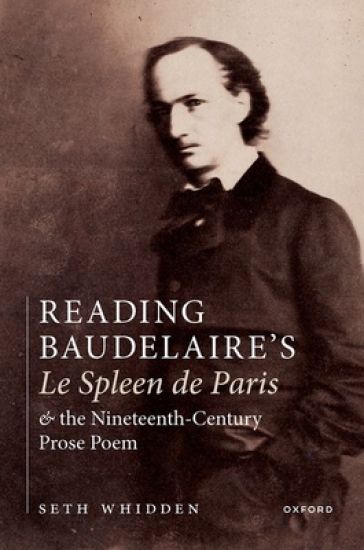
Reading Baudelaire's Le Spleen de Paris and the Nineteenth-Century Prose Poem
Through its readings of Charles Baudelaire's collection Le Spleen de Paris and other prose poems from the nineteenth century, this book considers the practice of reading prose poetry and how it might be different from reading poetry in verse. Among the numerous factors that helped shape the nascent modernity in Baudelaire's poetic prose are the poems' themes, forms, linguistic qualities, and modes. The contradictions identifiable at the level of prose poetry's discourse are similarly perceptible in other aspects of Baudelaire's poetic language, beyond the discursive: in the poems' formal considerations, which retain recognisable traces of verse despite their prose presentation; and, with respect to both poetic form and thematics, in the sights and sounds that contribute to their poeticity. With a focus on what makes prose texts poetic, this study sheds light on Baudelaire the practitioner of the prose poem, as he navigated and complicated the boundaries between verse, prose, and poetry. Rather than rejecting those categories, Baudelaire forges a poetic space in which the notions of poetry and prose are recast, juxtaposed in a delicate balance in a textual space they manage to share. This coexistence of poetry and prose--previously thought of as incompatible--is the underlying tension and framework that contributes importantly to the modernity of his prose poetry. In turn, this new mode of poetry calls for new modes of reading poetry and new ways of engaging with a text.
Authority in Crisis in French Literature, 1850–1880
By the 1850s, the expansion of printing and distribution technologies provided writers with more readers and literary outlets than ever before, while the ever-changing political contexts occasioned by the revolutions of 1830 and 1848 brought about differing degrees of political, social, and literary censure and pressure. Seth Whidden examines crises of literary authority in nineteenth-century French literature, both in response to the attempts of the Second Empire (1852-1870) to restore the unquestioned imperial authority that had been established by Napoleon I and in the aftermath of the bloody Paris Commune of 1871. In each of his chapters, Whidden offers a representative case study highlighting one of several phenomena-literary collaboration, parody, destabilized poetic form, the substitution of one poetic or narrative voice with that of the man-that enabled challenges to the traditional status of the writer and, by extension, the political authority that it reflected. Whidden focuses on the play Le Supplice d’une femme (1865); the Cercle Zutiste, a group of writers, musicians, and artists who met regularly in the fall of 1871, only months after the fall of the Second Empire; Arthur Rimbaud’s Commune-era poems; and Jules Verne’s 1851 ’Un voyage en ballon,’ later reprinted as ’Un drame dans les airs’ in 1874. Whidden concludes with a futuristic look at authority and auctority as it pertains to midcentury writers taking stock of the weakened authority still possible in a post-Second Empire France and envisioning what kind of auctority is still to come.
Leaving Parnassus

Leaving Parnassus

Seth Whidden

Editions Rodopi B.V.
2007
nidottu
Leaving Parnassus: The Lyric Subject in Verlaine and Rimbaud considers how the crisis of the lyric subject in the middle of the nineteenth century in France is a direct response to the aesthetic principles of Parnassian poetry, which dominated the second half of the century much more than critics often think. The poets considered here rebel against the strict confines of traditional and contemporary poetry and attempt to create radically new discursive practices. Specifically, the close readings of poems apply recent studies of subjectivity in poetry and focus on the works of Paul Verlaine and Arthur Rimbaud to see how each subverts the dominant tradition of French poetry in a unique way. Whereas previous studies considered isolated aspects of each poet’s lyric subject, Leaving Parnassus shows that the situation of the lyric is a source of subversion throughout the poets’ entire work, and as such it is crucial to our full understanding of their respective innovations.