Kirjojen hintavertailu – 12 903 724 kirjaa ja 27 kauppaa

Kirjailija

Shahid Javed Burki

Kirjat ja teokset yhdessä paikassa: 11 kirjaa, julkaisuja vuosilta 1988–2025, suosituimpiin kuuluu Pakistan. Vertaile teosten hintoja ja tarkista saatavuus suomalaisista kirjakaupoista.

11 kirjaa

Kirjojen julkaisuvuodet: 1988–2025.

Pakistan

Pakistan

Shahid Javed Burki

OUP Pakistan
2025
nidottu
There are several studies on Pakistan's external relations but none of them paint the picture on as wide a canvas as the one chosen for this work. Most studies deal with bilateral relations; however, the scope of this work is much wider. This book examines Pakistan's relations with India, China, the United States, and Afghanistan and several other countries in a dynamic framework. The author looks at Pakistan's external relations from several disciplinary angles and explains that it is difficult to fully comprehend economic changes—in particular, the influences on the making of public policy—without understanding the political, social, and cultural environment in which Pakistan's economy functions. Some of the topics discussed in the book are demography; geography; migrations; religion; climate change and global warning; American-China trade war; America's conflict with Iran; India's decision to absorb Kashmir as a 'territory' of the Indian Union; and the impact of international migration on the political systems in several Western nations.
Pakistan

Pakistan

Shahid Javed Burki

Routledge
2019
sidottu
Although it achieved independence in 1947, Pakistan still has not succeeded in integrating its diverse peoples into a nation?as its short yet turbulent history vividly demonstrates. The nation's search for stability is traced in this revised and updated introduction to Pakistan's political, economic, and social development. New chapters detail political developments since 1991, including the elections of 1993 and 1996. Economic changes, including the financial crisis that led to the fall of Benazir Bhutto's government in 1996, are given particular attention. Also included is an extensive analysis of the nuclear arms race between India and Pakistan, an issue of global concern.
Rising Powers and Global Governance

Rising Powers and Global Governance

Shahid Javed Burki

Palgrave Macmillan
2018
nidottu
This book reinforces the need to understand the sources of global change that is taking place and to accommodate it in the world political, social, and economic systems. Linking the United States, China, India, and Russia along with Europe and the Middle East, the author addresses demographics, international trade, technology, and climate change as global challenges that require cooperation in order to be solved. Both academics and policymakers will be enlightened, discovering ways of addressing global change by working together rather than through confrontation.
Rising Powers and Global Governance

Rising Powers and Global Governance

Shahid Javed Burki

Palgrave Macmillan
2016
sidottu
This book reinforces the need to understand the sources of global change that is taking place and to accommodate it in the world political, social, and economic systems. Linking the United States, China, India, and Russia along with Europe and the Middle East, the author addresses demographics, international trade, technology, and climate change as global challenges that require cooperation in order to be solved. Both academics and policymakers will be enlightened, discovering ways of addressing global change by working together rather than through confrontation.
Historical Dictionary of Pakistan

Historical Dictionary of Pakistan

Shahid Javed Burki

Rowman Littlefield
2015
sidottu
Pakistan is unlike most other countries in the emerging world. It is one of the two nations – the other being the state of Israel – founded on the basis of religion. Although it was created to provide a homeland for the Muslim community of British India, in its original form it was able to accommodate only about half of the people of Islamic faith who lived in the subcontinent. Pakistan’s birth in 1947 resulted in one of the largest movements of people in human history when some 14 million people left their homes, with 8 million Muslims leaving India for what is now Pakistan and 6 million Hindus and Sikhs moving in the opposite direction. This was the first large-scale incidence of ethnic cleansing the world was to witness. This fourth edition of Historical Dictionary of Pakistan covers its history through a chronology, an introductory essay, appendixes, and an extensive bibliography. The dictionary section has over 700 cross-referenced entries on important personalities, politics, economy, foreign relations, religion, and culture. This book is an excellent access point for students, researchers, and anyone wanting to know more about Pakistan.
South Asia in the New World Order

South Asia in the New World Order

Shahid Javed Burki

Routledge
2014
nidottu
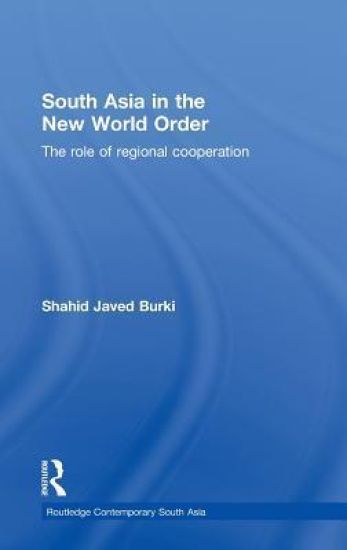
Rapid changes have taken place in the structure of the global economy, and this book looks at how South Asia can take advantage of these changes. The author argues that the developing global economy will be more complex than originally thought, that instead of a bipolar model with two countries, the US and China, at the centre, it will be multipolar with eight centres of economic activity, including India. The book goes on to suggest that in the context of such a model, there should be regional cooperation between India and its immediate neighbouring countries for South Asia to advance as an economic region. It argues that South Asia will need to look at its history, and that changes in attitudes, particularly in India and Pakistan, are necessary. The possible benefits to the region, in terms of increases in the rates of economic growth if the regional approach is adopted, are discussed. The book presents a useful contribution to studies in South Asia, as well as Asian Economics.
South Asia in the New World Order

South Asia in the New World Order

Shahid Javed Burki

Routledge
2011
sidottu
Rapid changes have taken place in the structure of the global economy, and this book looks at how South Asia can take advantage of these changes. The author argues that the developing global economy will be more complex than originally thought, that instead of a bipolar model with two countries, the US and China, at the centre, it will be multipolar with eight centres of economic activity, including India. The book goes on to suggest that in the context of such a model, there should be regional cooperation between India and its immediate neighbouring countries for South Asia to advance as an economic region. It argues that South Asia will need to look at its history, and that changes in attitudes, particularly in India and Pakistan, are necessary. The possible benefits to the region, in terms of increases in the rates of economic growth if the regional approach is adopted, are discussed. The book presents a useful contribution to studies in South Asia, as well as Asian Economics.
Sustaining Reform with a US–Pakistan Free Trade Agreement

Sustaining Reform with a US–Pakistan Free Trade Agreement

Gary Clyde Hufbauer; Shahid Javed Burki

The Peterson Institute for International Economics
2006
nidottu
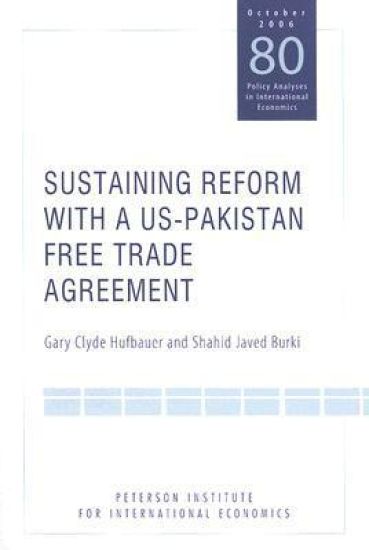
The United States and Pakistan established diplomatic relations in 1947, shortly after Pakistan gained its independence. Since then, relations have alternated between episodes of close partnership and sharp friction-reflecting the ups and downs of global and regional geopolitics. The tides of foreign policy have correspondingly affected trade and investment. Post-September 11th diplomacy has now created a strong relationship between Pakistan and the United States. Would a free trade agreement between these two counties benefit them? What type of economic benefits could be expected? This new book looks at this question and many others and concludes that a free trade agreement between the United States and Pakistan would benefit both countries.
Changing Perceptions and Altered Reality

Changing Perceptions and Altered Reality

Shahid Javed Burki; World Bank

World Bank Publications
2000
nidottu
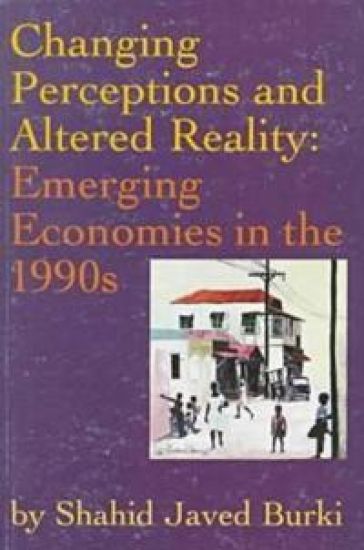
There was the economic development 'miracle' in the East Asia Region, then the great crash. In the Latin American and Caribbean region, there remain question marks, little increased growth, and no 'miracle' in sight. Given the opportunity to observe both of these regions first hand over a 25-year period, Shahid Javed Burki, relates his observations, perceptions, and comparisons of these diverse emerging economies. As he departs the World Bank, Mr. Burki leaves this contribution to the store of Bank knowledge for future reference. It is both a professional and personal narrative of two dynamic regions undergoing tremendous change. Mr. Burki shares his unique insight into these economies and his own changing perceptions during his work in the Latin American and Caribbean region.
Pakistan

Pakistan

Shahid Javed Burki

Westview Press Inc
1999
nidottu
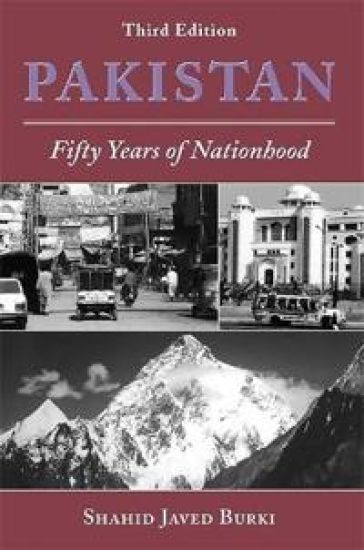
Although it achieved independence in 1947, Pakistan still has not succeeded in integrating its diverse peoples into a nation?as its short yet turbulent history vividly demonstrates. The nation's search for stability is traced in this revised and updated introduction to Pakistan's political, economic, and social development. New chapters detail political developments since 1991, including the elections of 1993 and 1996. Economic changes, including the financial crisis that led to the fall of Benazir Bhutto's government in 1996, are given particular attention. Also included is an extensive analysis of the nuclear arms race between India and Pakistan, an issue of global concern.
Pakistan Under Bhutto, 1971–1977

Pakistan Under Bhutto, 1971–1977

Shahid Javed Burki

Palgrave Macmillan
1988
nidottu
An updated and revised account of economic and political decision-making in Pakistan during 1971-77 under the leadership of Zulfikar Ali Bhutto. Questioning the reasons for Bhutto's reversal of policy in 1974, the author argues that Bhutto's actions were influenced by prominent social groups.