Kirjojen hintavertailu – 12 903 735 kirjaa ja 27 kauppaa

Kirjailija

Shakuntala Banaji

Kirjat ja teokset yhdessä paikassa: 5 kirjaa, julkaisuja vuosilta 2015–2024, suosituimpiin kuuluu Children and Media in India. Vertaile teosten hintoja ja tarkista saatavuus suomalaisista kirjakaupoista.

5 kirjaa

Kirjojen julkaisuvuodet: 2015–2024.

Social Media and Hate

Social Media and Hate

Shakuntala Banaji; Ramnath Bhat

TAYLOR FRANCIS LTD
2024
nidottu
Using expert interviews and focus groups, this book investigates the theoretical and practical intersection of misinformation and social media hate in contemporary societies. Social Media and Hate argues that these phenomena, and the extreme violence and discrimination they initiate against targeted groups, are connected to the socio-political contexts, values and behaviours of users of social media platforms such as Facebook, TikTok, ShareChat, Instagram and WhatsApp. The argument moves from a theoretical discussion of the practices and consequences of sectarian hatred, through a methodological evaluation of quantitative and qualitative studies on this topic, to four qualitative case studies of social media hate, and its effects on groups, individuals and wider politics in India, Brazil, Myanmar and the UK. The technical, ideological and networked similarities and connections between social media hate against people of African and Asian descent, indigenous communities, Muslims, Dalits, dissenters, feminists, LGBTQIA communities, Rohingya and immigrants across the four contexts is highlighted, stressing the need for an equally systematic political response. This is an insightful text for scholars and academics in the fields of Cultural Studies, Community Psychology, Education, Journalism, Media and Communication Studies, Political Science, Social Anthropology, Social Psychology, and Sociology.
Social Media and Hate

Social Media and Hate

Shakuntala Banaji; Ramnath Bhat

TAYLOR FRANCIS LTD
2021
sidottu
Using expert interviews and focus groups, this book investigates the theoretical and practical intersection of misinformation and social media hate in contemporary societies. Social Media and Hate argues that these phenomena, and the extreme violence and discrimination they initiate against targeted groups, are connected to the socio-political contexts, values and behaviours of users of social media platforms such as Facebook, TikTok, ShareChat, Instagram and WhatsApp. The argument moves from a theoretical discussion of the practices and consequences of sectarian hatred, through a methodological evaluation of quantitative and qualitative studies on this topic, to four qualitative case studies of social media hate, and its effects on groups, individuals and wider politics in India, Brazil, Myanmar and the UK. The technical, ideological and networked similarities and connections between social media hate against people of African and Asian descent, indigenous communities, Muslims, Dalits, dissenters, feminists, LGBTQIA communities, Rohingya and immigrants across the four contexts is highlighted, stressing the need for an equally systematic political response. This is an insightful text for scholars and academics in the fields of Cultural Studies, Community Psychology, Education, Journalism, Media and Communication Studies, Political Science, Social Anthropology, Social Psychology, and Sociology.
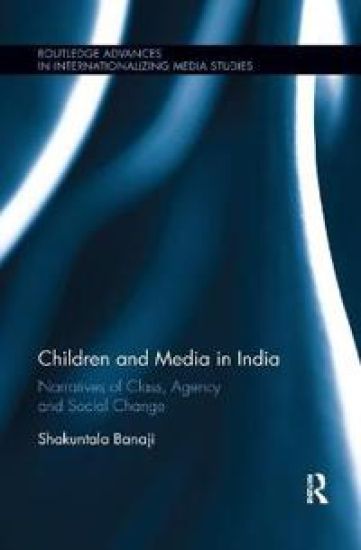
Children and Media in India

Children and Media in India

Shakuntala Banaji

Routledge
2019
nidottu
Is the bicycle, like the loudspeaker, a medium of communication in India? Do Indian children need trade unions as much as they need schools? What would you do with a mobile phone if all your friends were playing tag in the rain or watching Indian Idol? Children and Media in India illuminates the experiences, practices and contexts in which children and young people in diverse locations across India encounter, make, or make meaning from media in the course of their everyday lives. From textbooks, television, film and comics to mobile phones and digital games, this book examines the media available to different socioeconomic groups of children in India and their articulation with everyday cultures and routines. An authoritative overview of theories and discussions about childhood, agency, social class, caste and gender in India is followed by an analysis of films and television representations of childhood informed by qualitative interview data collected between 2005 and 2015 in urban, small-town and rural contexts with children aged nine to 17. The analysis uncovers and challenges widely held assumptions about the relationships among factors including sociocultural location, media content and technologies, and children’s labour and agency. The analysis casts doubt on undifferentiated claims about how new technologies ‘affect’, ‘endanger’ and/or ‘empower’, pointing instead to the importance of social class – and caste – in mediating relationships among children, young people and the poor. The analysis of children’s narratives of daily work, education, caring and leisure supports the conclusion that, although unrecognised and underrepresented, subaltern children’s agency and resourceful conservation makes a significant contribution to economic, interpretive and social reproduction in India.
Children and Media in India

Children and Media in India

Shakuntala Banaji

Routledge
2016
sidottu
Is the bicycle, like the loudspeaker, a medium of communication in India? Do Indian children need trade unions as much as they need schools? What would you do with a mobile phone if all your friends were playing tag in the rain or watching Indian Idol? Children and Media in India illuminates the experiences, practices and contexts in which children and young people in diverse locations across India encounter, make, or make meaning from media in the course of their everyday lives. From textbooks, television, film and comics to mobile phones and digital games, this book examines the media available to different socioeconomic groups of children in India and their articulation with everyday cultures and routines. An authoritative overview of theories and discussions about childhood, agency, social class, caste and gender in India is followed by an analysis of films and television representations of childhood informed by qualitative interview data collected between 2005 and 2015 in urban, small-town and rural contexts with children aged nine to 17. The analysis uncovers and challenges widely held assumptions about the relationships among factors including sociocultural location, media content and technologies, and children’s labour and agency. The analysis casts doubt on undifferentiated claims about how new technologies ‘affect’, ‘endanger’ and/or ‘empower’, pointing instead to the importance of social class – and caste – in mediating relationships among children, young people and the poor. The analysis of children’s narratives of daily work, education, caring and leisure supports the conclusion that, although unrecognised and underrepresented, subaltern children’s agency and resourceful conservation makes a significant contribution to economic, interpretive and social reproduction in India.
Youth Participation in Democratic Life

Youth Participation in Democratic Life

Bart Cammaerts; Michael Bruter; Shakuntala Banaji; Sarah Harrison; Nick Anstead

Palgrave Macmillan
2015
sidottu
This book is concerned with the contexts, nature and quality of the participation of young people in European democratic life. The authors understand democracy broadly as both institutional politics and civic cultures, and a wide range of methods are used to analyse and assess youth participation and attitudes.