

Kirjojen hintavertailu – 12 859 829 kirjaa ja 27 kauppaa

Kirjailija

Shane Gunster

Kirjat ja teokset yhdessä paikassa: 3 kirjaa, julkaisuja vuosilta 2004–2017, suosituimpiin kuuluu Journalism and Climate Crisis. Vertaile teosten hintoja ja tarkista saatavuus suomalaisista kirjakaupoista.

3 kirjaa

Kirjojen julkaisuvuodet: 2004–2017.

Journalism and Climate Crisis

Journalism and Climate Crisis

Robert Hackett; Susan Forde; Shane Gunster; Kerrie Foxwell-Norton

Routledge
2017
sidottu
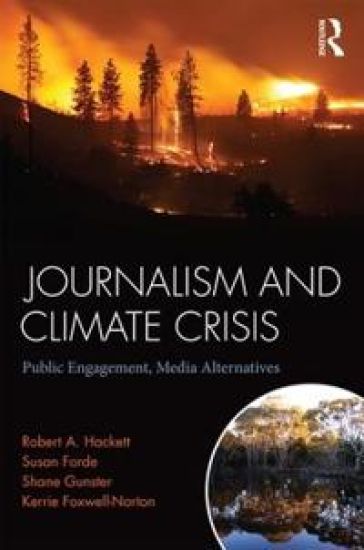
Journalism and Climate Crisis: Public Engagement, Media Alternatives recognizes that climate change is more than an environmental crisis. It is also a question of political and communicative capacity. This book enquires into which approaches to journalism, as a particularly important form of public communication, can best enable humanity to productively address climate crisis. The book combines selective overviews of previous research, normative enquiry (what should journalism be doing?) and original empirical case studies of environmental communication and media coverage in Australia and Canada. Bringing together perspectives from the fields of environmental communication and journalism studies, the authors argue for forms of journalism that can encourage public engagement and mobilization to challenge the powerful interests vested in a high-carbon economy – ‘facilitative’ and ‘radical’ roles particularly well-suited to alternative media and alternative journalism. Ultimately, the book argues for a fundamental rethinking of relationships between journalism, publics, democracy and climate crisis. This book will interest researchers, students and activists in environmental politics, social movements and the media.
Journalism and Climate Crisis

Journalism and Climate Crisis

Robert Hackett; Susan Forde; Shane Gunster; Kerrie Foxwell-Norton

Routledge
2017
nidottu
Journalism and Climate Crisis: Public Engagement, Media Alternatives recognizes that climate change is more than an environmental crisis. It is also a question of political and communicative capacity. This book enquires into which approaches to journalism, as a particularly important form of public communication, can best enable humanity to productively address climate crisis. The book combines selective overviews of previous research, normative enquiry (what should journalism be doing?) and original empirical case studies of environmental communication and media coverage in Australia and Canada. Bringing together perspectives from the fields of environmental communication and journalism studies, the authors argue for forms of journalism that can encourage public engagement and mobilization to challenge the powerful interests vested in a high-carbon economy – ‘facilitative’ and ‘radical’ roles particularly well-suited to alternative media and alternative journalism. Ultimately, the book argues for a fundamental rethinking of relationships between journalism, publics, democracy and climate crisis. This book will interest researchers, students and activists in environmental politics, social movements and the media.
Capitalizing on Culture

Capitalizing on Culture

Shane Gunster

University of Toronto Press
2004
sidottu
Building on the work of Theodor Adorno and Walter Benjamin, Capitalizing on Culture presents an innovative, accessible, and timely exploration of critical theory in a cultural landscape dominated by capital. Despite the increasing prevalence of commodification as a dominant factor in the production, promotion, and consumption of most forms of mass culture, many in the cultural studies field have failed to engage systematically either with culture as commodity or with critical theory. Shane Gunster corrects that oversight, providing attentive readings of Adorno and Benjamin's work in order to generate a complex, non-reductive theory of human experience that attends to the opportunities and dangers arising from the confluence of culture and economics. Gunster juxtaposes Benjamin's thoughts on memory, experience, and capitalism with Adorno's critique of mass culture and modern aesthetics to illuminate the key position that the commodity form plays in each thinker's work and to invigorate the dialectical complexity their writings acquire when considered together. This blending of perspectives is subsequently used to ground a theoretical interrogation of the comparative failure of cultural studies to engage substantively with the effect of commodification upon cultural practices. As a result, Capitalizing on Culture offers a fresh examination of critical theory that will be valuable to scholars studying the intersection of culture and capitalism.