Kirjojen hintavertailu – 12 903 724 kirjaa ja 27 kauppaa

Kirjailija

Sherif Sakr

Kirjat ja teokset yhdessä paikassa: 16 kirjaa, julkaisuja vuosilta 2011–2026, suosituimpiin kuuluu Process Analytics. Vertaile teosten hintoja ja tarkista saatavuus suomalaisista kirjakaupoista.

16 kirjaa

Kirjojen julkaisuvuodet: 2011–2026.

Process Analytics

Process Analytics

Seyed-Mehdi-Reza Beheshti; Boualem Benatallah; Sherif Sakr; Daniela Grigori; Hamid Reza Motahari-Nezhad; Moshe Chai Barukh; Ahmed Gater; Seung Hwan Ryu

Springer International Publishing AG
2016
sidottu
This book starts with an introduction to process modeling and process paradigms, then explains how to query and analyze process models, and how to analyze the process execution data. In this way, readers receive a comprehensive overview of what is needed to identify, understand and improve business processes. The book chiefly focuses on concepts, techniques and methods. It covers a large body of knowledge on process analytics – including process data querying, analysis, matching and correlating process data and models – to help practitioners and researchers understand the underlying concepts, problems, methods, tools and techniques involved in modern process analytics. Following an introduction to basic business process and process analytics concepts, it describes the state of the art in this area before examining different analytics techniques in detail. In this regard, the book covers analytics over different levelsof process abstractions, from process execution data and methods for linking and correlating process execution data, to inferring process models, querying process execution data and process models, and scalable process data analytics methods. In addition, it provides a review of commercial process analytics tools and their practical applications. The book is intended for a broad readership interested in business process management and process analytics. It provides researchers with an introduction to these fields by comprehensively classifying the current state of research, by describing in-depth techniques and methods, and by highlighting future research directions. Lecturers will find a wealth of material to choose from for a variety of courses, ranging from undergraduate courses in business process management to graduate courses in business process analytics. Lastly, it offers professionals a reference guide to the state of the art in commercial tools and techniques, complemented by many real-world use case scenarios.
Large-Scale Graph Processing Using Apache Giraph

Large-Scale Graph Processing Using Apache Giraph

Sherif Sakr; Faisal Moeen Orakzai; Ibrahim Abdelaziz; Zuhair Khayyat

Springer International Publishing AG
2018
nidottu
This book takes its reader on a journey through Apache Giraph, a popular distributed graph processing platform designed to bring the power of big data processing to graph data. Designed as a step-by-step self-study guide for everyone interested in large-scale graph processing, it describes the fundamental abstractions of the system, its programming models and various techniques for using the system to process graph data at scale, including the implementation of several popular and advanced graph analytics algorithms. The book is organized as follows: Chapter 1 starts by providing a general background of the big data phenomenon and a general introduction to the Apache Giraph system, its abstraction, programming model and design architecture. Next, chapter 2 focuses on Giraph as a platform and how to use it. Based on a sample job, even more advanced topics like monitoring the Giraph application lifecycle and different methods for monitoring Giraph jobs are explained. Chapter 3 then provides an introduction to Giraph programming, introduces the basic Giraph graph model and explains how to write Giraph programs. In turn, Chapter 4 discusses in detail the implementation of some popular graph algorithms including PageRank, connected components, shortest paths and triangle closing. Chapter 5 focuses on advanced Giraph programming, discussing common Giraph algorithmic optimizations, tunable Giraph configurations that determine the system’s utilization of the underlying resources, and how to write a custom graph input and output format. Lastly, chapter 6 highlights two systems that have been introduced to tackle the challenge of large scale graph processing, GraphX and GraphLab, and explains the main commonalities and differences between these systems and Apache Giraph. This book serves as an essential reference guide for students, researchers and practitioners in the domain of large scale graph processing. It offers step-by-step guidance, with several code examples and the complete source code available in the related github repository. Students will find a comprehensive introduction to and hands-on practice with tackling large scale graph processing problems using the Apache Giraph system, while researchers will discover thorough coverage of the emerging and ongoing advancements in big graph processing systems.
Process Analytics

Process Analytics

Seyed-Mehdi-Reza Beheshti; Boualem Benatallah; Sherif Sakr; Daniela Grigori; Hamid Reza Motahari-Nezhad; Moshe Chai Barukh; Ahmed Gater; Seung Hwan Ryu

Springer International Publishing AG
2018
nidottu
This book starts with an introduction to process modeling and process paradigms, then explains how to query and analyze process models, and how to analyze the process execution data. In this way, readers receive a comprehensive overview of what is needed to identify, understand and improve business processes. The book chiefly focuses on concepts, techniques and methods. It covers a large body of knowledge on process analytics – including process data querying, analysis, matching and correlating process data and models – to help practitioners and researchers understand the underlying concepts, problems, methods, tools and techniques involved in modern process analytics. Following an introduction to basic business process and process analytics concepts, it describes the state of the art in this area before examining different analytics techniques in detail. In this regard, the book covers analytics over different levelsof process abstractions, from process execution data and methods for linking and correlating process execution data, to inferring process models, querying process execution data and process models, and scalable process data analytics methods. In addition, it provides a review of commercial process analytics tools and their practical applications. The book is intended for a broad readership interested in business process management and process analytics. It provides researchers with an introduction to these fields by comprehensively classifying the current state of research, by describing in-depth techniques and methods, and by highlighting future research directions. Lecturers will find a wealth of material to choose from for a variety of courses, ranging from undergraduate courses in business process management to graduate courses in business process analytics. Lastly, it offers professionals a reference guide to the state of the art in commercial tools and techniques, complemented by many real-world use case scenarios.
Linked Data

Linked Data

Sherif Sakr; Marcin Wylot; Raghava Mutharaju; Danh Le Phuoc; Irini Fundulaki

Springer International Publishing AG
2018
sidottu
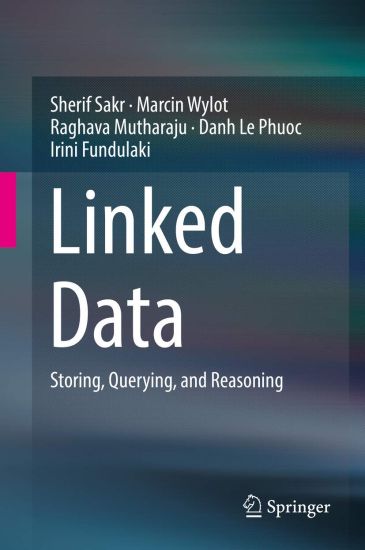
This book describes efficient and effective techniques for harnessing the power of Linked Data by tackling the various aspects of managing its growing volume: storing, querying, reasoning, provenance management and benchmarking. To this end, Chapter 1 introduces the main concepts of the Semantic Web and Linked Data and provides a roadmap for the book. Next, Chapter 2 briefly presents the basic concepts underpinning Linked Data technologies that are discussed in the book. Chapter 3 then offers an overview of various techniques and systems for centrally querying RDF datasets, and Chapter 4 outlines various techniques and systems for efficiently querying large RDF datasets in distributed environments. Subsequently, Chapter 5 explores how streaming requirements are addressed in current, state-of-the-art RDF stream data processing. Chapter 6 covers performance and scaling issues of distributed RDF reasoning systems, while Chapter 7 details benchmarks forRDF query engines and instance matching systems. Chapter 8 addresses the provenance management for Linked Data and presents the different provenance models developed. Lastly, Chapter 9 offers a brief summary, highlighting and providing insights into some of the open challenges and research directions. Providing an updated overview of methods, technologies and systems related to Linked Data this book is mainly intended for students and researchers who are interested in the Linked Data domain. It enables students to gain an understanding of the foundations and underpinning technologies and standards for Linked Data, while researchers benefit from the in-depth coverage of the emerging and ongoing advances in Linked Data storing, querying, reasoning, and provenance management systems. Further, it serves as a starting point to tackle the next research challenges in the domain of Linked Data management.
Large-Scale Graph Processing Using Apache Giraph

Large-Scale Graph Processing Using Apache Giraph

Sherif Sakr; Faisal Moeen Orakzai; Ibrahim Abdelaziz; Zuhair Khayyat

Springer International Publishing AG
2017
sidottu
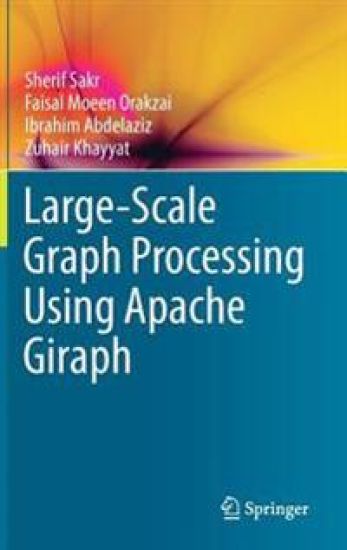
This book takes its reader on a journey through Apache Giraph, a popular distributed graph processing platform designed to bring the power of big data processing to graph data. Designed as a step-by-step self-study guide for everyone interested in large-scale graph processing, it describes the fundamental abstractions of the system, its programming models and various techniques for using the system to process graph data at scale, including the implementation of several popular and advanced graph analytics algorithms. The book is organized as follows: Chapter 1 starts by providing a general background of the big data phenomenon and a general introduction to the Apache Giraph system, its abstraction, programming model and design architecture. Next, chapter 2 focuses on Giraph as a platform and how to use it. Based on a sample job, even more advanced topics like monitoring the Giraph application lifecycle and different methods for monitoring Giraph jobs are explained. Chapter 3 then provides an introduction to Giraph programming, introduces the basic Giraph graph model and explains how to write Giraph programs. In turn, Chapter 4 discusses in detail the implementation of some popular graph algorithms including PageRank, connected components, shortest paths and triangle closing. Chapter 5 focuses on advanced Giraph programming, discussing common Giraph algorithmic optimizations, tunable Giraph configurations that determine the system’s utilization of the underlying resources, and how to write a custom graph input and output format. Lastly, chapter 6 highlights two systems that have been introduced to tackle the challenge of large scale graph processing, GraphX and GraphLab, and explains the main commonalities and differences between these systems and Apache Giraph. This book serves as an essential reference guide for students, researchers and practitioners in the domain of large scale graph processing. It offers step-by-step guidance, with several code examples and the complete source code available in the related github repository. Students will find a comprehensive introduction to and hands-on practice with tackling large scale graph processing problems using the Apache Giraph system, while researchers will discover thorough coverage of the emerging and ongoing advancements in big graph processing systems.
Cloud Data Management

Cloud Data Management

Liang Zhao; Sherif Sakr; Anna Liu; Athman Bouguettaya

Springer International Publishing AG
2016
nidottu
In practice, the design and architecture of a cloud varies among cloud providers. We present a generic evaluation framework for the performance, availability and reliability characteristics of various cloud platforms. We describe a generic benchmark architecture for cloud databases, specifically NoSQL database as a service. It measures the performance of replication delay and monetary cost. Service Level Agreements (SLA) represent the contract which captures the agreed upon guarantees between a service provider and its customers. The specifications of existing service level agreements (SLA) for cloud services are not designed to flexibly handle even relatively straightforward performance and technical requirements of consumer applications. We present a novel approach for SLA-based management of cloud-hosted databases from the consumer perspective and an end-to-end framework for consumer-centric SLA management of cloud-hosted databases. The framework facilitates adaptive and dynamic provisioning of the database tier of the software applications based on application-defined policies for satisfying their own SLA performance requirements, avoiding the cost of any SLA violation and controlling the monetary cost of the allocated computing resources. In this framework, the SLA of the consumer applications are declaratively defined in terms of goals which are subjected to a number of constraints that are specific to the application requirements. The framework continuously monitors the application-defined SLA and automatically triggers the execution of necessary corrective actions (scaling out/in the database tier) when required. The framework is database platform-agnostic, uses virtualization-based database replication mechanisms and requires zero source code changes of the cloud-hosted software applications.
Cloud Data Management

Cloud Data Management

Liang Zhao; Sherif Sakr; Anna Liu; Athman Bouguettaya

Springer International Publishing AG
2014
sidottu
In practice, the design and architecture of a cloud varies among cloud providers. We present a generic evaluation framework for the performance, availability and reliability characteristics of various cloud platforms. We describe a generic benchmark architecture for cloud databases, specifically NoSQL database as a service. It measures the performance of replication delay and monetary cost. Service Level Agreements (SLA) represent the contract which captures the agreed upon guarantees between a service provider and its customers. The specifications of existing service level agreements (SLA) for cloud services are not designed to flexibly handle even relatively straightforward performance and technical requirements of consumer applications. We present a novel approach for SLA-based management of cloud-hosted databases from the consumer perspective and an end-to-end framework for consumer-centric SLA management of cloud-hosted databases. The framework facilitates adaptive and dynamic provisioning of the database tier of the software applications based on application-defined policies for satisfying their own SLA performance requirements, avoiding the cost of any SLA violation and controlling the monetary cost of the allocated computing resources. In this framework, the SLA of the consumer applications are declaratively defined in terms of goals which are subjected to a number of constraints that are specific to the application requirements. The framework continuously monitors the application-defined SLA and automatically triggers the execution of necessary corrective actions (scaling out/in the database tier) when required. The framework is database platform-agnostic, uses virtualization-based database replication mechanisms and requires zero source code changes of the cloud-hosted software applications.
Big Data 2.0 Processing Systems

Big Data 2.0 Processing Systems

Sherif Sakr

Springer Nature Switzerland AG
2021
nidottu
This book provides readers the “big picture” and a comprehensive survey of the domain of big data processing systems. For the past decade, the Hadoop framework has dominated the world of big data processing, yet recently academia and industry have started to recognize its limitations in several application domains and thus, it is now gradually being replaced by a collection of engines that are dedicated to specific verticals (e.g. structured data, graph data, and streaming data). The book explores this new wave of systems, which it refers to as Big Data 2.0 processing systems. After Chapter 1 presents the general background of the big data phenomena, Chapter 2 provides an overview of various general-purpose big data processing systems that allow their users to develop various big data processing jobs for different application domains. In turn, Chapter 3 examines various systems that have been introduced to support the SQL flavor on top of the Hadoop infrastructure and provide competing and scalable performance in the processing of large-scale structured data. Chapter 4 discusses several systems that have been designed to tackle the problem of large-scale graph processing, while the main focus of Chapter 5 is on several systems that have been designed to provide scalable solutions for processing big data streams, and on other sets of systems that have been introduced to support the development of data pipelines between various types of big data processing jobs and systems. Next, Chapter 6 focuses on covering the emerging frameworks and systems in the domain of scalable machine learning and deep learning processing. Lastly, Chapter 7 shares conclusions and an outlook on future research challenges. This new and considerably enlarged second edition not only contains the completely new chapter 6, but also offers a refreshed content for the state-of-the-art in all domains of big data processing over the last years. Overall, the book offers a valuable reference guide for professional, students, and researchers in the domain of big data processing systems. Further, its comprehensive content will hopefully encourage readers to pursue further research on the subject.
Big Data 2.0 Processing Systems

Big Data 2.0 Processing Systems

Sherif Sakr

Springer Nature Switzerland AG
2020
sidottu
This book provides readers the “big picture” and a comprehensive survey of the domain of big data processing systems. For the past decade, the Hadoop framework has dominated the world of big data processing, yet recently academia and industry have started to recognize its limitations in several application domains and thus, it is now gradually being replaced by a collection of engines that are dedicated to specific verticals (e.g. structured data, graph data, and streaming data). The book explores this new wave of systems, which it refers to as Big Data 2.0 processing systems. After Chapter 1 presents the general background of the big data phenomena, Chapter 2 provides an overview of various general-purpose big data processing systems that allow their users to develop various big data processing jobs for different application domains. In turn, Chapter 3 examines various systems that have been introduced to support the SQL flavor on top of the Hadoop infrastructure and provide competing and scalable performance in the processing of large-scale structured data. Chapter 4 discusses several systems that have been designed to tackle the problem of large-scale graph processing, while the main focus of Chapter 5 is on several systems that have been designed to provide scalable solutions for processing big data streams, and on other sets of systems that have been introduced to support the development of data pipelines between various types of big data processing jobs and systems. Next, Chapter 6 focuses on covering the emerging frameworks and systems in the domain of scalable machine learning and deep learning processing. Lastly, Chapter 7 shares conclusions and an outlook on future research challenges. This new and considerably enlarged second edition not only contains the completely new chapter 6, but also offers a refreshed content for the state-of-the-art in all domains of big data processing over the last years. Overall, the book offers a valuable reference guide for professional, students, and researchers in the domain of big data processing systems. Further, its comprehensive content will hopefully encourage readers to pursue further research on the subject.
Linked Data

Linked Data

Sherif Sakr; Marcin Wylot; Raghava Mutharaju; Danh Le Phuoc; Irini Fundulaki

Springer Nature Switzerland AG
2019
nidottu
This book describes efficient and effective techniques for harnessing the power of Linked Data by tackling the various aspects of managing its growing volume: storing, querying, reasoning, provenance management and benchmarking. To this end, Chapter 1 introduces the main concepts of the Semantic Web and Linked Data and provides a roadmap for the book. Next, Chapter 2 briefly presents the basic concepts underpinning Linked Data technologies that are discussed in the book. Chapter 3 then offers an overview of various techniques and systems for centrally querying RDF datasets, and Chapter 4 outlines various techniques and systems for efficiently querying large RDF datasets in distributed environments. Subsequently, Chapter 5 explores how streaming requirements are addressed in current, state-of-the-art RDF stream data processing. Chapter 6 covers performance and scaling issues of distributed RDF reasoning systems, while Chapter 7 details benchmarks forRDF query engines and instance matching systems. Chapter 8 addresses the provenance management for Linked Data and presents the different provenance models developed. Lastly, Chapter 9 offers a brief summary, highlighting and providing insights into some of the open challenges and research directions. Providing an updated overview of methods, technologies and systems related to Linked Data this book is mainly intended for students and researchers who are interested in the Linked Data domain. It enables students to gain an understanding of the foundations and underpinning technologies and standards for Linked Data, while researchers benefit from the in-depth coverage of the emerging and ongoing advances in Linked Data storing, querying, reasoning, and provenance management systems. Further, it serves as a starting point to tackle the next research challenges in the domain of Linked Data management.