Kirjojen hintavertailu – 12 859 818 kirjaa ja 27 kauppaa
Kirjailija
Shira Telushkin
Kirjat ja teokset yhdessä paikassa: 4 kirjaa, julkaisuja vuosilta 2022–2026, suosituimpiin kuuluu Plough Quarterly No. 32 – Hope in Apocalypse. Vertaile teosten hintoja ja tarkista saatavuus suomalaisista kirjakaupoista.
David Bentley Hart; Mindy Belz; Peter J. Leithart; Shira Telushkin; Joseph Julián González; Peter Turkson; Eleanor Parker; Lyman Stone; Anika T. Prather; Brandon McGinley; Joel Clarkson
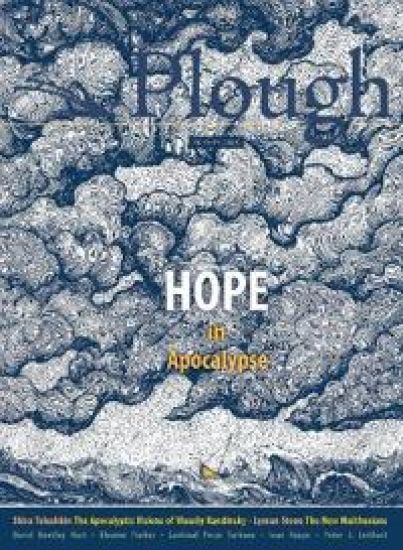
In times that feel apocalyptic, where do we place our hope? It's an apocalyptic moment. The grim effects of climate change have left many people in despair. Young people often cite climate fears as a reason they are not having children. Then there’s the threat of nuclear war, again in the cards, which could make climate worries a moot point. The paradoxical answer ancient Judaism gave to such despair was a promise: the promise of doomsday, the “Day of the Lord” when God will visit his people and establish lasting justice and peace. Judgment, according to the Hebrew prophets, will be followed by renewal – for the faithful, and perhaps even for the entire cosmos. Over the centuries since, this hopeful vision of apocalypse has carried many others through moments of crisis and catastrophe. Might it do the same for us? On this theme: creation is transformed and made new. That’s what the “end of the age” meant to Jesus and his early - Peter J. Leithart says when old worlds die, we need something sturdier than the myth of progress. - Brandon McGinley says you can’t protect your kids from tragedy. - Cardinal Peter Turkson points to the spiritual roots of the climate crisis. - David Bentley Hart says disruption, not dogma, is Christianity’s grounds for hope. - Hanna-Barbara Gerl-Falkovitz reminds us that the Book of Revelation ends well. - Lyman Stone argues that those who claim that having children threatens the environment are wrong. - Eleanor Parker recounts how, amid Viking terror, one Anglo-Saxon bishop held a kingdom together. - Shira Telushkin describes how artist Wassily Kandinsky forged a path from the material to the spiritual. - Anika T. Prather learned to let her children grieve during the pandemic. Also in the issue: - Ukrainian pastor Ivan Rusyn describes ministering in wartime Bucha and Kyiv. - Mindy Belz reports on farmers who held out in Syria despite ISIS. - New poems by winners of the 2022 Rhina Espaillat Poetry Award - A profile of newly sainted Charles de Foucauld - Reviews of Elena Ferrante’s In the Margins, Abigail Favale’s The Genesis of Gender, and Emily St. John Mandel’s Sea of Tranquility - Readers’ forum, comics, and morePlough Quarterly features stories, ideas, and culture for people eager to apply their faith to the challenges we face. Each issue includes in-depth articles, interviews, poetry, book reviews, and art.
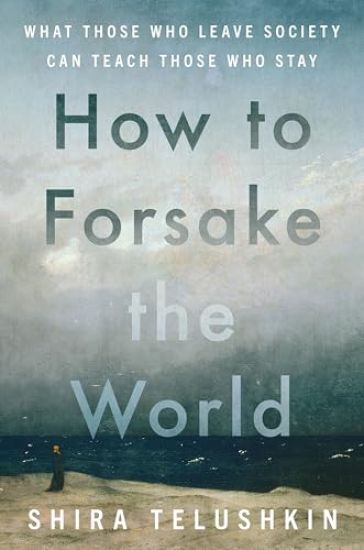
A mix of philosophy, history, and journalism that illuminates individuals in closed off communities who have left society to find their own meaning —offering insight for everyone yearning to pursue a deeper, more fulfilled life. When journalist and scholar Shira Telushkin was a girl, she was entranced by stories of men and women who removed themselves from the world to seek eternal truths. The daughter of a rabbi who strongly believed the best life was one that alleviated the suffering of others, Shira felt conflicted about her curiosity. “These people, to whom I was so drawn, lived lives with no clear utility to others, and yet in reading their stories I felt convinced, briefly, that there was a purpose to life, and this was it.” What is the highest level of being? Is it a life lived in sacrifice to others to make the world a better place, or is it sacrificing the world and ignoring its needs to reach an eternal truth? This book is Telushkin’s journey to uncover answers and find peace between seeking and serving. How to Forsake the World chronicles her odyssey to understand her own yearnings. Telushkin introduces four fascinating communities—Talmudic scholars seeking knowledge, off-the-grid anarchists seeking freedom, Buddhist renunciants seeking enlightenment, cloistered nuns seeking salvation—and asks how their values and determination to walk paths on their own terms might broaden modern conceptions of meaning and purpose in a society where success and worthiness are deeply tied to productivity and being useful. With keen writing, affable voice, extraordinary access, and extensive research, Telushkin brings her subjects to vivid, urgent life, providing a rare opportunity to explore the uncharted territory where wellness and burnout intersect with deeper philosophical and historical inquiries about what we owe to others and to ourselves.
James Rebanks; Benoit Gautier; Tish Harrison Warren; Adam Nicolson; Alister McGrath; Cristian Wiman; Shira Telushkin; Alastiar Roberts; Norann Voll; Bobbie Jamieson; Brian D. Miller; Ben Wray; William P. Hyland
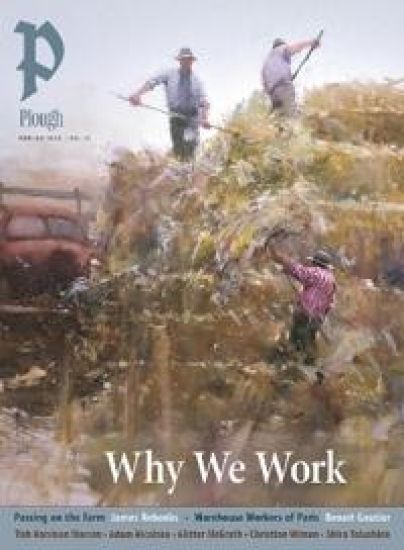
Is our work merely a way to put food on the table, or does it have inherent value? Should our work define us? Does it play too large a role in our lives? Does it make us feel more human, or less so? This issue explores the realities of work for people with various jobs, but also probes the reasons people work and what they hope to gain from their labor. From warehouse workers to poets, food delivery specialists to cloistered nuns, farmers to police officers, this issue considers personal, spiritual, and social aspects of one of the most basic human activities. On this theme: James Rebanks prepares to pass on the farm to his children. Benoit Gautier rides a shuttlebus with dislocated French warehouse workers. Shira Telushkin asks why young women today are becoming cloistered nuns. Ben Wray talks to food-delivery riders in three countries about their attempts to organize. John Clair, a police chief, wants policing to be about relationships, not statistics. Norann Voll tells how her father taught her to embrace her blue-collar roots. Maureen Swinger honors the unpaid and unheralded work of caring for an aging loved one. Alastair Roberts recommends the divine rhythm of work and Sabbath rest God established in Genesis. Also in this issue: Adam Nicolson finds a different sort of freedom sailing a sixteen-foot wooden boat. Alister McGrath explores the connection between detective fiction and the spiritual quest. Tish Harrison Warren introduces Stanley Hauerwas to new audiences. Christian Wiman shares a new poem about a glass-eyed monk. Plough Quarterly features stories, ideas, and culture for people eager to apply their faith to the challenges we face. Each issue includes in-depth articles, interviews, poetry, book reviews, and art.
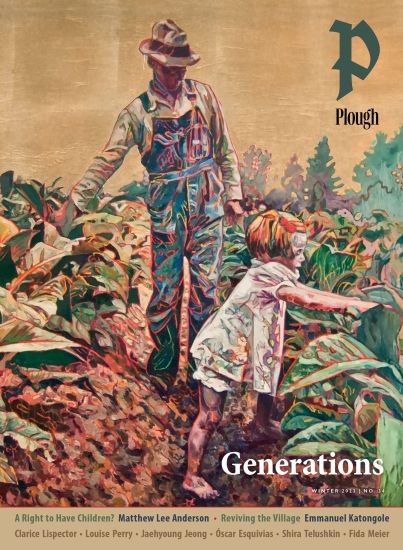
We’re born with a hunger for roots and a desire to pass on a legacy. The past two decades have seen a boom in family history services that combine genealogy with DNA testing, though this is less a sign of a robust connection to past generations than of its absence. Everywhere we see a pervasive rootlessness coupled with a cult of youth that thinks there is little to learn from our elders. The nursing home tragedies of the Covid-19 pandemic laid bare this devaluing of the old. But it’s not only the elderly who are negatively affected when the links between generations break down; the young lose out too. When the hollowing-out of intergenerational connections deprives youth of the sense of belonging to a story beyond themselves, other sources of identity, from trivial to noxious, will fill the void. Yet however important biological kinship is, the New Testament tells us it is less important than the family called into being by God’s promises. “Who is my mother, and who are my brothers?” Jesus asks a crowd of listeners, then answers: “Whoever does the will of my Father in heaven is my brother, and sister, and mother.” In this great intergenerational family, we are linked by a bond of brotherhood and sisterhood to believers from every era of the human story, past, present, and yet to be born. To be sure, our biological families and inheritances still matter, but heredity and blood kinship are no longer the primary source of our identity. Here is a cure for rootlessness. On this theme: - Matthew Lee Anderson argues that even in an age of IVF no one has a right to have a child. - Emmanuel Katongole describes how African Christians are responding to ecological degradation by returning to their roots. - Louise Perry worries that young environmentalist don’t want kids. - Helmuth Eiwen asks what we can do about the ongoing effects of the sins of our ancestors. - Terence Sweeney misses an absent father who left him nothing. - Wendy Kiyomi gives personal insight into the challenges of adopting children with trauma in their past. - Alastair Roberts decodes that long list of “begats” in Matthew’s Gospel. - Rhys Laverty explains why his hometown, Chessington, UK, is still a family-friendly neighborhood. - Springs Toledo recounts, for the first time, a buried family story of crime and forgiveness. - Monica Pelliccia profiles three generations of women who feed migrants riding the trains north. Also in the issue: - A new Christmas story by Óscar Esquivias, translated from the Spanish - Original poetry by Aaron Poochigian - Reviews of Kim Haines-Eitzen’s Sonorous Desert, Matthew P. Schneider’s God Loves the Autistic Mind, Adam Nicolson’s Life between the Tides, and Ash Davidson’s Damnation Spring. - An appreciation for Augustine’s mother, Monica - Short sketches by Clarice Lispector of her father and sonPlough Quarterly features stories, ideas, and culture for people eager to apply their faith to the challenges we face. Each issue includes in-depth articles, interviews, poetry, book reviews, and art.