Kirjojen hintavertailu – 12 859 829 kirjaa ja 27 kauppaa
Kirjailija
Shiv Kumar
Kirjat ja teokset yhdessä paikassa: 40 kirjaa, julkaisuja vuosilta 2016–2026, suosituimpiin kuuluu Mudra Mastery. Vertaile teosten hintoja ja tarkista saatavuus suomalaisista kirjakaupoista.
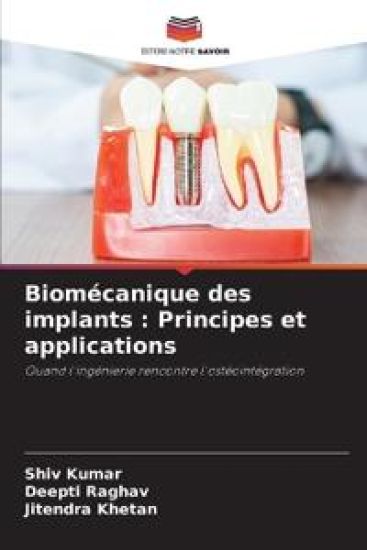
La biom canique joue un r le crucial dans la dentisterie implantaire en appliquant des principes d'ing nierie tels que la statique, la dynamique et l'analyse des contraintes pour g rer les forces de mastication. Les implants doivent supporter les charges verticales et lat rales tout en minimisant les contraintes sur l'os environnant. Une angulation inad quate ou une surcharge peut entra ner une perte osseuse ou une d faillance de l'implant, tandis qu'une contrainte insuffisante peut provoquer une atrophie osseuse. Les r sultats optimaux d pendent d'un contact ferme entre l'os et l'implant et d'un minimum de micromouvements. Des facteurs sp cifiques au patient, tels que la densit osseuse, l'occlusion et l'ampleur de la force, guident la conception de l'implant. Un plus grand nombre d'implants, des diam tres plus larges et un placement strat gique permettent de r partir efficacement les contraintes. La r duction de la longueur du porte- -faux, l'augmentation de la surface et une angulation pr cise sont essentielles pour viter les surcharges biom caniques. L'analyse par l ments finis (FEA) permet de simuler la r partition des contraintes, mais des limites subsistent. Avec les progr s constants dans la conception des implants, l'objectif est clair: obtenir un succ s long terme en alignant la stabilit m canique sur l'int grit biologique.
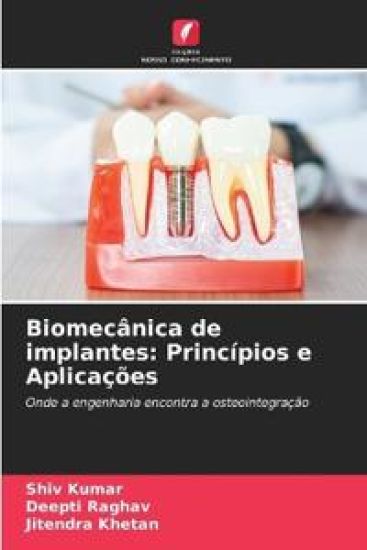
A biomec nica desempenha um papel crucial na implantologia dent ria, aplicando princ pios de engenharia como a est tica, a din mica e a an lise de tens o para gerir as for as de mastiga o. Os implantes t m de suportar cargas verticais e laterais, minimizando a tens o no osso circundante. Uma angula o incorrecta ou uma sobrecarga podem levar perda ssea ou falha do implante, enquanto que uma tens o insuficiente pode causar atrofia ssea. Os resultados ptimos dependem de um contacto firme osso-implante e de um micromovimento m nimo. Os factores espec ficos do doente, como a densidade ssea, a oclus o e a magnitude da for a, orientam a conce o do implante. Mais implantes, di metros mais largos e coloca o estrat gica ajudam a distribuir eficazmente o stress. A redu o do comprimento do cantilever, o aumento da rea de superf cie e a angula o precisa s o fundamentais para evitar a sobrecarga biomec nica. A An lise de Elementos Finitos (FEA) ajuda a simular a distribui o de tens es, mas continuam a existir limita es. Com os avan os cont nuos na conce o de implantes, o objetivo claro: alcan ar o sucesso a longo prazo, alinhando a estabilidade mec nica com a integridade biol gica.
Biomechanika odgrywa kluczową rolę w stomatologii implantologicznej, stosując zasady inżynierii, takie jak statyka, dynamika i analiza naprężeń w celu zarządzania silami żucia. Implanty muszą radzic sobie z obciążeniami pionowymi i bocznymi, jednocześnie minimalizując obciążenie otaczającej kości. Nieprawidlowe kątowanie lub przeciążenie może prowadzic do utraty kości lub uszkodzenia implantu, podczas gdy zbyt male obciążenie może powodowac zanik kości. Optymalne wyniki zależą od mocnego kontaktu kości z implantem i minimalnych mikroruch w. Czynniki specyficzne dla pacjenta, takie jak gęstośc kości, okluzja i wielkośc sily, kierują projektowaniem implant w. Większa liczba implant w, szersze średnice i strategiczne rozmieszczenie pomagają skutecznie rozlożyc naprężenia. Zmniejszenie dlugości wspornika, zwiększenie powierzchni i precyzyjne kątowanie są kluczem do uniknięcia przeciążenia biomechanicznego. Analiza element w skończonych (MES) pomaga symulowac rozklad naprężeń, ale nadal istnieją ograniczenia. Dzięki ciąglym postępom w projektowaniu implant w cel jest jasny: osiągnięcie dlugoterminowego sukcesu poprzez dostosowanie stabilności mechanicznej do integralności biologicznej.
La biomeccanica svolge un ruolo cruciale nell'implantologia, applicando principi ingegneristici come la statica, la dinamica e l'analisi delle sollecitazioni per gestire le forze masticatorie. Gli impianti devono gestire i carichi verticali e laterali riducendo al minimo lo stress sull'osso circostante. Un'angolazione impropria o un sovraccarico possono portare alla perdita di osso o al fallimento dell'impianto, mentre una sollecitazione troppo bassa pu causare l'atrofia ossea. I risultati ottimali dipendono da un contatto stabile tra osso e impianto e da una micromozione minima. I fattori specifici del paziente, come la densit ossea, l'occlusione e l'entit della forza, guidano la progettazione dell'impianto. Un maggior numero di impianti, diametri pi ampi e un posizionamento strategico aiutano a distribuire efficacemente lo stress. La riduzione della lunghezza del cantilever, l'aumento della superficie e l'angolazione precisa sono fondamentali per evitare il sovraccarico biomeccanico. L'analisi agli elementi finiti (FEA) aiuta a simulare la distribuzione delle sollecitazioni, ma rimangono dei limiti. Con i continui progressi nella progettazione degli impianti, l'obiettivo chiaro: ottenere un successo a lungo termine allineando la stabilit meccanica con l'integrit biologica.
Die Biomechanik spielt in der Implantologie eine entscheidende Rolle, indem sie technische Prinzipien wie Statik, Dynamik und Spannungsanalyse anwendet, um die Kaukr fte zu beherrschen. Implantate m ssen vertikalen und lateralen Belastungen standhalten und gleichzeitig die Belastung des umgebenden Knochens minimieren. Eine falsche Angulation oder berbelastung kann zu Knochenverlust oder Implantatversagen f hren, w hrend eine zu geringe Belastung zu Knochenschwund f hren kann. Optimale Ergebnisse h ngen von einem festen Knochen-Implantat-Kontakt und minimaler Mikrobewegung ab. Patientenspezifische Faktoren wie Knochendichte, Okklusion und Belastungsst rke bestimmen das Implantatdesign. Mehr Implantate, gr ere Durchmesser und eine strategische Platzierung helfen, die Belastung effektiv zu verteilen. Eine Verringerung der Cantilever-L nge, eine Vergr erung der Oberfl che und eine pr zise Angulation sind der Schl ssel zur Vermeidung einer biomechanischen berlastung. Die Finite-Elemente-Analyse (FEA) hilft bei der Simulation der Spannungsverteilung, doch gibt es auch hier Grenzen. Mit den kontinuierlichen Fortschritten im Implantatdesign ist das Ziel klar: langfristiger Erfolg durch die Abstimmung von mechanischer Stabilit t und biologischer Integrit t.
This book is a collection of over 225 multiple choice type questions (MCQs) and more than 40 practice/exam questions with solutions. The book also included steam tables as an appendix to aid in problem solving . This book proves useful for undergraduate students of mechanical engineering and related disciplines.
This book has been written for the introductory course of fluid mechanics for students at the undergraduate and postgraduate levels. It provides the fundamental knowledge allowing students in engineering and natural sciences to enter fluid mechanics and its applications in various fields where fluid flows need to be dealt with. Volume 2 of this book contains ten chapters to help build the basic understanding of the subject matter. It adequately addresses the more complex and advanced issues on fluid mechanics in simplest of manners. The book covers laminar flow (viscous flow), turbulent flow, boundary layer theory, flow through pipe, pipe flow measurement, orifices and mouthpieces, flow past submerged bodies, flow through open channels, notches and weirs, and compressible flows. The concepts are supported by numerous solved examples and multiple-choice questions to aid self-learning in students. The book also contains illustrated diagrams for better understanding of the concepts. The book is extremely useful for the undergraduate and postgraduate students of engineering and natural sciences.
This book provides the fundamental knowledge allowing students in engineering and natural sciences to enter fluid mechanics and its applications in various fields where fluid flows need to be dealt with. This textbook is written for the introductory course of fluid mechanics for students at the undergraduate and postgraduate levels. Volume 1 of this textbook contains seven chapters to help build the basic understanding of the subject matter. It adequately covers the properties of fluids, pressure and its measurement, hydrostatic forces on surface, buoyancy, and floatation, kinematics of fluid motion, dynamics of fluid flow, and dimensional and model analysis. The concepts are supported by numerous solved examples and multiple-choice questions to aid self-learning in students. The textbook also contains illustrated diagrams for better understanding of the concepts. The book is extremely useful for the undergraduate and postgraduate students of engineering and natural sciences.