Kirjojen hintavertailu – 12 903 725 kirjaa ja 27 kauppaa

Kirjailija

Shoshana Felman

Kirjat ja teokset yhdessä paikassa: 10 kirjaa, julkaisuja vuosilta 1989–2007, suosituimpiin kuuluu Jacques Lacan and the Adventure of Insight. Vertaile teosten hintoja ja tarkista saatavuus suomalaisista kirjakaupoista.

10 kirjaa

Kirjojen julkaisuvuodet: 1989–2007.

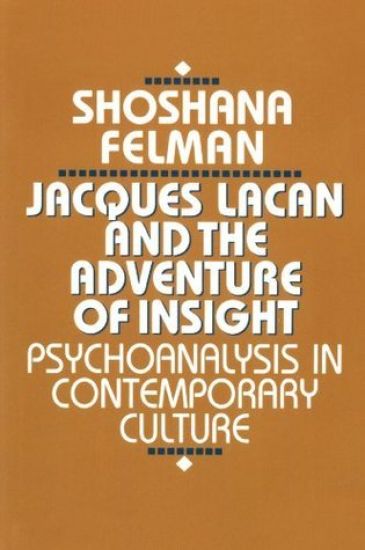
Jacques Lacan and the Adventure of Insight

Jacques Lacan and the Adventure of Insight

Shoshana Felman

Harvard University Press
1989
nidottu
Jacques Lacan, one of the most influential and controversial French thinkers of the twentieth century, was a practicing and teaching psychoanalyst in Paris, but his revolutionary seminars on Freud reached out far beyond professional circles: they were enthusiastically attended by writers, artists, scientists, philosophers, and intellectuals from many disciplines. Shoshana Felman elucidates the power and originality of Lacan’s work. She brilliantly analyzes Lacan’s investigation of psychoanalysis not as dogma but as an ongoing self-critical process of discovery. By focusing on Lacan’s singular way of making Freud’s thought new again—and of thus enabling us to participate in the very moment of intellectual struggle and insight—Felman shows how this moment of illumination has become crucial to contemporary thinking and has redefined insight as such. This book is a groundbreaking statement not only on Lacan but on psychoanalysis in general. Felman argues that, contrary to popular opinion, Lacan’s preoccupation is with psychoanalytic practice rather than with theory for its own sake. His true clinical originality consists not in the incidental innovations that separate his theory from other psychoanalytic schools, but in the insight he gives us into the structural foundations of what is common to the practice of all schools: the transference action and the psychoanalytic dialogue. In chapters on Poe’s tale “The Purloined Letter”; Sophocles’s Oedipus plays, a case report by Melanie Klein, and Freud’s writings, Felman demonstrates Lacan’s rediscovery of these texts as renewed and renewable intellectual adventures and as parables of the psychoanalytic encounter. The book explores these questions: How and why does psychoanalytic practice work? What accounts for clinical success? What did Freud learn from the literary Oedipus, and how does Freud text take us beyond Oedipus? How does psychoanalysis inform, and radically displace, our conception of what learning is and of what reading is? This book will be an intellectual event not only for clinicians and literary critics, but also for the broader audience of readers interested in contemporary thought.
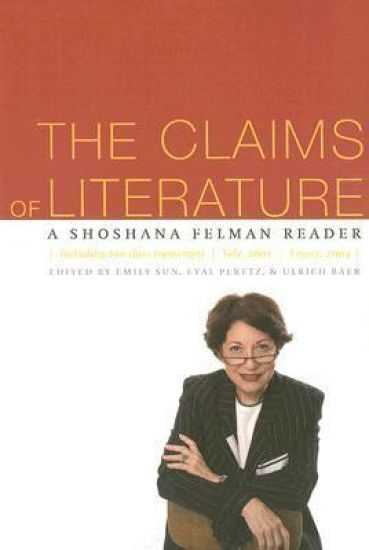
The Claims of Literature

The Claims of Literature

Shoshana Felman

Fordham University Press
2007
sidottu
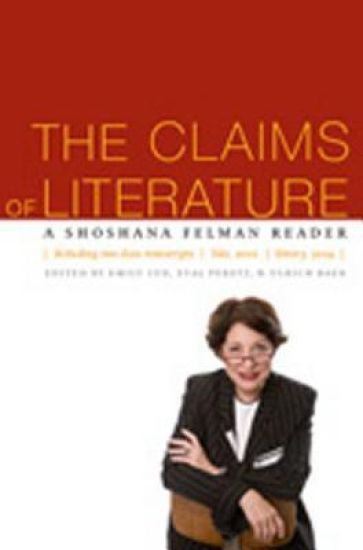
Shoshana Felman ranks as one of the most influential literary critics of the past five decades. Her work has inspired and shaped such divergent fields as psychoanalytic criticism, deconstruction, speech-act theory and performance studies, feminist and gender studies, trauma studies, and critical legal studies. Shoshana Felman has not only influenced these fields: her work has opened channels of communication between them. In all of her work Felman charts a way for literary critics to address the ways in which texts have real effects in the world and how our quest for meaning is transformed in the encounter with the texts that hold such a promise. The present collection gathers the most exemplary and influential essays from Felman's oeuvre, including articles previously untranslated into English. The Claims of Literature also includes responses to Felman's work by leading contemporary theorists, including Stanley Cavell, Judith Butler, Julia Kristeva, Cathy Caruth, Juliet Mitchell, Winfried Menninghaus, and Austin Sarat. It concludes with a section on Felman as a teacher, giving transcripts of two of her classes, one at Yale in September 2001, the other at Emory in December 2004.
The Claims of Literature

The Claims of Literature

Shoshana Felman

Fordham University Press
2007
pokkari
Shoshana Felman ranks as one of the most influential literary critics of the past five decades. Her work has inspired and shaped such divergent fields as psychoanalytic criticism, deconstruction, speech-act theory and performance studies, feminist and gender studies, trauma studies, and critical legal studies. Shoshana Felman has not only influenced these fields: her work has opened channels of communication between them. In all of her work Felman charts a way for literary critics to address the ways in which texts have real effects in the world and how our quest for meaning is transformed in the encounter with the texts that hold such a promise. The present collection gathers the most exemplary and influential essays from Felman's oeuvre, including articles previously untranslated into English. The Claims of Literature also includes responses to Felman's work by leading contemporary theorists, including Stanley Cavell, Judith Butler, Julia Kristeva, Cathy Caruth, Juliet Mitchell, Winfried Menninghaus, and Austin Sarat. It concludes with a section on Felman as a teacher, giving transcripts of two of her classes, one at Yale in September 2001, the other at Emory in December 2004.
Writing and Madness

Writing and Madness

Shoshana Felman

Stanford University Press
2003
sidottu
Writing and Madness is Shoshana Felman's most influential work of literary theory and criticism. Exploring the relations between literature, philosophy, and psychoanalysis through brilliant studies of Balzac, Nerval, Flaubert, and James, as well as Lacan, Foucault, and Derrida, this book seeks the specificity of literature in its relation to what culture excludes under the label "madness." Why and how do literary writers reclaim the discourse of the madman, and how does this reclaiming reveal something essential about the relation between literature and power, as well as between literature and knowledge? Every literary text continues to communicate with madness—with what has been excluded, decreed abnormal, unacceptable, or senseless—by dramatizing a dynamically revitalized relation between sense and nonsense, reason and unreason, the readable and the unreadable. This revelation of the irreducibility of the relation between the readable and the unreadable constitutes what the author calls la chose littéraire—the literary thing.
Writing and Madness

Writing and Madness

Shoshana Felman

Stanford University Press
2003
pokkari

Halvin toimitettuna 33,40 €

Writing and Madness is Shoshana Felman's most influential work of literary theory and criticism. Exploring the relations between literature, philosophy, and psychoanalysis through brilliant studies of Balzac, Nerval, Flaubert, and James, as well as Lacan, Foucault, and Derrida, this book seeks the specificity of literature in its relation to what culture excludes under the label "madness." Why and how do literary writers reclaim the discourse of the madman, and how does this reclaiming reveal something essential about the relation between literature and power, as well as between literature and knowledge? Every literary text continues to communicate with madness—with what has been excluded, decreed abnormal, unacceptable, or senseless—by dramatizing a dynamically revitalized relation between sense and nonsense, reason and unreason, the readable and the unreadable. This revelation of the irreducibility of the relation between the readable and the unreadable constitutes what the author calls la chose littéraire—the literary thing.
The Scandal of the Speaking Body

The Scandal of the Speaking Body

Shoshana Felman; Stanley Cavell; Judith Butler

Stanford University Press
2002
pokkari
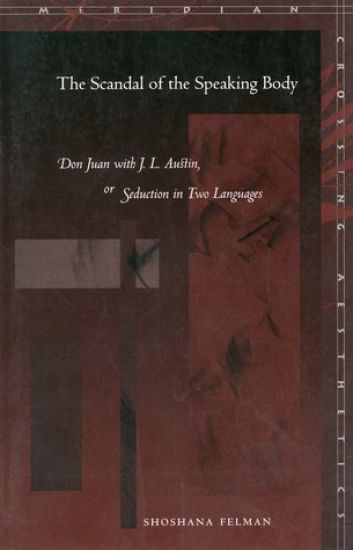
What is a promise? What are the consequences of the act of promising? In this bold yet subtle meditation, the author contemplates the seductive promise of speech and the seductive promise of love. Imagining an encounter between Molière's Don Juan and J. L. Austin, between a mythical figure of the French classical theater and a twentieth-century philosopher, she explores the relation between speech and the erotic, using a literary text as the ground for a telling encounter between philosophy, linguistics, and Lacanian psychoanalytic theory. In the years since the publication of this book (which the author today calls "the boldest, the most provocative, but also the most playful" she has written), speech act theory has continued to play a central and defining role in the theories of sexuality, gender, performance studies, post-colonial studies, and cultural studies. This book remains topical as readers increasingly discover how multiply relevant the speaking body is. Moving beyond the domain of formal linguistic analysis to address these questions, the author has written a daring and seductive book.
The Scandal of the Speaking Body

The Scandal of the Speaking Body

Shoshana Felman; Stanley Cavell; Judith Butler

Stanford University Press
2002
sidottu
What is a promise? What are the consequences of the act of promising? In this bold yet subtle meditation, the author contemplates the seductive promise of speech and the seductive promise of love. Imagining an encounter between Molière's Don Juan and J. L. Austin, between a mythical figure of the French classical theater and a twentieth-century philosopher, she explores the relation between speech and the erotic, using a literary text as the ground for a telling encounter between philosophy, linguistics, and Lacanian psychoanalytic theory. In the years since the publication of this book (which the author today calls "the boldest, the most provocative, but also the most playful" she has written), speech act theory has continued to play a central and defining role in the theories of sexuality, gender, performance studies, post-colonial studies, and cultural studies. This book remains topical as readers increasingly discover how multiply relevant the speaking body is. Moving beyond the domain of formal linguistic analysis to address these questions, the author has written a daring and seductive book.
The Juridical Unconscious

The Juridical Unconscious

Shoshana Felman

Harvard University Press
2002
nidottu
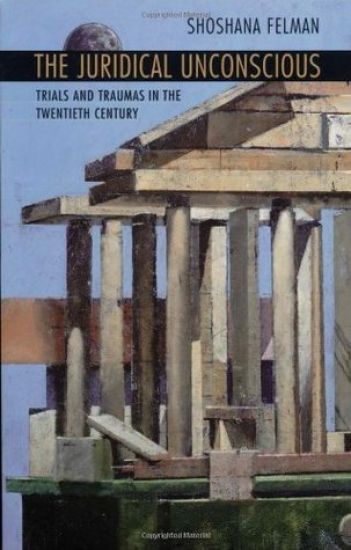
Death, wrote Walter Benjamin, lends storytellers all their authority. How do trials, in turn, borrow their authority from death? This book offers a groundbreaking account of the surprising interaction between trauma and justice. Moving from texts by Arendt, Benjamin, Freud, Zola, and Tolstoy to the Dreyfus and Nuremberg trials, as well as the trials of O. J. Simpson and Adolf Eichmann, Shoshana Felman argues that the adjudication of collective traumas in the twentieth century transformed both culture and law. This transformation took place through legal cases that put history itself on trial, and that provided a stage for the expression of the persecuted--the historically "expressionless." Examining legal events that tried to repair the crimes and injuries of history, Felman reveals the "juridical unconscious" of trials and brilliantly shows how this juridical unconscious is bound up with the logic of the trauma that a trial attempts to articulate and contain but so often reenacts and repeats. Her book gives the drama of the law a new jurisprudential dimension and reveals the relation between law and literature in a new light.
What Does a Woman Want?

What Does a Woman Want?

Shoshana Felman

Johns Hopkins University Press
1993
pokkari
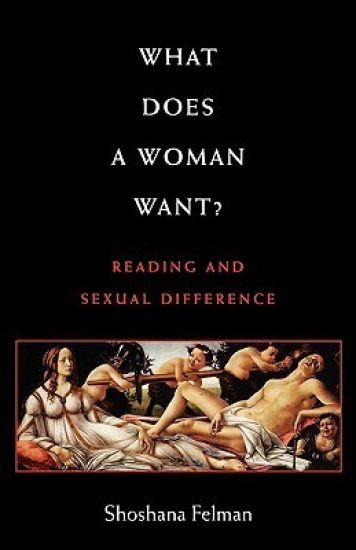
'What does a woman want?'-the question Freud famously formulated in a letter to Marie Bonaparte-is a quintessentially male question that arises from women's resistance to their place in a patriarchal society. But what might it mean, asks Shoshana Felman, for a woman to reclaim this question as her own? Can this question engender, through the literary or the psychoanalytic work, a woman's voice as its speaking subject? Felman explores these questions through close readings of autobiographical texts by Virginia Woolf, Simone de Beauvoir, and Adrienne Rich which attempt to redefine women as the subject of their own desire.
Testimony

Testimony

Shoshana Felman; Dori Laub

Routledge
1991
nidottu
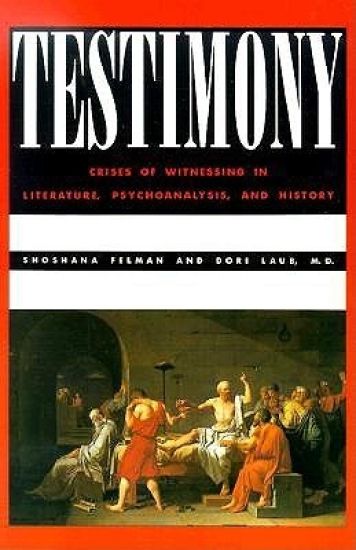
In this unique collection, Yale literary critic Shoshana Felman and psychoanalyst Dori Laub examine the nature and function of memory and the act of witnessing, both in their general relation to the acts of writing and reading, and in their particular relation to the Holocaust. Moving from the literary to the visual, from the artistic to the autobiographical, and from the psychoanalytic to the historical, the book defines for the first time the trauma of the Holocaust as a radical crisis of witnessing "the unprecedented historical occurrence of...an event eliminating its own witness." Through the alternation of a literary and clinical perspective, the authors focus on the henceforth modified relation between knowledge and event, literature and evidence, speech and survival, witnessing and ethics.