Kirjojen hintavertailu – 12 859 829 kirjaa ja 27 kauppaa

Kirjailija

Shu-Qing Yang

Kirjat ja teokset yhdessä paikassa: 3 kirjaa, julkaisuja vuosilta 2020–2025, suosituimpiin kuuluu Sustainable Water Resource Development Using Coastal Reservoirs. Vertaile teosten hintoja ja tarkista saatavuus suomalaisista kirjakaupoista.

3 kirjaa

Kirjojen julkaisuvuodet: 2020–2025.

Near-boundary Fluid Mechanics

Near-boundary Fluid Mechanics

Shu-Qing Yang

ELSEVIER SCIENCE PUBLISHING CO INC
2025
nidottu
Near-Boundary Fluid Mechanics focuses on the near-boundary region and its significance. It delves into topics like boundary shear stress, drag reduction using polymer additives, turbulence sources, secondary currents, log-law validity, sediment transport, and more. Unlike similar books, it emphasizes the importance of the near-boundary region. This book is organized into chapters covering internal flows, external flows, loose boundary flows, and density currents. It extends Prandtl's fundamental concept to internal flows, showing how potential flow theory can describe flow without a solid boundary. In addition, the book provides a theoretical analysis of boundary shear stress in three-dimensional flows and explores the turbulent structures in drag-reduction flows. A key feature is clarifying the role of wall-normal velocity in mass, moment, and energy transfer. Additionally, Archimedes' principle is covered to explain pressure drag and establishes a relationship between wake volume and hydrodynamic force.
Coastal Reservoir Technology and Applications

Coastal Reservoir Technology and Applications

Shu-Qing Yang

Elsevier - Health Sciences Division
2022
nidottu
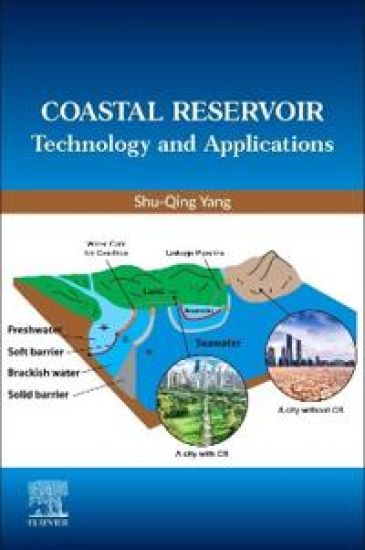
Coastal Reservoir Technology and Applications presents the analyses showing that the world is not running out of water, but water is running out of river mouths—we need to work to harness this resource. Compared with inland water storages and desalination technology, coastal reservoirs are a nature-based water solution without disturbing the environment. This book mainly answers the questions of what the coastal reservoir technology is, where we should construct coastal reservoirs, and how to supply sufficient, high-quality and affordable water to the world with minimum environmental/social impacts. Chapter 1 reviews modes of water resources development in the history along with current problems and reasons. Chapter 2 discusses the definition of coastal reservoirs, its classifications and applications, and the SPP/downstream water management strategy. Other chapters analyse water crisis in every continent, as well as their water solutions. The possible coastal reservoir for each major river is suggested as well. Without freshwater, no one can survive. Likewise, without sufficient, high-quality and affordable freshwater, no community can achieve sustainable development. However, water is also a killer when it is too much (floods), too dirty (pollution), and too turbid. Different from other books, this resource shows how to solve these water problems. Coastal reservoirs and SPP strategy are suggested to develop floodwater in a safe way in coastal and inland regions, respectively. Solution of water-food-energy-ecosystem nexus needs a paradigm shift from upstream to downstream water management, i.e., from mountainous dams to coastal reservoirs, which conserves the precious, clean freshwater in seawater environment.
Sustainable Water Resource Development Using Coastal Reservoirs

Sustainable Water Resource Development Using Coastal Reservoirs

T.G. Sitharam; Shu-Qing Yang; Roger Falconer; Muttucumaru Sivakumar; Brian Jones; Sreevalsa Kolathayar; Lim Sinpoh

Butterworth-Heinemann Inc
2020
nidottu
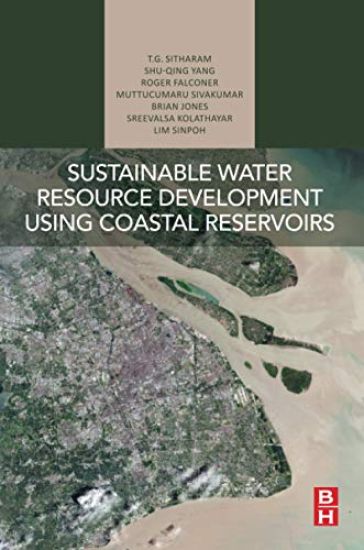
Coastal reservoirs are viewed in many regions of the world as an emerging concept of storing fresh water when the river basin is in flood. Similar reservoirs (or impoundments) can be used to generate tidal renewable energy and/or provide the catalysis for urban regeneration. Constructed near the coast in natural river basins, these reservoirs have a smaller environmental footprint and are less obstructive than inland dams. Written by an international group of Civil, Environmental, and Geotechnical Engineers, Sustainable Water Resource Development using Coastal Reservoirs discusses the latest research and breakthroughs in their use, while offering expert advice into their sustainable design and construction. The perfect reference for researchers exploring the feasibility of this emerging technology or experienced professionals who wish to implement this technology as a water scarcity solution or a tidal renewable energy source or for urban regeneration, Sustainable Water Resource Development using Coastal Reservoirs provides an expert resource to the design, construction and use of coastal reservoirs. The reference begins with a brief but readable examination of water quantity, quality design and geotechnical considerations. The book includes international case studies to clearly illustrate the various uses, design, planning, construction, and operation methods. These case studies include projects such as: Afsluitdijk in the IJsselmeer, (Netherlands), Zuiderzee (Netherlands), Thanneermukkom Bund (India), Sihwa (South Korea), Saemangeum, (South Korea), Chenhang (China), Plover Cove (China), and Marina Barrage (Singapore).