

Kirjailija
Shubham Sinha
Kirjat ja teokset yhdessä paikassa: 29 kirjaa, julkaisuja vuosilta 2014–2025, suosituimpiin kuuluu Moulage nasoalvéolaire préchirurgical. Vertaile teosten hintoja ja tarkista saatavuus suomalaisista kirjakaupoista.
29 kirjaa
Kirjojen julkaisuvuodet: 2014–2025.
Moulage nasoalvéolaire préchirurgical
Shubham Sinha; Kavita Dhinsa; Gunjan Yadav
Editions Notre Savoir
2025
pokkari
Präoperative nasoalveoläre Abformung
Shubham Sinha; Kavita Dhinsa; Gunjan Yadav
Verlag Unser Wissen
2025
pokkari
Przedoperacyjne formowanie nosowo-pecherzykowe
Shubham Sinha; Kavita Dhinsa; Gunjan Yadav
Wydawnictwo Nasza Wiedza
2025
pokkari

Moldagem nasoalveolar pré-cirúrgica
Shubham Sinha; Kavita Dhinsa; Gunjan Yadav
Edicoes Nosso Conhecimento
2025
pokkari
Modellamento prechirurgico del nasoalveolo
Shubham Sinha; Kavita Dhinsa; Gunjan Yadav
Edizioni Sapienza
2025
pokkari
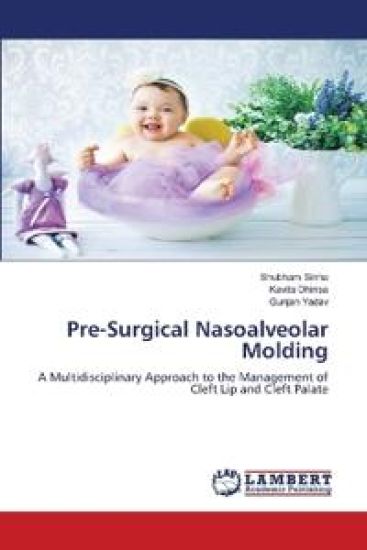
Pre-Surgical Nasoalveolar Molding
Shubham Sinha; Kavita Dhinsa; Gunjan Yadav
Lap Lambert Academic Publishing
2025
pokkari
Reprint of the original, first published in 1872.
Reprint of the original, first published in 1872.

Article 370 & 35A and the constitution of Jammu and Kashmir: Indian Law Series
Shubham Sinha
Independently Published
2019
nidottu
This book is a brief description of Article 370 of the constitution of India and the constitution of Jammu and Kashmir which, gives a deeper idea for the understanding of special status of Jammu and Kashmir it's necessity and essentials to establish and revoke it. Incorporated into the Constitution on October 17, 1949, Article 370 absolves J&K from the Indian Constitution (aside from Article 1 and Article 370 itself) and licenses the state to draft its own Constitution. It limits Parliament's administrative powers in regard of J&K. For broadening a focal law on subjects incorporated into the Instrument of Accession (IoA), unimportant "discussion" with the state government is required. Be that as it may, for extending it to different issues, "simultaneousness" of the state government is obligatory. The IoA became an integral factor when the Indian Independence Act, 1947 isolated British India into India and Pakistan. For somewhere in the range of 600 princely expresses whose power was reestablished on Independence, the Act accommodated three alternatives: to remain an autonomous nation, join Dominion of India, or join Dominion of Pakistan - and this uniting with both of the two nations was to be through an IoA. Despite the fact that no endorsed structure was given, a state so joining could indicate the terms on which it consented to join. The adage for contracts between states is pacta sunt servanda, for example guarantees between states must be regarded; if there is a rupture of agreement, the general standard is that gatherings are to be reestablished to the first position. Various different states appreciate unique status under Article 371, from 371A to 371I. The Schedule affixed to the Instrument of Accession enabled Parliament to administer in regard of J&K just on Defense, External Affairs and Communications. In Kashmir's Instrument of Accession in Clause 5, Raja Hari Singh, leader of J&K, unequivocally referenced that the particulars of "my Instrument of Accession can't be fluctuated by any change of the Act or of Indian Independence Act except if such alteration is acknowledged by me by an Instrument strengthening to this Instrument". Provision 7 said "nothing in this Instrument will be esteemed to submit me in any capacity to acknowledgment of any future constitution of India or to chain my carefulness to go into courses of action with the Government of India under any such future constitution". Raja Hari Singh had at first chosen to stay autonomous and consent to halt arrangements with India and Pakistan, and Pakistan in actuality marked it. However, following an attack from tribesmen and Army men in casually dressed from Pakistan, he looked for the assistance of India, which thus looked for the increase of Kashmir to India. Hari Singh marked the Instrument of Accession on October 26, 1947 and Governor General Lord Mountbatten acknowledged it on October 27, 1947.
The Muslim Women (Protection of Rights on Marriage) Bill, 2018 -- Triple Talaq Bill or Triple Talaq Law of India: Indian Law Series
Shubham Sinha
Independently Published
2019
nidottu
Triple talaq is a form of divorce that was practised in India, whereby a Muslim man could legally divorce his wife by pronouncing talaq (the Arabic word for divorce) three times. The pronouncement could be oral or written, or, in recent times, delivered by electronic means such as telephone, SMS, email or social media. The man did not need to cite any cause for the divorce and the wife need not have been present at the time of pronouncement. After a period of iddat, during which it was ascertained whether the wife is pregnant, the divorce became irrevocable. In the recommended practice, a waiting period was required before each pronouncement of talaq, during which reconciliation was attempted. However, it had become common to make all three pronouncements in one sitting. While the practice was frowned upon, it was not prohibited. A divorced woman could not remarry her divorced husband unless she first married another man, a practice called nikah halala. Until she remarried, she retained the custody of male toddlers and prepubescent female children. Beyond those restrictions, the children came under the guardianship of the father.

Railway Laws of India: Indian Law Series
Shubham Sinha
Createspace Independent Publishing Platform
2016
nidottu
Americans with Disabilities Act of 1990 - ADA - 42 U.S. Code Chapter 126: ( Federal Employment and Labor Laws ) - US Law Series
Shubham Sinha
Createspace Independent Publishing Platform
2016
nidottu
The Banking Laws of India (Actuaries Act 2006): Indian Law Series
Shubham Sinha
Createspace Independent Publishing Platform
2015
nidottu
The Banking Laws of India (Bankers Book Evidence Act): Indian Law Series
Shubham Sinha
Createspace Independent Publishing Platform
2015
nidottu
The Banking Laws of India (The African Development Bank Act, 1983): Indian Law Series
Shubham Sinha
Createspace Independent Publishing Platform
2015
nidottu
The Income Tax law of India: Indian Law Series
Shubham Sinha
Createspace Independent Publishing Platform
2015
nidottu
This book is BARE ACT of Indian Law on Income Tax within Indian territories. It is the hardcore set of rules as exactly provided by Indian government authorities. The Income-tax Act, 1961 is the charging Statute of Income Tax in India. It provides for levy, administration, collection and recovery of Income Tax. Recently the Government of India has brought out a draft statute called the "Direct Taxes Code" intended to replace the Income Tax Act,1961 and the Wealth Tax Act, 1956. Public Commentary has been called for the Draft Bill. The redrafted bill is supposed to be made public soon. 1) Subject to the provisions of this Act, the total income of any previous year of a person who is a resident includes all income from whatever source derived which-(a) is received or is deemed to be received in India in such year by or on behalf of such person; or(b) accrues or arises or is deemed to accrue or arise to him in India during such year; or(c) accrues or arises to him outside India during such year: Provided that, in the case of a person not ordinarily resident in India within the meaning of sub-section (6) of section 6, the income which accrues or arises to him outside India shall not be so included unless it is derived from a business controlled in or a profession set up in India.(2) Subject to the provisions of this Act, the total income of any previous year of a person who is a non-resident includes all income from whatever source derived which-(a) is received or is deemed to be received in India in such year by or on behalf of such person; or(b) accrues or arises or is deemed to accrue or arise to him in India during such year. Explanation 1.-Income accruing or arising outside India shall not be deemed to be received in India within the meaning of this section by reason only of the fact that it is taken into account in a balance sheet prepared in India. Explanation 2.-For the removal of doubts, it is hereby declared that income which has been included in the total income of a person on the basis that it has accrued or arisen or is deemed to have accrued or arisen to him shall not again be so included on the basis that it is received or deemed to be received by him in
The Property Law of India: Indian Law Series
Shubham Sinha
Createspace Independent Publishing Platform
2015
nidottu
Code of Civil Procedure of California (Part -1): US Law Series
Shubham Sinha
Createspace Independent Publishing Platform
2015
nidottu
Code of Civil Procedure of California (Part-2): US Law Series
Shubham Sinha
Createspace Independent Publishing Platform
2015
nidottu