Kirjojen hintavertailu – 12 903 724 kirjaa ja 27 kauppaa

Kirjailija

Shunsuke Managi

Kirjat ja teokset yhdessä paikassa: 11 kirjaa, julkaisuja vuosilta 2007–2024, suosituimpiin kuuluu Technology, Natural Resources and Economic Growth. Vertaile teosten hintoja ja tarkista saatavuus suomalaisista kirjakaupoista.

11 kirjaa

Kirjojen julkaisuvuodet: 2007–2024.

Natural Capital and Climate Smart Agriculture

Natural Capital and Climate Smart Agriculture

Pradyot Ranjan Jena; Shunsuke Managi; Ritanjali Majhi

TAYLOR FRANCIS LTD
2024
sidottu
India is the fastest growing and the world’s third-largest economy in terms of GDP in PPP terms. Sustainable development of India will ensure the welfare of the inhabitants of this most populated country. This book assesses trends of natural capital and areas of improvement through climate resilient agricultural adaptation in India. The book looks at how the agricultural sector can become more climate resilient to ensure food security and human capital development. It also suggests a policy framework towards climate-resilient agricultural development. It outlines determinants of climate-smart agricultural practices and their impact on agricultural yield, biodiversity, and food security, and as well as outreach activities for wider collaboration from around the world. This book will interest those who are researching accounting natural capital impacts of climate-resilient agriculture and 2030 SDGs.
Japan’s Quest for Nuclear Energy and the Price It Has Paid

Japan’s Quest for Nuclear Energy and the Price It Has Paid

Noriko Hikosaka Behling; Thomas G. Behling; Mark C. Williams; Shunsuke Managi

Elsevier Science Publishing Co Inc
2019
nidottu
Japan’s Quest for Nuclear Energy and the Price it has Paid: Accidents, Consequences, and Lessons Learned for the Global Nuclear Industry identifies major accidents in Japan that have happened at different stages of the nuclear fuel cycle in Japan, assesses the underlying causes of nuclear accidents, and identifies other systemic problems in the nuclear industry. It provides recommendations on how government, industry and academic institutions can work together toward achieving a zero-accident safety culture.
Environmental Economics

Environmental Economics

Shunsuke Managi; Koichi Kuriyama

Routledge
2016
sidottu
This book aids those concerned about environmental issues to firmly grasp relevant analytical methods and to comprehend the thought process behind environmental economics. It does so by drawing from specific environmental issues and at the same time providing commentary that facilitates understanding. This text contains in-depth explanations necessary for a thorough understanding of the fundamental aspects and importance of environmental economics. Environmental Economics seeks to elucidate the mechanisms that give rise to environmental problems by approaching environmental issues from an economic perspective. At the same time, it is a study aiming to indicate specific countermeasures that could resolve present environmental issues. This text has been put together in way that allows readers without specialized economics knowledge to easily understand the situation, issues and challenges of environmental economics.
Environmental Economics

Environmental Economics

Shunsuke Managi; Koichi Kuriyama

Routledge
2016
nidottu
This book aids those concerned about environmental issues to firmly grasp relevant analytical methods and to comprehend the thought process behind environmental economics. It does so by drawing from specific environmental issues and at the same time providing commentary that facilitates understanding. This text contains in-depth explanations necessary for a thorough understanding of the fundamental aspects and importance of environmental economics. Environmental Economics seeks to elucidate the mechanisms that give rise to environmental problems by approaching environmental issues from an economic perspective. At the same time, it is a study aiming to indicate specific countermeasures that could resolve present environmental issues. This text has been put together in way that allows readers without specialized economics knowledge to easily understand the situation, issues and challenges of environmental economics.
Waste and Recycling

Waste and Recycling

Takayoshi Shinkuma; Shunsuke Managi

Routledge
2013
nidottu
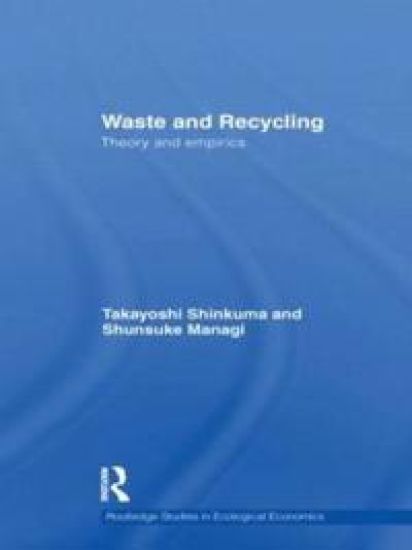
As "business as usual" has become the mantra of today's world, it's unlikely to see a decrease in hazardous waste generated from greater economic growth. Written by renowned experts, the book suggests a solution, supported by theoretical arguments to this waste problem. The book discusses how main problems for waste management can be addressed through appropriate policies adopted by governments in OECD countries. The book also raises thoughtful questions on how household waste management services should be privatized and who should pay for the disposal and recycling costs. It attempts to answer these questions. The book considers several factors hindering the first-best optimal outcome and highlights two crucial ones. It elaborates further with models and the solutions on how to overcome these obstacles. The book covers not only traditional resource economics and waste management, but also the recent problem of Electric waste (E-waste) and illustrates in details, how the environments of developing countries are inevitably polluted even with the Basel ban Amendment in place. The book proposes an alternative international trading regulation to address E-waste. This book will certainly appeal to industry decision-makers, policy makers and legislators.
Technology, Natural Resources and Economic Growth

Technology, Natural Resources and Economic Growth

Shunsuke Managi

Edward Elgar Publishing Ltd
2011
sidottu
Through a combination of global data analysis and focused country level analysis, this timely book provides answers to the most pertinent country and industry specific questions defining the current relationship between technology, natural resources and economic growth. Shunsuke Managi takes a distinctive approach by focusing on the design and implementation of environmental regulations that encourage technological progress and, in doing so, looks at ways to ensure productivity improvements in the face of increasingly stringent environmental regulations and natural resource depletion. The findings in this important book demonstrate how successful environmental policies can contribute to efficiency by encouraging, rather than inhibiting, technological innovation. Technology, Natural Resources and Economic Growth will provide a valuable resource for a wide readership including postgraduate students, researchers, academics and policy makers working in the fields of environmental and ecological economics.
Waste and Recycling

Waste and Recycling

Takayoshi Shinkuma; Shunsuke Managi

Routledge
2011
sidottu
As "business as usual" has become the mantra of today's world, it's unlikely to see a decrease in hazardous waste generated from greater economic growth. Written by renowned experts, the book suggests a solution, supported by theoretical arguments to this waste problem. The book discusses how main problems for waste management can be addressed through appropriate policies adopted by governments in OECD countries. The book also raises thoughtful questions on how household waste management services should be privatized and who should pay for the disposal and recycling costs. It attempts to answer these questions. The book considers several factors hindering the first-best optimal outcome and highlights two crucial ones. It elaborates further with models and the solutions on how to overcome these obstacles. The book covers not only traditional resource economics and waste management, but also the recent problem of Electric waste (E-waste) and illustrates in details, how the environments of developing countries are inevitably polluted even with the Basel ban Amendment in place. The book proposes an alternative international trading regulation to address E-waste. This book will certainly appeal to industry decision-makers, policy makers and legislators.
The Economics of Sustainable Development

The Economics of Sustainable Development

Surender Kumar; Shunsuke Managi

Springer-Verlag New York Inc.
2010
nidottu
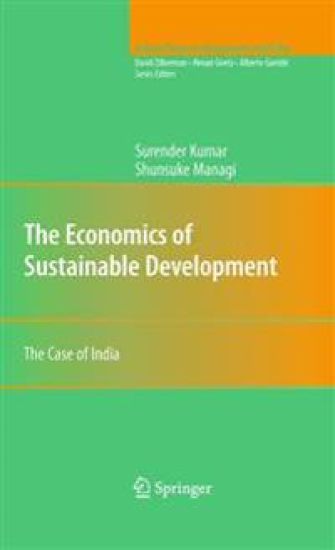
This book highlights methodological approaches for the economics of sustainable development and brings together recent empirical work done in India, especially by Dr. Surender Kumar and Dr. Shunsuke Managi. Various chapters in this book use Indian data to show the very wide applicability of methodologies in the theory of production for dealing with many empirical issues of environmentally sustainable development in a developing country. I congratulate the authors for the time and effort devoted to compiling this very useful reference on the subject and the publishers for publishing this volume. The methodologies of cost functions, distance functions, and production fu- tions have been used in many recent studies and in the studies reported in this book for environmental valuation. Environmental valuation is required for designing policy instruments like pollution taxes for sustainable development and for meas- ing green GDP. The UN methodology of integrated environmental and economic accounting provides ways of measuring the cost of maintaining environmental resources at sustainable levels or the maintenance cost for estimating green GDP. Some of the chapters in this book show that the methodology of distance functions could be used for estimating the cost of environmentally sustainable development.
Chinese Economic Development and the Environment

Chinese Economic Development and the Environment

Shunsuke Managi; Shinji Kaneko

Edward Elgar Publishing Ltd
2009
sidottu
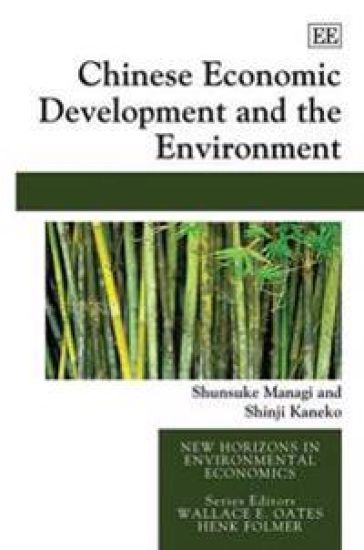
Over the past two decades, China has become an economic powerhouse. However, as the world's largest producer of CO2 emissions, the scale and seriousness of China's environmental problems are clearly evident. This pioneering book provides an economic analysis of the significant environmental and energy problems facing China in the 21st century. Chinese Economic Development and the Environment measures productivity, taking into account energy resources and environmental attributes that are central to sustaining economies. Applying an integrated model of energy production, transformation and consumption processes, the authors investigate the underlying driving forces behind trends in CO2 emissions in relation to the total primary energy supply. Exploring the history and development of China's economic, energy and environmental policy, this book will strongly appeal to postgraduate students in economics and environmental studies. It will also be beneficial for practitioners and policy-makers interested in understanding how successful market and environmental policies can contribute to efficiency by encouraging, rather than inhibiting, technological innovation.
The Economics of Sustainable Development

The Economics of Sustainable Development

Surender Kumar; Shunsuke Managi

Springer-Verlag New York Inc.
2009
sidottu
This book highlights methodological approaches for the economics of sustainable development and brings together recent empirical work done in India, especially by Dr. Surender Kumar and Dr. Shunsuke Managi. Various chapters in this book use Indian data to show the very wide applicability of methodologies in the theory of production for dealing with many empirical issues of environmentally sustainable development in a developing country. I congratulate the authors for the time and effort devoted to compiling this very useful reference on the subject and the publishers for publishing this volume. The methodologies of cost functions, distance functions, and production fu- tions have been used in many recent studies and in the studies reported in this book for environmental valuation. Environmental valuation is required for designing policy instruments like pollution taxes for sustainable development and for meas- ing green GDP. The UN methodology of integrated environmental and economic accounting provides ways of measuring the cost of maintaining environmental resources at sustainable levels or the maintenance cost for estimating green GDP. Some of the chapters in this book show that the methodology of distance functions could be used for estimating the cost of environmentally sustainable development.
Technological Change and Environmental Policy

Technological Change and Environmental Policy

Shunsuke Managi

Edward Elgar Publishing Ltd
2007
sidottu
This important book provides a comprehensive analysis of technological change and environmental policy within the oil and gas industry. It identifies and measures the impact of technological change, both in market and environmental output sectors and takes steps to identify key causal relationships. The author focuses on the design and implementation of environmental policies that encourage technological progress in the face of the depletion of natural resources and the increasing stringency of environmental regulations. Detailed policy scenarios provide quantitative assessments indicating the significance of the potential benefits of technological change and well-designed environmental policy. With a sophisticated description of innovations within the oil and gas industry, this book will be of great interest to postgraduate students in economics, as well as in public policy, business administration and engineering. It will also appeal to practitioners in the energy industry and energy and environmental policymakers as it demonstrates how successful market and environmental policies can contribute to efficiency by encouraging, rather than inhibiting, technological innovation.