Kirjojen hintavertailu – 12 859 828 kirjaa ja 27 kauppaa

Kirjailija

Shuzhi Sam Ge

Kirjat ja teokset yhdessä paikassa: 12 kirjaa, julkaisuja vuosilta 2011–2025, suosituimpiin kuuluu Modeling, Control and Coordination of Helicopter Systems. Vertaile teosten hintoja ja tarkista saatavuus suomalaisista kirjakaupoista.

12 kirjaa

Kirjojen julkaisuvuodet: 2011–2025.

Multimodal Perception and Secure State Estimation for Robotic Mobility Platforms

Multimodal Perception and Secure State Estimation for Robotic Mobility Platforms

Xinghua Liu; Rui Jiang; Badong Chen; Shuzhi Sam Ge

JOHN WILEY SONS INC
2022
sidottu
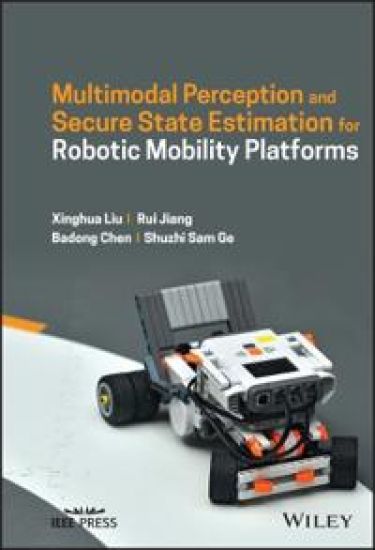
Multimodal Perception and Secure State Estimation for Robotic Mobility Platforms Enables readers to understand important new trends in multimodal perception for mobile robotics This book provides a novel perspective on secure state estimation and multimodal perception for robotic mobility platforms such as autonomous vehicles. It thoroughly evaluates filter-based secure dynamic pose estimation approaches for autonomous vehicles over multiple attack signals and shows that they outperform conventional Kalman filtered results. As a modern learning resource, it contains extensive simulative and experimental results that have been successfully implemented on various models and real platforms. To aid in reader comprehension, detailed and illustrative examples on algorithm implementation and performance evaluation are also presented. Written by four qualified authors in the field, sample topics covered in the book include: Secure state estimation that focuses on system robustness under cyber-attacksMulti-sensor fusion that helps improve system performance based on the complementary characteristics of different sensorsA geometric pose estimation framework to incorporate measurements and constraints into a unified fusion scheme, which has been validated using public and self-collected dataHow to achieve real-time road-constrained and heading-assisted pose estimation This book will appeal to graduate-level students and professionals in the fields of ground vehicle pose estimation and perception who are looking for modern and updated insight into key concepts related to the field of robotic mobility platforms.
Fundamentals in Modeling and Control of Mobile Manipulators
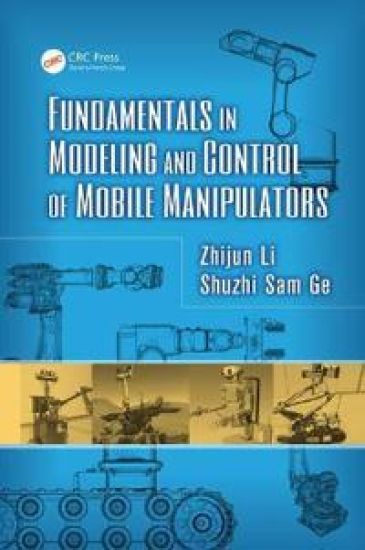
Mobile manipulators combine the advantages of mobile platforms and robotic arms, extending their operational range and functionality to large spaces and remote, demanding, and/or dangerous environments. They also bring complexity and difficulty in dynamic modeling and control system design. However, advances in nonlinear system analysis and control system design offer powerful tools and concepts for the control of mobile manipulator systems. Fundamentals in Modeling and Control of Mobile Manipulators presents a thorough theoretical treatment of several fundamental problems for mobile robotic manipulators. The book integrates fresh concepts and state-of-the-art results to systematically examine kinematics and dynamics, motion generation, feedback control, coordination, and cooperation. From this treatment, the authors form a basic theoretical framework for a mobile robotic manipulator that extends the theory of nonlinear control and applies to more realistic problems. Drawing on their research over the past ten years, the authors propose novel control theory concepts and techniques to tackle key problems. Topics covered include kinematic and dynamic modeling, control of nonholonomic systems, path planning that considers motion and manipulation, hybrid motion/force control and hybrid position/force control where the mobile manipulator is required to interact with environments, and coordination and cooperation strategies for multiple mobile manipulators. The book also includes practical examples of applications in engineering systems. This timely book investigates important scientific and engineering issues for researchers and engineers working with either single or multiple mobile manipulators for larger operational space, better cooperation, and improved productivity.
Dynamics and Control of Mechanical Systems in Offshore Engineering

Dynamics and Control of Mechanical Systems in Offshore Engineering

Wei He; Shuzhi Sam Ge; Bernard Voon Ee How; Yoo Sang Choo

Springer London Ltd
2016
nidottu
Dynamics and Control of Mechanical Systems in Offshore Engineering is a comprehensive treatment of marine mechanical systems (MMS) involved in processes of great importance such as oil drilling and mineral recovery. Ranging from nonlinear dynamic modeling and stability analysis of flexible riser systems, through advanced control design for an installation system with a single rigid payload attached by thrusters, to robust adaptive control for mooring systems, it is an authoritative reference on the dynamics and control of MMS. Readers will gain not only a complete picture of MMS at the system level, but also a better understanding of the technical considerations involved and solutions to problems that commonly arise from dealing with them. The text provides: · a complete framework of dynamical analysis and control design for marine mechanical systems;· new results on the dynamical analysis of riser, mooring and installation systems together with a general modeling method for a class of MMS;· a general method and strategy for realizing the control objectives of marine systems with guaranteed stability the effectiveness of which is illustrated by extensive numerical simulation; and · approximation-based control schemes using neural networks for installation of subsea structures with attached thrusters in the presence of time-varying environmental disturbances and parametric uncertainties. Most of the results presented are analytical with repeatable design algorithms with proven closed-loop stability and performance analysis of the proposed controllers is rigorous and detailed. Dynamicsand Control of Mechanical Systems in Offshore Engineering is primarily intended for researchers and engineers in the system and control community, but graduate students studying control and marine engineering will also find it a useful resource as will practitioners working on the design, running or maintenance of offshore platforms.
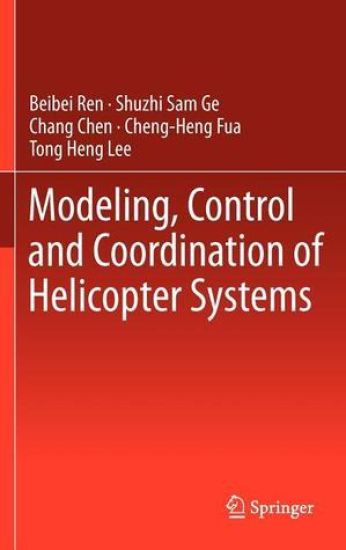
Modeling, Control and Coordination of Helicopter Systems

Modeling, Control and Coordination of Helicopter Systems

Beibei Ren; Shuzhi Sam Ge; Chang Chen; Cheng-Heng Fua; Tong Heng Lee

Springer-Verlag New York Inc.
2014
nidottu
Modeling, Control and Coordination of Helicopter Systems provides a comprehensive treatment of helicopter systems, ranging from related nonlinear flight dynamic modeling and stability analysis to advanced control design for single helicopter systems, and also covers issues related to the coordination and formation control of multiple helicopter systems to achieve high performance tasks. Ensuring stability in helicopter flight is a challenging problem for nonlinear control design and development. This book is a valuable reference on modeling, control and coordination of helicopter systems,providing readers with practical solutions for the problems that still plague helicopter system design and implementation. Readers will gain a complete picture of helicopters at the systems level, as well as a better understanding of the technical intricacies involved.
Dynamics and Control of Mechanical Systems in Offshore Engineering

Dynamics and Control of Mechanical Systems in Offshore Engineering

Wei He; Shuzhi Sam Ge; Bernard Voon Ee How; Yoo Sang Choo

Springer London Ltd
2013
sidottu
Dynamics and Control of Mechanical Systems in Offshore Engineering is a comprehensive treatment of marine mechanical systems (MMS) involved in processes of great importance such as oil drilling and mineral recovery. Ranging from nonlinear dynamic modeling and stability analysis of flexible riser systems, through advanced control design for an installation system with a single rigid payload attached by thrusters, to robust adaptive control for mooring systems, it is an authoritative reference on the dynamics and control of MMS. Readers will gain not only a complete picture of MMS at the system level, but also a better understanding of the technical considerations involved and solutions to problems that commonly arise from dealing with them. The text provides: · a complete framework of dynamical analysis and control design for marine mechanical systems;· new results on the dynamical analysis of riser, mooring and installation systems together with a general modeling method for a class of MMS;· a general method and strategy for realizing the control objectives of marine systems with guaranteed stability the effectiveness of which is illustrated by extensive numerical simulation; and · approximation-based control schemes using neural networks for installation of subsea structures with attached thrusters in the presence of time-varying environmental disturbances and parametric uncertainties. Most of the results presented are analytical with repeatable design algorithms with proven closed-loop stability and performance analysis of the proposed controllers is rigorous and detailed. Dynamicsand Control of Mechanical Systems in Offshore Engineering is primarily intended for researchers and engineers in the system and control community, but graduate students studying control and marine engineering will also find it a useful resource as will practitioners working on the design, running or maintenance of offshore platforms.
Fundamentals in Modeling and Control of Mobile Manipulators
Mobile manipulators combine the advantages of mobile platforms and robotic arms, extending their operational range and functionality to large spaces and remote, demanding, and/or dangerous environments. They also bring complexity and difficulty in dynamic modeling and control system design. However, advances in nonlinear system analysis and control system design offer powerful tools and concepts for the control of mobile manipulator systems. Fundamentals in Modeling and Control of Mobile Manipulators presents a thorough theoretical treatment of several fundamental problems for mobile robotic manipulators. The book integrates fresh concepts and state-of-the-art results to systematically examine kinematics and dynamics, motion generation, feedback control, coordination, and cooperation. From this treatment, the authors form a basic theoretical framework for a mobile robotic manipulator that extends the theory of nonlinear control and applies to more realistic problems. Drawing on their research over the past ten years, the authors propose novel control theory concepts and techniques to tackle key problems. Topics covered include kinematic and dynamic modeling, control of nonholonomic systems, path planning that considers motion and manipulation, hybrid motion/force control and hybrid position/force control where the mobile manipulator is required to interact with environments, and coordination and cooperation strategies for multiple mobile manipulators. The book also includes practical examples of applications in engineering systems. This timely book investigates important scientific and engineering issues for researchers and engineers working with either single or multiple mobile manipulators for larger operational space, better cooperation, and improved productivity.
Modeling, Control and Coordination of Helicopter Systems

Modeling, Control and Coordination of Helicopter Systems

Beibei Ren; Shuzhi Sam Ge; Chang Chen; Cheng-Heng Fua; Tong Heng Lee

Springer-Verlag New York Inc.
2011
sidottu
Modeling, Control and Coordination of Helicopter Systems provides a comprehensive treatment of helicopter systems, ranging from related nonlinear flight dynamic modeling and stability analysis to advanced control design for single helicopter systems, and also covers issues related to the coordination and formation control of multiple helicopter systems to achieve high performance tasks. Ensuring stability in helicopter flight is a challenging problem for nonlinear control design and development. This book is a valuable reference on modeling, control and coordination of helicopter systems,providing readers with practical solutions for the problems that still plague helicopter system design and implementation. Readers will gain a complete picture of helicopters at the systems level, as well as a better understanding of the technical intricacies involved.
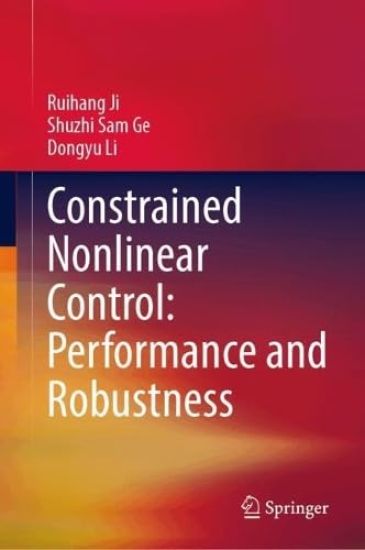
Constrained Nonlinear Control: Performance and Robustness

Constrained Nonlinear Control: Performance and Robustness

Ruihang Ji; Shuzhi Sam Ge; Dongyu Li

Springer Nature Switzerland AG
2025
sidottu
This book is concerned with nonlinear control with performance-related and system-ability-related constraints. It presents novel work on several kinds of commonly encountered nonlinear systems, including those with stricter transient performance requirements, those with two types of constraints, those with no initial-condition limitation, and those with limited resources. It shows how nonlinear systems with severe constraints can be successfully controlled with our powerful control design. Typically, the book discusses a Tunnel Prescribed Control for achieving enhanced performance; provides a comprehensive solution, namely, Saturation-tolerant Prescribed Control, to handle the conflict between constraints; and then develops a Self-adjustable Prescribed Control to address the defined Entry Capture Problem that performance constraints are satis?ed after (rather than from the beginning of) system operation. As such, the book will be of interest to researchers and graduate students in the fields of nonlinear systems, constrained control, and control engineering who would like to find out about the performance, robustness, and applications of constrained nonlinear systems.
Time-Synchronized Control: Analysis and Design

Time-Synchronized Control: Analysis and Design

Dongyu Li; Shuzhi Sam Ge; Tong Heng Lee

SPRINGER VERLAG, SINGAPORE
2023
nidottu
Previous research on fixed/finite-time sliding-mode control focuses on forcing a system state (vector) to converge within a certain time moment, regardless of how each state element converges. This book introduces a control problem with unique finite/fixed-time stability considerations, namely time-synchronized stability, where at the same time, all the system state elements converge to the origin, and fixed-time-synchronized stability, where the upper bound of the synchronized settling time is invariant with any initial state. Accordingly, sufficient conditions for (fixed-) time-synchronized stability are presented. These stability formulations grant essentially advantageous performance when a control system (with diversified subsystems) is expected to accomplish multiple actions synchronously, e.g., grasping with a robotic hand, multi-agent simultaneous cooperation, etc. Further, the analytical solution of a (fixed) time-synchronized stable system is obtained and discussed. Applications to linear systems, disturbed nonlinear systems, and network systems are provided. In addition, comparisons with traditional fixed/finite-time sliding mode control are suitably detailed to showcase the full power of (fixed-) time-synchronized control.
Time-Synchronized Control: Analysis and Design

Time-Synchronized Control: Analysis and Design

Dongyu Li; Shuzhi Sam Ge; Tong Heng Lee

Springer Verlag, Singapore
2022
sidottu
Previous research on fixed/finite-time sliding-mode control focuses on forcing a system state (vector) to converge within a certain time moment, regardless of how each state element converges. This book introduces a control problem with unique finite/fixed-time stability considerations, namely time-synchronized stability, where at the same time, all the system state elements converge to the origin, and fixed-time-synchronized stability, where the upper bound of the synchronized settling time is invariant with any initial state. Accordingly, sufficient conditions for (fixed-) time-synchronized stability are presented. These stability formulations grant essentially advantageous performance when a control system (with diversified subsystems) is expected to accomplish multiple actions synchronously, e.g., grasping with a robotic hand, multi-agent simultaneous cooperation, etc. Further, the analytical solution of a (fixed) time-synchronized stable system is obtained and discussed. Applications to linear systems, disturbed nonlinear systems, and network systems are provided. In addition, comparisons with traditional fixed/finite-time sliding mode control are suitably detailed to showcase the full power of (fixed-) time-synchronized control.
Stability Theory of Switched Dynamical Systems

Stability Theory of Switched Dynamical Systems

Zhendong Sun; Shuzhi Sam Ge

Springer London Ltd
2013
nidottu
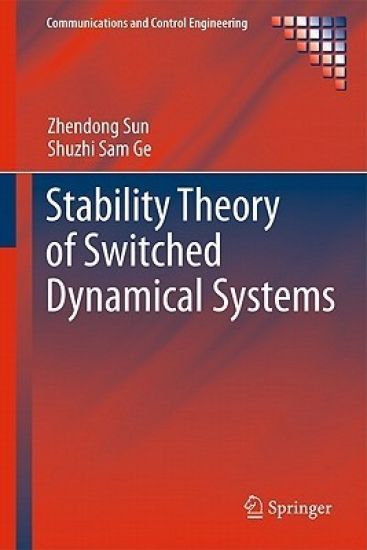
There are plenty of challenging and interesting problems open for investigation in the field of switched systems. Stability issues help to generate many complex nonlinear dynamic behaviors within switched systems. The authors present a thorough investigation of stability effects on three broad classes of switching mechanism: arbitrary switching where stability represents robustness to unpredictable and undesirable perturbation, constrained switching, including random (within a known stochastic distribution), dwell-time (with a known minimum duration for each subsystem) and autonomously-generated (with a pre-assigned mechanism) switching; and designed switching in which a measurable and freely-assigned switching mechanism contributes to stability by acting as a control input. For each of these classes this book propounds: detailed stability analysis and/or design, related robustness and performance issues, connections to other control problems and many motivating and illustrative examples.
Stability Theory of Switched Dynamical Systems

Stability Theory of Switched Dynamical Systems

Zhendong Sun; Shuzhi Sam Ge

Springer London Ltd
2011
sidottu
There are plenty of challenging and interesting problems open for investigation in the field of switched systems. Stability issues help to generate many complex nonlinear dynamic behaviors within switched systems. The authors present a thorough investigation of stability effects on three broad classes of switching mechanism: arbitrary switching where stability represents robustness to unpredictable and undesirable perturbation, constrained switching, including random (within a known stochastic distribution), dwell-time (with a known minimum duration for each subsystem) and autonomously-generated (with a pre-assigned mechanism) switching; and designed switching in which a measurable and freely-assigned switching mechanism contributes to stability by acting as a control input. For each of these classes this book propounds: detailed stability analysis and/or design, related robustness and performance issues, connections to other control problems and many motivating and illustrative examples.