Kirjojen hintavertailu – 12 859 819 kirjaa ja 27 kauppaa

Kirjailija

Simon Bornschier

Kirjat ja teokset yhdessä paikassa: 4 kirjaa, julkaisuja vuosilta 2008–2024, suosituimpiin kuuluu Cleavage Formation in the 21st Century. Vertaile teosten hintoja ja tarkista saatavuus suomalaisista kirjakaupoista.

4 kirjaa

Kirjojen julkaisuvuodet: 2008–2024.

Cleavage Formation in the 21st Century

Cleavage Formation in the 21st Century

Simon Bornschier; Lukas Haffert; Silja Häusermann; Marco Steenbergen; Delia Zollinger

Cambridge University Press
2024
pokkari
Western Europe is experiencing growing levels of political polarization between parties of the New Left and the Far Right. The authors argue that this antagonism reflects the emergence of a social cleavage between universalism and particularism. To understand cleavage formation in the midst of party system fragmentation and the proliferation of new competitors, they emphasize the crucial role of group identities. Anchored in social structure, group identities help us understand why specific party appeals resonate with certain groups, thereby mediating the link between socio-structural change and broader party blocks defined by their distinctive ideologies along the new cleavage. Based on original survey data from France, Germany, Switzerland, and the UK, this Element presents evidence for the formation of a universalism–particularism cleavage across European party systems that diverge strongly on institutional and political characteristics. This title is also available as Open Access on Cambridge Core.

Cleavage Formation in the 21st Century

Cleavage Formation in the 21st Century

Simon Bornschier; Lukas Haffert; Silja Häusermann; Marco Steenbergen; Delia Zollinger

Cambridge University Press
2024
sidottu
Western Europe is experiencing growing levels of political polarization between parties of the New Left and the Far Right. The authors argue that this antagonism reflects the emergence of a social cleavage between universalism and particularism. To understand cleavage formation in the midst of party system fragmentation and the proliferation of new competitors, they emphasize the crucial role of group identities. Anchored in social structure, group identities help us understand why specific party appeals resonate with certain groups, thereby mediating the link between socio-structural change and broader party blocks defined by their distinctive ideologies along the new cleavage. Based on original survey data from France, Germany, Switzerland, and the UK, this Element presents evidence for the formation of a universalism–particularism cleavage across European party systems that diverge strongly on institutional and political characteristics. This title is also available as Open Access on Cambridge Core.

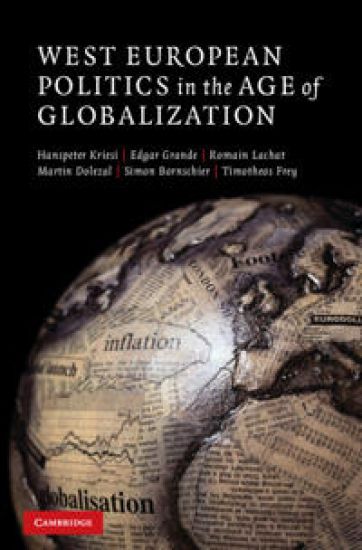
West European Politics in the Age of Globalization

West European Politics in the Age of Globalization

Hanspeter Kriesi; Edgar Grande; Romain Lachat; Martin Dolezal; Simon Bornschier; Timotheos Frey

Cambridge University Press
2008
sidottu
Over the past three decades the effects of globalization and denationalization have created a division between 'winners' and 'losers' in Western Europe. This study examines the transformation of party political systems in six countries (Austria, France, Germany, the Netherlands, Switzerland and the UK) using opinion surveys, as well as newly collected data on election campaigns. The authors argue that, as a result of structural transformations and the strategic repositioning of political parties, Europe has observed the emergence of a tripolar configuration of political power, comprising the left, the moderate right, and the new populist right. They suggest that, through an emphasis on cultural issues such as mass immigration and resistance to European integration, the traditional focus of political debate - the economy - has been downplayed or reinterpreted in terms of this new political cleavage. This new analysis of Western European politics will interest all students of European politics and political sociology.