Kirjojen hintavertailu – 12 859 818 kirjaa ja 27 kauppaa

Kirjailija

Simon Critchley

Kirjat ja teokset yhdessä paikassa: 50 kirjaa, julkaisuja vuosilta 1996–2025, suosituimpiin kuuluu Bigert & Bergström : Works 1986-2016. Vertaile teosten hintoja ja tarkista saatavuus suomalaisista kirjakaupoista.

50 kirjaa

Kirjojen julkaisuvuodet: 1996–2025.

Things Merely Are

Things Merely Are

Simon Critchley

Routledge
2005
sidottu
This book is an invitation to read poetry. Simon Critchley argues that poetry enlarges life with a range of observation, power of expression and attention to language that eclipses any other medium. In a rich engagement with the poetry of Wallace Stevens, Critchley reveals that poetry also contains deep and important philosophical insight. Above all, he agues for a 'poetic epistemology' that enables us to think afresh the philosophical problem of the relation between mind and world, and ultimately to cast the problem away. Drawing astutely on Kant, the German and English Romantics and Heidegger, Critchley argues that through its descriptions of particular things and their stubborn plainness - whether water, guitars, trees, or cats - poetry evokes the 'mereness' of things. It is this experience, he shows, that provokes the mood of calm and releases the imaginative insight we need to press back against the pressure of reality. Critchley also argues that this calm defines the cinematic eye of Terrence Malick, whose work is discussed at the end of the book.
Things Merely Are

Things Merely Are

Simon Critchley

Routledge
2005
nidottu
This book is an invitation to read poetry. Simon Critchley argues that poetry enlarges life with a range of observation, power of expression and attention to language that eclipses any other medium. In a rich engagement with the poetry of Wallace Stevens, Critchley reveals that poetry also contains deep and important philosophical insight. Above all, he agues for a 'poetic epistemology' that enables us to think afresh the philosophical problem of the relation between mind and world, and ultimately to cast the problem away. Drawing astutely on Kant, the German and English Romantics and Heidegger, Critchley argues that through its descriptions of particular things and their stubborn plainness - whether water, guitars, trees, or cats - poetry evokes the 'mereness' of things. It is this experience, he shows, that provokes the mood of calm and releases the imaginative insight we need to press back against the pressure of reality. Critchley also argues that this calm defines the cinematic eye of Terrence Malick, whose work is discussed at the end of the book.
Very Little ... Almost Nothing

Very Little ... Almost Nothing

Simon Critchley

Routledge
2004
sidottu
Very Little ... Almost Nothing puts the question of the meaning of life back at the centre of intellectual debate. Its central concern is how we can find a meaning to human finitude without recourse to anything that transcends that finitude. A profound but secular meditation on the theme of death, Critchley traces the idea of nihilism through Blanchot, Levinas, Jena Romanticism and Cavell, culminating in a reading of Beckett, in many ways the hero of the book. In this second edition, Simon Critchley has added a revealing and extended new preface, and a new chapter on Wallace Stevens which reflects on the idea of poetry as philosophy.
Very Little ... Almost Nothing

Very Little ... Almost Nothing

Simon Critchley

Routledge
2004
nidottu

Halvin toimitettuna 54,50 €

Very Little ... Almost Nothing puts the question of the meaning of life back at the centre of intellectual debate. Its central concern is how we can find a meaning to human finitude without recourse to anything that transcends that finitude. A profound but secular meditation on the theme of death, Critchley traces the idea of nihilism through Blanchot, Levinas, Jena Romanticism and Cavell, culminating in a reading of Beckett, in many ways the hero of the book. In this second edition, Simon Critchley has added a revealing and extended new preface, and a new chapter on Wallace Stevens which reflects on the idea of poetry as philosophy.
Humor

Humor

Simon Critchley

Routledge
2002
nidottu
Humor is een fascinerend, prachtig geschreven en komisch boek over wat homor ons kan vertellen over onze menselijke natuur. Van de oudheid tot aan de moderne tijd en puttend uit het werk van een breed scala aan auteurs, in het bijzonder Swift, Sterne, Shaftesbury, Bergson, Beckett en Freud, keert Humor het komische binnenstebuiten en onthult ons een smakelijk inzicht in wat we grappig vinden. Humor beantwoordt vragen zoals: "Waarom lijden komieken aan depressies", "Waarom lachen we zo vaak om dieren" en "Wat gebeurt er in racistische en seksistische humor". Humor zal niet alleen de lezers uit een reeks van disciplines zoals filosofie, theologie, literatuurwetenschap, psycholanalyse, geschiedenis en antropologie aanspreken, maar ook zeer tot de verbeelding spreken van een ieder met een gevoel voor humor - ieder van ons dus, hopelijk.
On Humour

On Humour

Simon Critchley

Routledge
2002
sidottu
Does humour make us human, or do the cats and dogs laugh along with us? On Humour is a fascinating, beautifully written and funny book on what humour can tell us about being human. Simon Critchley skilfully probes some of the most perennial but least understood aspects of humour, such as our tendency to laugh at animals and our bodies, why we mock death with comedy and why we think it's funny when people act like machines. He also looks at the darker side of humour, as rife in sexism and racism and argues that it is important for reminding us of people we would rather not be.
On Humour

On Humour

Simon Critchley

Routledge
2002
nidottu
Does humour make us human, or do the cats and dogs laugh along with us? On Humour is a fascinating, beautifully written and funny book on what humour can tell us about being human. Simon Critchley skilfully probes some of the most perennial but least understood aspects of humour, such as our tendency to laugh at animals and our bodies, why we mock death with comedy and why we think it's funny when people act like machines. He also looks at the darker side of humour, as rife in sexism and racism and argues that it is important for reminding us of people we would rather not be.
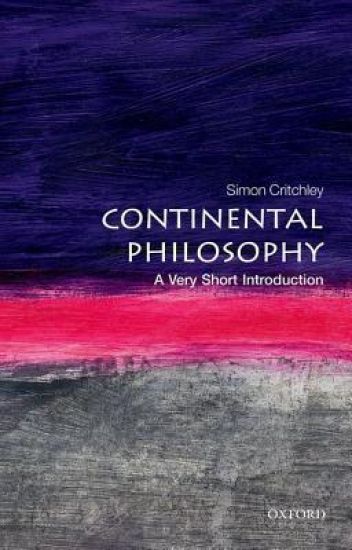
Continental Philosophy

Continental Philosophy

Simon Critchley

Oxford University Press
2001
nidottu

Halvin toimitettuna 18,90 €

Simon Critchley's Very Short Introduction shows that Continental philosophy encompasses a distinct set of philosophical traditions and practices, with a compelling range of problems all too often ignored by the analytic tradition. He discusses the ideas and approaches of philosophers such as Kant, Hegel, Nietzsche, Husserl, Heidegger, Sartre, Habermas, Foucault, and Derrida, and introduces key concepts such as existentialism, nihilism, and phenomenology by explaining their place in the Continental tradition. ABOUT THE SERIES: The Very Short Introductions series from Oxford University Press contains hundreds of titles in almost every subject area. These pocket-sized books are the perfect way to get ahead in a new subject quickly. Our expert authors combine facts, analysis, perspective, new ideas, and enthusiasm to make interesting and challenging topics highly readable.
Deconstruction and Pragmatism

Deconstruction and Pragmatism

Simon Critchley; Jacques Derrida; Ernesto Laclau; Richard Rorty

Routledge
1996
sidottu
Deconstruction and pragmatism constitute two of the major intellectual influences on the contemporary theoretical scene; influences personified in the work of Jacques Derrida and Richard Rorty. Both Rortian pragmatism, which draws the consequences of post-war developments in Anglo-American philosophy, and Derridian deconstruction, which extends and troubles the phonomenological and Heideggerian influence on the Continental tradition, have hitherto generally been viewed as mutually exclusive philosophical language games. The purpose of this volume is to bring deconstruction and pragmatism into critical confrontation with one another through staging a debate between Derrida and Rorty, itself based on discussions that took place at the College International de Philosophie in Paris in 1993. The ground for this debate is layed out in introductory papers by Simon Critchley and Ernesto Laclau, and the remainder of the volume records Derrida's and Rorty's responses to each other's work. Chantal Mouffe gives an overview of the stakes of this debate in a helpful preface.
Deconstruction and Pragmatism

Deconstruction and Pragmatism

Simon Critchley; Jacques Derrida; Ernesto Laclau; Richard Rorty

Routledge
1996
nidottu
Deconstruction and pragmatism constitute two of the major intellectual influences on the contemporary theoretical scene; influences personified in the work of Jacques Derrida and Richard Rorty. Both Rortian pragmatism, which draws the consequences of post-war developments in Anglo-American philosophy, and Derridian deconstruction, which extends and troubles the phonomenological and Heideggerian influence on the Continental tradition, have hitherto generally been viewed as mutually exclusive philosophical language games. The purpose of this volume is to bring deconstruction and pragmatism into critical confrontation with one another through staging a debate between Derrida and Rorty, itself based on discussions that took place at the College International de Philosophie in Paris in 1993. The ground for this debate is layed out in introductory papers by Simon Critchley and Ernesto Laclau, and the remainder of the volume records Derrida's and Rorty's responses to each other's work. Chantal Mouffe gives an overview of the stakes of this debate in a helpful preface.