Kirjojen hintavertailu – 12 903 725 kirjaa ja 27 kauppaa

Kirjailija

Simon Esmonde Cleary

Kirjat ja teokset yhdessä paikassa: 8 kirjaa, julkaisuja vuosilta 1987–2022, suosituimpiin kuuluu Extra-Mural areas of Romano-British towns. Vertaile teosten hintoja ja tarkista saatavuus suomalaisista kirjakaupoista.

Nimi esiintyy myös muodoissa: Simon Esmonde-Cleary

8 kirjaa

Kirjojen julkaisuvuodet: 1987–2022.

Chedworth Roman Villa

Chedworth Roman Villa

Simon Esmonde Cleary; Jason Wood; Emma Durham

SOCIETY FOR THE PROMOTION OF ROMAN STUDIES
2022
nidottu
Ten years in the planning and with contributions by 27 expert authors, this is a comprehensive record of archaeological research at Chedworth Roman Villa, Gloucestershire (now in the care of the National Trust), from the nineteenth to the twenty-first centuries. The volume brings together a large body of new, contextualised information about the villa including: a history of work at Chedworth from the 1860s to the present; a detailed fabric survey of the extant remains; description and analysis of the Roman structural remains; description and analysis of the decorative elements (e.g. mosaics, sculpture) and finds (e.g. coins, Roman artefacts, glass, pottery and bones); discussion of the development of the villa and its place in the landscape; the consolidation and display of the villa from its discovery in 1864 to the present. The volume is well illustrated with drawings and photos ranging in date from the late 1800s to the present. The volume will appeal to all with an interest in Roman Britain, and Roman villas in particular, and in the antiquarians who first discovered and investigated them.
Chedworth Roman Villa

Chedworth Roman Villa

Simon Esmonde Cleary

National Trust Books
2017
nidottu
Nestling in a wooded combe in the heart of the Cotswolds and surrounded by beautiful woodland walks, Chedworth Roman Villa is one of the most important sites where visitors can come into direct contact with Roman Britain. Its uncovering in 1864 yielded one of the most complete plans of a Romano-Britain villa, and the museum constructed immediately after is one of the earliest (if not the earliest) purpose-built, on-site museums in the country. The Villa and its finds demonstrate the prosperity of the Golden Age of Roman Britain in the fourth century AD. During this time Britain's ruling class had come to absorb much Roman culture, such as the gods and goddesses and myths of the Mediterranean. But this is not the full story. Parts of the villa complex have as yet not been excavated: the agricultural buildings, the houses of the labourers who cultivated the fields and tended the herds. It was these resources and workers that paid for the lords and ladies to live in such high style. This guide tells the story of how the fortunate wealthy few at the very top of Romano-British society lived and worked. It includes details about when the Villa was first built, who the people who lived at the Villa and on its lands were, what the landscape of this part of the Roman Cotswolds looked like, and how this great Villa came to be abandoned and fall into ruin. Including painstaking reconstructions and drawings of the villa and its facilities through the ages, this guide benefits from modern conservation and archaeology to reveal the secrets of a unique treasure of Roman Britain.
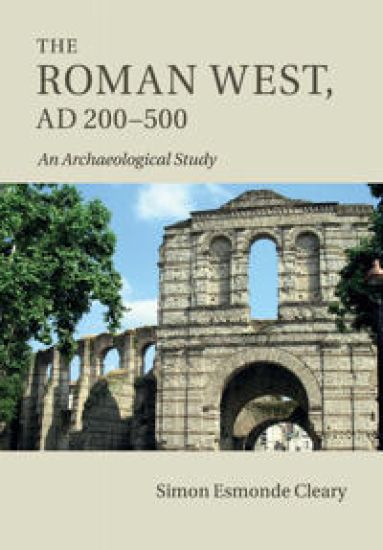
The Roman West, AD 200–500

The Roman West, AD 200–500

Simon Esmonde Cleary

Cambridge University Press
2016
pokkari
This book describes and analyses the development of the Roman West from Gibraltar to the Rhine, using primarily the extensive body of published archaeological evidence rather than the textual evidence underlying most other studies. It situates this development within a longer-term process of change, proposing the later second century rather than the 'third-century crisis' as the major turning-point, although the latter had longer-term consequences owing to the rise in importance of military identities. Elsewhere, more 'traditional' forms of settlement and display were sustained, to which was added the vocabulary of Christianity. The longer-term rhythms are also central to assessing the evidence for such aspects as rural settlement and patterns of economic interaction. The collapse of Roman imperial authority emphasised trends such as militarisation and regionalisation along with economic and cultural disintegration. Indicators of 'barbarian/Germanic' presence are reassessed within such contexts and the traditional interpretations questioned and alternatives proposed.
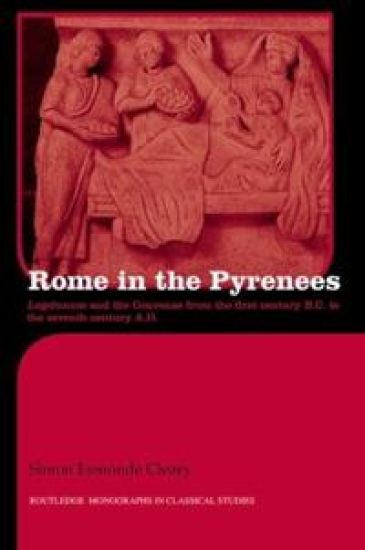
Rome in the Pyrenees

Rome in the Pyrenees

Simon Esmonde-Cleary

Routledge
2012
nidottu
Rome in the Pyrenees is a unique treatment in English of the archaeological and historical evidence for an important Roman town in Gaul, Lugdunum in the French Pyrenees, and for its surrounding people the Convenae. The book opens with the creation of the Convenae by Pompey the Great in the first century B. C. and runs down to the great Frankish siege in A. D. 585 and its aftermath. Now the town of Saint-Bertrand-de-Comminges, Lugdunum is one of the best-known Roman towns in Gaul, with a rich selection of monuments at the town itself and important remains in the countryside, such as the classic villa at Montmaurin or the votive altars, cinerary caskets and sarcophagi in the local marble. The book traces how the Convenae used their marble to help create their identity, invisible before Pompey but amongst the richest and most distinctive in Gaul by the second century A. D. Drawing on his own excavations at Saint-Bertrand and the extensive earlier and recent work there, Simon Esmonde Cleary combines a clear description of the buildings and monuments of Lugdunum and of its countryside with a discussion of what they can tell us about the impact of Rome on this remote corner of its empire. This book will be extremely valuable to ancient historians, classicists and students of Roman archaeology, and contains a guide to the visible Roman remains of the area.
The City in the Roman West, c.250 BC–c.AD 250

The City in the Roman West, c.250 BC–c.AD 250

Ray Laurence; Simon Esmonde Cleary; Gareth Sears

Cambridge University Press
2011
pokkari
The city is widely regarded as the most characteristic expression of the social, cultural and economic formations of the Roman Empire. This was especially true in the Latin-speaking West, where urbanism was much less deeply ingrained than in the Greek-speaking East but where networks of cities grew up during the centuries following conquest and occupation. This well-illustrated synthesis provides students and specialists with an overview of the development of the city in Italy, Gaul, Britain, Germany, Spain and North Africa, whether their interests lie in ancient history, Roman archaeology or the wider history of urbanism. It accounts not only for the city's geographical and temporal spread and its associated monuments (such as amphitheatres and baths), but also for its importance to the rulers of the Empire as well as the provincials and locals.
The City in the Roman West, c.250 BC–c.AD 250

The City in the Roman West, c.250 BC–c.AD 250

Ray Laurence; Simon Esmonde Cleary; Gareth Sears

Cambridge University Press
2011
sidottu
The city is widely regarded as the most characteristic expression of the social, cultural and economic formations of the Roman Empire. This was especially true in the Latin-speaking West, where urbanism was much less deeply ingrained than in the Greek-speaking East but where networks of cities grew up during the centuries following conquest and occupation. This well-illustrated synthesis provides students and specialists with an overview of the development of the city in Italy, Gaul, Britain, Germany, Spain and North Africa, whether their interests lie in ancient history, Roman archaeology or the wider history of urbanism. It accounts not only for the city's geographical and temporal spread and its associated monuments (such as amphitheatres and baths), but also for its importance to the rulers of the Empire as well as the provincials and locals.
Rome in the Pyrenees

Rome in the Pyrenees

Simon Esmonde-Cleary

Routledge
2007
sidottu
Rome in the Pyrenees is a unique treatment in English of the archaeological and historical evidence for an important Roman town in Gaul, Lugdunum in the French Pyrenees, and for its surrounding people the Convenae. The book opens with the creation of the Convenae by Pompey the Great in the first century B. C. and runs down to the great Frankish siege in A. D. 585 and its aftermath. Now the town of Saint-Bertrand-de-Comminges, Lugdunum is one of the best-known Roman towns in Gaul, with a rich selection of monuments at the town itself and important remains in the countryside, such as the classic villa at Montmaurin or the votive altars, cinerary caskets and sarcophagi in the local marble. The book traces how the Convenae used their marble to help create their identity, invisible before Pompey but amongst the richest and most distinctive in Gaul by the second century A. D. Drawing on his own excavations at Saint-Bertrand and the extensive earlier and recent work there, Simon Esmonde Cleary combines a clear description of the buildings and monuments of Lugdunum and of its countryside with a discussion of what they can tell us about the impact of Rome on this remote corner of its empire. This book will be extremely valuable to ancient historians, classicists and students of Roman archaeology, and contains a guide to the visible Roman remains of the area.