Kirjojen hintavertailu – 12 903 725 kirjaa ja 27 kauppaa

Kirjailija

Simon Hug

Kirjat ja teokset yhdessä paikassa: 5 kirjaa, julkaisuja vuosilta 2001–2022, suosituimpiin kuuluu Voices of Europe. Vertaile teosten hintoja ja tarkista saatavuus suomalaisista kirjakaupoista.

5 kirjaa

Kirjojen julkaisuvuodet: 2001–2022.

Sharing Power, Securing Peace?

Sharing Power, Securing Peace?

Lars-Erik Cederman; Simon Hug; Julian Wucherpfennig

Cambridge University Press
2022
sidottu
Does power sharing bring peace? Policymakers around the world seem to think so. Yet, while there are many successful examples of power sharing in multi-ethnic states, such as Switzerland, South Africa and Indonesia, other instances show that such arrangements offer no guarantee against violent conflict, including Rwanda, Yugoslavia, Zimbabwe and South Sudan. Given this mixed record, it is not surprising that scholars disagree as to whether power sharing actually reduces conflict. Based on systematic data and innovative methods, this book comes to a mostly positive conclusion by focusing on practices rather than merely formal institutions, studying power sharing's preventive effect, analyzing how power sharing is invoked in anticipation of conflict, and by showing that territorial power sharing can be effective if combined with inclusion at the center. The authors' findings demonstrate that power sharing is usually the best option to reduce and prevent civil conflict in divided states.

Sharing Power, Securing Peace?

Sharing Power, Securing Peace?

Lars-Erik Cederman; Simon Hug; Julian Wucherpfennig

Cambridge University Press
2022
pokkari
Does power sharing bring peace? Policymakers around the world seem to think so. Yet, while there are many successful examples of power sharing in multi-ethnic states, such as Switzerland, South Africa and Indonesia, other instances show that such arrangements offer no guarantee against violent conflict, including Rwanda, Yugoslavia, Zimbabwe and South Sudan. Given this mixed record, it is not surprising that scholars disagree as to whether power sharing actually reduces conflict. Based on systematic data and innovative methods, this book comes to a mostly positive conclusion by focusing on practices rather than merely formal institutions, studying power sharing's preventive effect, analyzing how power sharing is invoked in anticipation of conflict, and by showing that territorial power sharing can be effective if combined with inclusion at the center. The authors' findings demonstrate that power sharing is usually the best option to reduce and prevent civil conflict in divided states.

Voices of Europe

Voices of Europe

Simon Hug

Rowman Littlefield Publishers
2003
nidottu
Referendums are playing an increasingly influential role in the process of European integration. Starting with the entry of a first wave of new European Community members in the 1970s, this instrument of popular decision making has grown ever more important. Later stages in the enlargement process of the European Union have led to even more referendums. Indeed, European integration was seriously jeopardized when Danish voters first rejected the Maastricht Treaty and France's citizens almost joined them. Yet we know very little about how referendums affect the integration process. This landmark study bridges this gap in two ways. First, it offers a thorough comparative analysis of referendums that have occurred so far in the process of European integration. Utilizing a detailed study of voting behavior by citizens in these referendum campaigns, Simon Hug argues that understanding this behavior is of crucial importance if we want to accurately assess the impact of referendums on European integration. The author then draws on his comparative data to analyze the likely consequences of referendums based on those that have taken place and proposals for new initiatives. With its detailed empirical analysis and theoretical foundation, this book makes an important contribution both to the study of referendums and to our understanding of institutional reform and integration within the EU.
Voices of Europe

Voices of Europe

Simon Hug

Rowman Littlefield Publishers
2002
sidottu
This landmark study explores the increasingly important role that referendums play in the process of European integration. Employing an original research design, Simon Hug effectively blends formal modeling and statistical analysis to assess the consequences of European Union-wide referendums. He shows that their use has created more difficulties than the backers of direct democracy anticipated. With its detailed empirical analysis, this book makes an important contribution both to the study of referendums and to our understanding of institutional reform and integration within the EU.
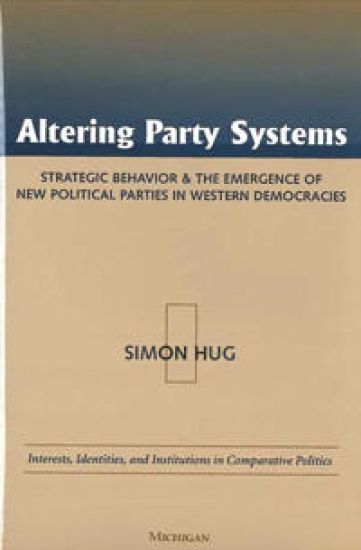
Altering Party Systems

Altering Party Systems

Simon Hug

The University of Michigan Press
2001
sidottu
New political parties have regularly appeared in developed democracies around the world. In some countries issues focusing on the environment, immigration, economic decline, and regional concerns have been brought to the forefront by new political parties. In other countries these issues have been addressed by established parties, and new issue-driven parties have failed to form. Most current research is unable to explain why under certain circumstances new issues or neglected old ones lead to the formation of new parties. Based on a novel theoretical framework, this study demonstrates the crucial interplay between established parties and possible newcomers to explain the emergence of new political parties. Deriving stable hypotheses from a simple theoretical model, the book proceeds to a study of party formation in twenty-two developed democracies. New or neglected issues still appear as a driving force in explaining the emergence of new parties, but their effect is partially mediated by institutional factors, such as access to the ballot, public support for parties, and the electoral system. The hypotheses in part support existing theoretical work, but in part present new insights. The theoretical model also pinpoints problems of research design that are hardly addressed in the comparative literature on new political parties. These insights from the theoretical model lead to empirical tests that improve on those employed in the literature and allow for a much-enhanced understanding of the formation and the success of new parties. Simon Hug is Lecturer in Political Science, University of Geneva.