

Kirjailija
Simon Lilley
Kirjat ja teokset yhdessä paikassa: 8 kirjaa, julkaisuja vuosilta 2004–2026, suosituimpiin kuuluu Deltics. Vertaile teosten hintoja ja tarkista saatavuus suomalaisista kirjakaupoista.
8 kirjaa
Kirjojen julkaisuvuodet: 2004–2026.

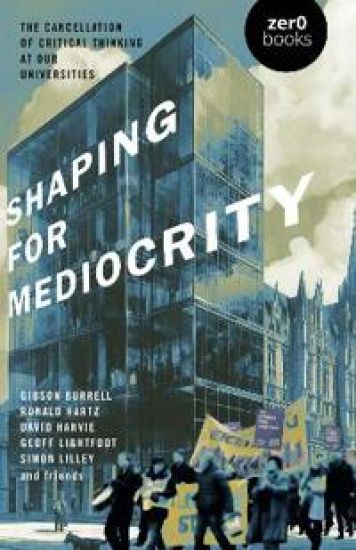
Shaping for Mediocrity
David Harvie; Gibson Burrell; Ronald Hartz; Geoff Lightfoot; Simon Lilley
Collective Ink
2024
nidottu
Halvin toimitettuna 17,60 €
In 2021, as part of a programme called Shaping for Excellence, bosses at the University of Leicester made redundant numerous scholars in what was simultaneously an attack on academic freedom and trade union organisation. The authors of Shaping for Mediocrity not only had front-row seats in the campaign against these mass redundancies, they were in the ring - both as targeted employees and as trade union officers and negotiators. Shaping for Mediocrity tells the inside story of these attacks and the campaign against them. It situates this story within a longer history of struggle to make the university a place where critical thinking is possible, showing how events in Leicester are both reflective of higher education in the UK following four decades of neoliberal 'reform' and a particularly egregious instance of the increasingly authoritarian management of public institutions such as universities.

The first Brush Type 4 No D1500 was delivered to British Railways in September 1962, working its first passenger trains on 8 October. This new book from Simon Lilley is a pictorial history of their first 20 years in service with a mix of black and white and colour photographs used to illustrate the history of the Class 47s from their very early days to the early 1980s. All the key developments of the class over these years are captured and explained, including livery changes as green gave way to corporate blue and locomotives were fitted with train air-brakes and electric train heating equipment. There were many variations within the Class 47 fleet, both big and small, and this book highlights those differences. The wide mix of locations gives a geographical spread across country, and include some locations not normally associated with the locomotives, reflecting their work over the years across the rail network on a wide variety passenger, parcels and freight duties.

This comprehensive textbook reveals the fascinating complexity of management studies and takes an engaging critical approach designed to help students challenge the preconceptions of the discipline. As managers, students will need to think independently in response to a broad range of scenarios. Here, key topics such as leadership, sustainability, and ethics are rethought by international experts and illustrated with organizational examples. The result is a challenging, yet accessible, analysis of contemporary work with the aim of improving management practice at its core. The new and second edition of this highly regarded textbook has been revised and updated throughout. Written by a highly experienced team of expert, this textbook is an essential resource for advanced undergraduate, postgraduate and MBA students of management and organizational behaviour.

Representing Organization
Simon Lilley; Geoffrey Lightfoot; Paulo Amaral M. N.
Oxford University Press
2004
sidottu
This work attempts to bridge the gap between the abstractions of current theories of organization and the somewhat excessively grounded material that forms the bulk of literatures within the information systems and knowledge management communities. It provides a theoretically informed analysis of the organizational impact of information technologies by examining and commenting upon the myriad ways in which various actors, organizations, and environments are represented through these technologies. The book deploys a number of different theoretical lenses (including systems theory, social constructivism, labour process theory, post-structuralism and actor network theory) that offer complementary and contrasting insights into the computerization of (managerial) work and its administration, and uses these theories to consider real examples of the development and implementation of knowledge and information systems.
Representing Organization
Simon Lilley; Geoffrey Lightfoot; Paulo Amaral M. N.
Oxford University Press
2004
nidottu
This textbook provides an accessible theoretical analysis of the organizational impact of information technologies. It seeks to examine and comment upon the myriad ways in which actors, organizations, and environments are represented through these technologies. Contemporary threats to organizational form and stability are considered alongside the potential that information technologies offer to both exacerbate and overcome them. It examines, amongst others, issues surrounding the material and symbolic aspects of information systems; risk and prediction; systems implementation and systems success; knowledge management practices; accountability and other management practices; computerized modelling; and the virtual organization. To this end it deploys a number of different theoretical lenses including: · systems theory · social constructivism · labour process theory · post-structuralism · actor network theory These offer complementary and contrasting insights into the computerization of managerial work. In order to ensure that the book is both relevant and approachable to students from a range of backgrounds these theories are applied to real examples of the development and implementation of information systems. This combination fosters practical knowledge that is theoretically informed. The book thus aims to bridge the gap between the abstractions of current theories of organization and the grounded material that forms the bulk of Information Systems literature. It thus offers a novel way into the ongoing debates surrounding technological change and the perennial problems of managerial control. It has been designed to support theoretically informed Information and Technology courses at the advanced undergraduate and postgraduate levels, and will also be of interest to academics in the fields of Management, Information Technology, Sociological, and Cultural studies.