Kirjojen hintavertailu – 12 903 725 kirjaa ja 27 kauppaa

Kirjailija

Simon Reich

Kirjat ja teokset yhdessä paikassa: 6 kirjaa, julkaisuja vuosilta 1990–2021, suosituimpiin kuuluu The Fruits of Fascism. Vertaile teosten hintoja ja tarkista saatavuus suomalaisista kirjakaupoista.

6 kirjaa

Kirjojen julkaisuvuodet: 1990–2021.

Across Type, Time and Space

Across Type, Time and Space

Peter Dombrowski; Simon Reich

Cambridge University Press
2021
pokkari
The field of grand strategy is exceptionally American-centric theoretically, methodologically and empirically. Indeed, many scholars treat the United States as a unique case, and thus incomparable. This Element addresses the shortcomings of this approach by developing a novel framework for the purpose of systematic comparison, both within and among different countries. Using the United States as a benchmark, three dimensions are considered in which grand strategy can be compared: first, attributes of the major types commonly discussed in the literature; second, similarities and differences in the implementation of grand strategies over time, using US strategic relations with contemporary Russia as an example; and finally, across space, properties of the grand strategies that are interactively employed by other major powers in relation to the United States in the Indo-Pacific. The Element can be used by scholars and students alike to expand analysis beyond the confines that currently dominate the field.

The End of Grand Strategy

The End of Grand Strategy

Simon Reich; Peter Dombrowski

Cornell University Press
2018
sidottu
In The End of Grand Strategy, Simon Reich and Peter Dombrowski challenge the common view of grand strategy as unitary. They eschew prescription of any one specific approach, chosen from a spectrum that stretches from global primacy to restraint and isolationism, in favor of describing what America's military actually does, day to day. They argue that a series of fundamental recent changes in the global system, the inevitable jostling of bureaucratic politics, and the practical limitations of field operations combine to ensure that each presidential administration inevitably resorts to a variety of strategies. Proponents of different American grand strategies have historically focused on the pivotal role of the Navy. In response, Reich and Dombrowski examine six major maritime operations, each of which reflects one major strategy. One size does not fit all, say the authors—the attempt to impose a single overarching blueprint is no longer feasible. Reich and Dombrowski declare that grand strategy, as we know it, is dead. The End of Grand Strategy is essential reading for policymakers, military strategists, and analysts and critics at advocacy groups and think tanks.
Good-Bye Hegemony!

Good-Bye Hegemony!

Simon Reich; Richard Ned Lebow

Princeton University Press
2014
pokkari
Many policymakers, journalists, and scholars insist that U. S. hegemony is essential for warding off global chaos. Good-Bye Hegemony! argues that hegemony is a fiction propagated to support a large defense establishment, justify American claims to world leadership, and buttress the self-esteem of voters. It is also contrary to American interests and the global order. Simon Reich and Richard Ned Lebow argue that hegemony should instead find expression in agenda setting, economic custodianship, and the sponsorship of global initiatives. Today, these functions are diffused through the system, with European countries, China, and lesser powers making important contributions. In contrast, the United States has often been a source of political and economic instability. Rejecting the focus on power common to American realists and liberals, the authors offer a novel analysis of influence. In the process, they differentiate influence from power and power from material resources. Their analysis shows why the United States, the greatest power the world has ever seen, is increasingly incapable of translating its power into influence. Reich and Lebow use their analysis to formulate a more realistic place for America in world affairs.
Good-Bye Hegemony!

Good-Bye Hegemony!

Simon Reich; Richard Ned Lebow

Princeton University Press
2014
sidottu
Many policymakers, journalists, and scholars insist that U. S. hegemony is essential for warding off global chaos. Good-Bye Hegemony! argues that hegemony is a fiction propagated to support a large defense establishment, justify American claims to world leadership, and buttress the self-esteem of voters. It is also contrary to American interests and the global order. Simon Reich and Richard Ned Lebow argue that hegemony should instead find expression in agenda setting, economic custodianship, and the sponsorship of global initiatives. Today, these functions are diffused through the system, with European countries, China, and lesser powers making important contributions. In contrast, the United States has often been a source of political and economic instability. Rejecting the focus on power common to American realists and liberals, the authors offer a novel analysis of influence. In the process, they differentiate influence from power and power from material resources. Their analysis shows why the United States, the greatest power the world has ever seen, is increasingly incapable of translating its power into influence. Reich and Lebow use their analysis to formulate a more realistic place for America in world affairs.
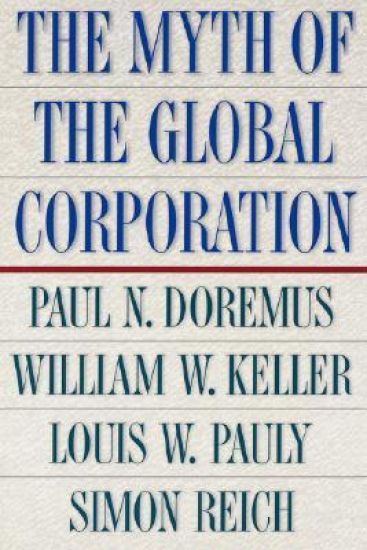
The Myth of the Global Corporation

The Myth of the Global Corporation

Paul Doremus; William W. Keller; Louis W. Pauly; Simon Reich

Princeton University Press
1999
pokkari
Critics and defenders of multinational corporations often agree on at least one thing: that the activities of multinationals are creating an overwhelmingly powerful global market that is quickly rendering national borders obsolete. The authors of this book, however, argue that such expectations commonly rest on a myth. They examine key activities of multinational corporations in the United States, Japan, and Europe and explore the relationship between corporate behavior and national institutions and cultures. They demonstrate that the world's leading multinationals continue to be shaped decisively by the policies and values of their home countries and that their core operations are not converging to create a seamless global market. With a wealth of fresh evidence, the authors show that Japanese and German multinationals, in particular, remain only weakly committed to laissez-faire policy orientations and continue to exhibit strong allegiance to national goals in such areas as investment and employment. They also bring to light the consequences of enduring differences in government policies on, for example, industrial cartels, capital markets, and research and development. The authors agree that the world economy is becoming more complex and integrated as overt barriers to trade and investment fall away. But they conclude that the extent of this integration is decisively limited by structural divergence at the level of the firm. The book will be essential reading for those seeking to understand the growing interdependence of still-distinctive industrial societies and the wellsprings of the true global economy.
The Fruits of Fascism

The Fruits of Fascism

Simon Reich

Cornell University Press
1990
pokkari
The West German "economic miracle," Simon Reich suggests, may be best understood as a result of the discriminatory economic policies of the Nazi regime. Reich contends that ideological and institutional characteristics originating under fascism were sustained despite Germany's return to democracy and heavily influenced the economic success of its automobile industry. By contrast, the liberal economic policies of the British state led in time to the decline of an industrial sector that in 1930 had closely resembled its German counterpart. Through detailed comparative histories of German and British automobile firms, Reich challenges traditional explanations of the divergent performances of the two nations' economies and sheds new light on the relationship between state policy and economic success in pre- and postwar Europe. Liberal, nondiscriminatory British policies favorable to multinational investment contributed significantly to the decline of domestic firms, he argues, so that eventually multinationals could threaten the health of the entire British economy by investing elsewhere. The Nazi state, however, thwarted the development of American subsidiaries and fostered a core of producers, government officials, bankers, and labor union leaders.