Kirjojen hintavertailu – 12 903 725 kirjaa ja 27 kauppaa

Kirjailija

Simon Schaffer

Kirjat ja teokset yhdessä paikassa: 6 kirjaa, julkaisuja vuosilta 2017–2026, suosituimpiin kuuluu The Board of Longitude. Vertaile teosten hintoja ja tarkista saatavuus suomalaisista kirjakaupoista.

Nimi esiintyy myös muodoissa: Simon Schäffer

6 kirjaa

Kirjojen julkaisuvuodet: 2017–2026.

The Board of Longitude

The Board of Longitude

Alexi Baker; Richard Dunn; Rebekah Higgitt; Simon Schaffer; Sophie Waring

Cambridge University Press
2025
sidottu
In the first book-length history of the Board of Longitude, a distinguished team of historians of science bring to life one of Georgian Britain's most important scientific institutions. Having developed in the eighteenth century following legislation offering rewards for methods to determine longitude at sea, the Board came to support the work of navigators, instrument makers, clockmakers and surveyors, and assembled the Nautical Almanac. Utilizing the archives and records of the Board, recently digitised by the same team, the authors shed new light on the Board's involvement in colonial projects, Pacific and Arctic exploration, as well as on innovative practitioners whose work would otherwise be lost to history. This is an invaluable guide to science, state and society in Georgian Britain, a period of dramatic industrial and imperial and technological expansion.

The Board of Longitude

The Board of Longitude

Alexi Baker; Richard Dunn; Rebekah Higgitt; Simon Schaffer; Sophie Waring

Cambridge University Press
2025
pokkari
In the first book-length history of the Board of Longitude, a distinguished team of historians of science bring to life one of Georgian Britain's most important scientific institutions. Having developed in the eighteenth century following legislation offering rewards for methods to determine longitude at sea, the Board came to support the work of navigators, instrument makers, clockmakers and surveyors, and assembled the Nautical Almanac. Utilizing the archives and records of the Board, recently digitised by the same team, the authors shed new light on the Board's involvement in colonial projects, Pacific and Arctic exploration, as well as on innovative practitioners whose work would otherwise be lost to history. This is an invaluable guide to science, state and society in Georgian Britain, a period of dramatic industrial and imperial and technological expansion.

Working Knowledge

Working Knowledge

Simon Schaffer

THE UNIVERSITY OF CHICAGO PRESS
2026
sidottu
Collects key articles by Simon Schaffer, one of the most important historians of science working today. Working Knowledge is the first English-language collection of essays by Simon Schaffer, coauthor of Leviathan and the Air-Pump, a landmark text in the history of science. Though the latter may be his most famous book, Schaffer is also renowned for seminal articles on Isaac Newton and the cultures of popular spectacle, nineteenth-century physics and its practices of labor discipline and standardization, the history of anthropology and collecting, and the globe-spanning cultural interactions that have shaped modern science. Working Knowledge compiles these well-known pieces alongside newer selections, making them accessible in a single place and representing the huge scope and impact of Schaffer’s oeuvre. The Reader divides sixteen of Schaffer’s articles across five thematic sections, which take up timely issues like the turn toward global histories of science; the intersection of science and capitalism; the interaction between bodies and machines; and the connection between science, politics, and the environment. Eight new essays by notable historians such as Adrian Johns, Lissa Roberts, and Steven Shapin bring Schaffer’s pieces into discussion with current scholarship. Illustrations and brief commentaries by Schaffer and the artist Adam Lowe, a longtime collaborator, are included throughout the volume. Bringing together essential articles that were previously scattered across several publications, Working Knowledge is an insightful introduction to Schaffer and his ever-relevant writing.
Applying Neuro-Cognitive Framing to Personal Selling
Intermediate Examination Paper from the year 2018 in the subject Communications - Public Relations, Advertising, Marketing, Social Media, grade: 1,0, University of Cooperative Education Loerrach, language: English, abstract: In this thesis, I would like to connect Neuro-Cognitive Framing with established marketing frameworks to find out whether Framing may become an integral part of future promotion strategy. Neuro-Cognitive Framing is a new communication concept developed by linguistic expert Elisabeth Wehling. It suggests that human thinking happens based on interpretative frameworks, called Frames, which are created through individual real-world experience. The concept is assessed and applied on a pre-established personal selling framework to evaluate if Framing is applicable to personal selling whilst improving personal selling efficacy. After comprehensive theoretical assessment, an implementation guide for Framing in personal selling is established and the concept is explored in a qualitative research experiment.
Leviathan and the Air-Pump

Leviathan and the Air-Pump

Steven Shapin; Simon Schaffer

Princeton University Press
2017
pokkari
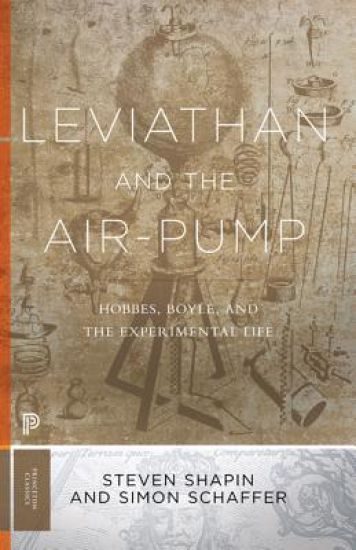
Leviathan and the Air-Pump examines the conflicts over the value and propriety of experimental methods between two major seventeenth-century thinkers: Thomas Hobbes, author of the political treatise Leviathan and vehement critic of systematic experimentation in natural philosophy, and Robert Boyle, mechanical philosopher and owner of the newly invented air-pump. The issues at stake in their disputes ranged from the physical integrity of the air-pump to the intellectual integrity of the knowledge it might yield. Both Boyle and Hobbes were looking for ways of establishing knowledge that did not decay into ad hominem attacks and political division. Boyle proposed the experiment as cure. He argued that facts should be manufactured by machines like the air-pump so that gentlemen could witness the experiments and produce knowledge that everyone agreed on. Hobbes, by contrast, looked for natural law and viewed experiments as the artificial, unreliable products of an exclusive guild. The new approaches taken in Leviathan and the Air-Pump have been enormously influential on historical studies of science. Shapin and Schaffer found a moment of scientific revolution and showed how key scientific givens--facts, interpretations, experiment, truth--were fundamental to a new political order. Shapin and Schaffer were also innovative in their ethnographic approach. Attempting to understand the work habits, rituals, and social structures of a remote, unfamiliar group, they argued that politics were tied up in what scientists did, rather than what they said. Steven Shapin and Simon Schaffer use the confrontation between Hobbes and Boyle as a way of understanding what was at stake in the early history of scientific experimentation. They describe the protagonists' divergent views of natural knowledge, and situate the Hobbes-Boyle disputes within contemporary debates over the role of intellectuals in public life and the problems of social order and assent in Restoration England. In a new introduction, the authors describe how science and its social context were understood when this book was first published, and how the study of the history of science has changed since then.