Kirjojen hintavertailu – 12 859 829 kirjaa ja 27 kauppaa

Kirjailija

Simon Szreter

Kirjat ja teokset yhdessä paikassa: 6 kirjaa, julkaisuja vuosilta 1996–2021, suosituimpiin kuuluu Changing Family Size in England and Wales. Vertaile teosten hintoja ja tarkista saatavuus suomalaisista kirjakaupoista.

6 kirjaa

Kirjojen julkaisuvuodet: 1996–2021.

After the Virus

After the Virus

Hilary Cooper; Simon Szreter

Cambridge University Press
2021
pokkari
Why was the UK so unprepared for the pandemic, suffering one of the highest death rates and worst economic contractions of the major world economies in 2020? Hilary Cooper and Simon Szreter reveal the deep roots of our vulnerability and set out a powerful manifesto for change post-Covid-19. They argue that our commitment to a flawed neoliberal model and the associated disinvestment in our social fabric left the UK dangerously exposed and unable to mount an effective response. This is not at all what made Britain great. The long history of the highly innovative universal welfare system established by Elizabeth I facilitated both the industrial revolution and, when revived after 1945, the postwar Golden Age of rising prosperity. Only by learning from that past can we create the fairer, nurturing and empowering society necessary to tackle the global challenges that lie ahead - climate change, biodiversity collapse and global inequality.

Sex Before the Sexual Revolution

Sex Before the Sexual Revolution

Simon Szreter; Kate Fisher

Cambridge University Press
2010
pokkari
What did sex mean for ordinary people before the sexual revolution of the 1960s and 1970s, who were often pitied by later generations as repressed, unfulfilled and full of moral anxiety? This book provides the first rounded, first-hand account of sexuality in marriage in the early and mid-twentieth century. These award-winning authors look beyond conventions of silence among the respectable majority to challenge stereotypes of ignorance and inhibition. Based on vivid, compelling and frank testimonies from a socially and geographically diverse range of individuals, the book explores a spectrum of sexual experiences, from learning about sex and sexual practices in courtship, to attitudes to the body, marital ideals and birth control. It demonstrates that while the era's emphasis on silence and strict moral codes could for some be a source of inhibition and dissatisfaction, for many the culture of privacy and innocence was central to fulfilling and pleasurable intimate lives.
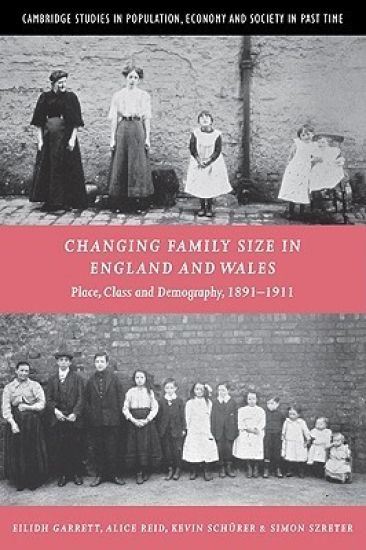
Changing Family Size in England and Wales

Changing Family Size in England and Wales

Eilidh Garrett; Alice Reid; Kevin Schürer; Simon Szreter

Cambridge University Press
2006
pokkari
This volume is an important study in demographic history. It draws on the individual returns from the 1891, 1901 and 1911 censuses of England and Wales, to which Garrett, Reid, Schürer and Szreter were permitted access ahead of scheduled release dates. Using the responses of the inhabitants of thirteen communities to the special questions included in the 1911 'fertility' census, they consider the interactions between the social, economic and physical environments in which people lived and their family-building experience and behaviour. Techniques and approaches based in demography, history and geography enable the authors to re-examine the declines in infant mortality and marital fertility which occurred at the turn of the twentieth century. Comparisons are drawn within and between white-collar, agricultural and industrial communities, and the analyses, conducted at both local and national level, lead to conclusions which challenge both contemporary and current orthodoxies.
Fertility, Class and Gender in Britain, 1860–1940

Fertility, Class and Gender in Britain, 1860–1940

Simon Szreter

Cambridge University Press
2002
pokkari
This book offers an original interpretation of the history of falling fertilities in Britain between 1860 and 1940. It integrates the approaches of the social sciences and of demographic, feminist, and labour history with intellectual, social, and political history. It exposes the conceptual and statistical inadequacies of the orthodox picture of a national, unitary class-differential fertility decline, and presents an entirely new analysis of the famous 1911 fertility census of England and Wales. Surprising and important findings emerge concerning the principal methods of birth control: births were spaced from early on in marriage; and sexual abstinence by married couples was a far more significant practice than previously imagined. The author presents a new general approach to the study of fertility change, raising central issues concerning the relationship between history and social science.
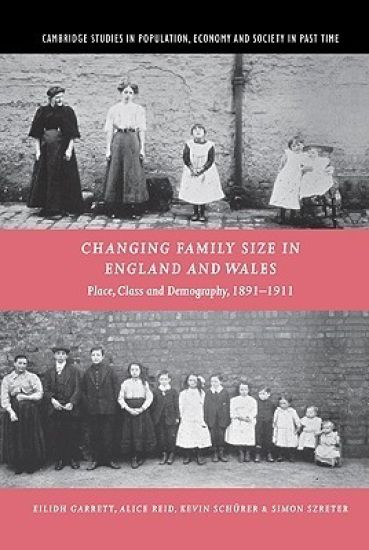
Changing Family Size in England and Wales

Changing Family Size in England and Wales

Eilidh Garrett; Alice Reid; Kevin Schürer; Simon Szreter

Cambridge University Press
2001
sidottu
This volume is an important study in demographic history. It draws on the individual returns from the 1891, 1901 and 1911 censuses of England and Wales, to which Garrett, Reid, Schürer and Szreter were permitted access ahead of scheduled release dates. Using the responses of the inhabitants of thirteen communities to the special questions included in the 1911 'fertility' census, they consider the interactions between the social, economic and physical environments in which people lived and their family-building experience and behaviour. Techniques and approaches based in demography, history and geography enable the authors to re-examine the declines in infant mortality and marital fertility which occurred at the turn of the twentieth century. Comparisons are drawn within and between white-collar, agricultural and industrial communities, and the analyses, conducted at both local and national level, lead to conclusions which challenge both contemporary and current orthodoxies.
Fertility, Class and Gender in Britain, 1860–1940

Fertility, Class and Gender in Britain, 1860–1940

Simon Szreter

Cambridge University Press
1996
sidottu
This book offers an original interpretation of the history of falling fertilities in Britain between 1860 and 1940. It integrates the approaches of the social sciences and of demographic, feminist, and labour history with intellectual, social, and political history. It exposes the conceptual and statistical inadequacies of the orthodox picture of a national, unitary class-differential fertility decline, and presents an entirely new analysis of the famous 1911 fertility census of England and Wales. Surprising and important findings emerge concerning the principal methods of birth control: births were spaced from early on in marriage; and sexual abstinence by married couples was a far more significant practice than previously imagined. The author presents a new general approach to the study of fertility change, raising central issues concerning the relationship between history and social science.