Kirjailija
Simon Winchester
Kirjat ja teokset yhdessä paikassa: 57 kirjaa, julkaisuja vuosilta 1999–2026, suosituimpiin kuuluu Lonely Planet Tales from Nowhere. Vertaile teosten hintoja ja tarkista saatavuus suomalaisista kirjakaupoista.
57 kirjaa
Kirjojen julkaisuvuodet: 1999–2026.
The definitive biography of the world's most important body of water â?? the Atlantic.
In the summer of 1858, in a garden behind Christ Church in Oxford, Charles Dodgson--better known by his pseudonym Lewis Carroll--dressed the six-year-old Alice Liddell in ragamuffin's clothes, draped the folds of cloth low enough to expose her bare chest, asked her to look deep into his eyes--and then snapped the camera's shutter. In The Alice Behind Wonderland, Simon Winchester uses the famous photograph of Alice--notorious for the child's alluring pose--as the launching pad for an energetic and penetrating look at the inspiration behind, and the making of, one of the greatest classics of children's literature: Alice's Adventures in Wonderland. Indeed, Winchester shows that it was Dodgson's photographic love affair with Alice that transformed this shy and half-deaf mathematician into one of the world's best-loved writers. Equally important, this photograph offers a window into Dodgson's troubled Victorian's mind and soul; it is a picture imbued with more meaning than its appearance would suggest. Much like the fictional Alice's world, as the photograph is subject to closer examination, it becomes nothing short of curiouser and curiouser. Alice Liddell as The Beggar Maid was, in short, the muse that would inspire the creation of Alice in Wonderland. Deftly engaging with Dogson's published writings, private diaries, and photography, Winchester weaves together the poignant, turbulent, and entirely fascinating story behind Lewis Carroll and the making of his Alice.
Atlantic: Great Sea Battles, Heroic Discoveries, Titanic Storms, and a Vast Ocean of a Million Stories
Simon Winchester
Harper Large Print
2010
nidottu
"Variably genial, cautionary, lyrical, admonitory, terrifying, horrifying and inspiring... A lifetime of thought, travel, reading, imagination and memory inform this affecting account." --Kirkus Reviews (starred review)Blending history and anecdote, geography and reminiscence, science and exposition, New York Times bestselling author Simon Winchester tells the breathtaking saga of the Atlantic Ocean. A gifted storyteller and consummate historian, Winchester sets the great blue sea's epic narrative against the backdrop of mankind's intellectual evolution, telling not only the story of an ocean, but the story of civilization. Fans of Winchester's Krakatoa, The Man Who Loved China, and The Professor and the Madman will love this masterful, penetrating, and resonant tale of humanity finding its way across the ocean of history.
Acclaimed writer Simon Winchester brings his keen literary eye to this year's volume of the finest travel writing from the past year. "Full of insights, humor, the exotic and distant, and the ordinary and near" (Library Journal) this collection finds "a perfect mix of exotic locale and elegant prose" (Publishers Weekly).
The Map That Changed the World: William Smith and the Birth of Modern Geology
Simon Winchester
HARPER PERENNIAL
2009
nidottu
Halvin toimitettuna 22,00 €
From the author of the bestselling The Professor and the Madman comes the fascinating story of William Smith, the orphaned son of an English country blacksmith, who became obsessed with creating the world's first geological map and ultimately became the father of modern geology. In 1793 William Smith, a canal digger, made a startling discovery that was to turn the fledgling science of the history of the earth -- and a central plank of established Christian religion -- on its head. He noticed that the rocks he was excavating were arranged in layers; more important, he could see quite clearly that the fossils found in one layer were very different from those found in another. And out of that realization came an epiphany: that by following the fossils, one could trace layers of rocks as they dipped and rose and fell -- clear across England and, indeed, clear across the world. Determined to publish his discovery by creating a map that would display the hidden underside of England, he spent twenty years traveling the length and breadth of the kingdom by stagecoach and on foot, studying rock outcrops and fossils, piecing together the image of this unseen universe. In 1815 he published his epochal beautiful hand-painted map, more than eight feet tall and six feet wide. But four years after its triumphant publication, and with his young wife going steadily mad to the point of nymphomania, Smith ended up in debtors' prison, a victim of plagiarism, swindled out of his recognition and his profits. He left London for the north of England and remained homeless for ten long years as he searched for work. It wasn't until 1831, when his employer, a sympathetic nobleman, brought him into contact with the Geological Society of London -- which had earlier denied him a fellowship -- that at last this quiet genius was showered with the honors long overdue him. He was summoned south to receive the society's highest award, and King William IV offered him a lifetime pension. The Map That Changed the World is, at its foundation, a tale of endurance and achievement, of one man's dedication in the face of ruin and homelessness. The world's coal and oil industry, its gold mining, its highway systems, and its railroad routes were all derived entirely from the creation of Smith's first map.; and with a keen eye and thoughtful detail, Simon Winchester unfolds the poignant sacrifice behind this world-changing discovery.
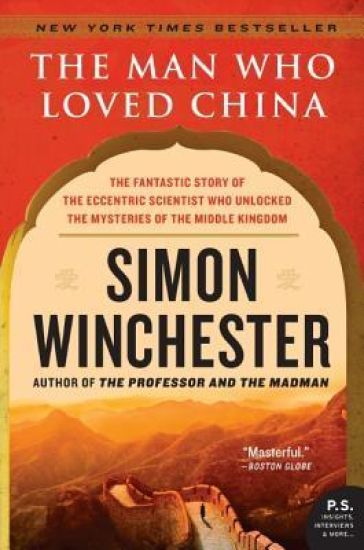
The Man Who Loved China: The Fantastic Story of the Eccentric Scientist Who Unlocked the Mysteries of the Middle Kingdom
Simon Winchester
HARPER PERENNIAL
2009
nidottu
In sumptuous and illuminating detail, Simon Winchester, the bestselling author of The Professor and the Madman ("Elegant and scrupulous"--New York Times Book Review) and Krakatoa ("A mesmerizing page-turner"--Time) brings to life the extraordinary story of Joseph Needham, the brilliant Cambridge scientist who unlocked the most closely held secrets of China, long the world's most technologically advanced country. No cloistered don, this tall, married Englishman was a freethinking intellectual, who practiced nudism and was devoted to a quirky brand of folk dancing. In 1937, while working as a biochemist at Cambridge University, he instantly fell in love with a visiting Chinese student, with whom he began a lifelong affair. He soon became fascinated with China, and his mistress swiftly persuaded the ever-enthusiastic Needham to travel to her home country, where he embarked on a series of extraordinary expeditions to the farthest frontiers of this ancient empire. He searched everywhere for evidence to bolster his conviction that the Chinese were responsible for hundreds of mankind's most familiar innovations--including printing, the compass, explosives, suspension bridges, even toilet paper--often centuries before the rest of the world. His thrilling and dangerous journeys, vividly recreated by Winchester, took him across war-torn China to far-flung outposts, consolidating his deep admiration for the Chinese people. After the war, Needham was determined to tell the world what he had discovered, and began writing his majestic Science and Civilisation in China, describing the country's long and astonishing history of invention and technology. By the time he died, he had produced, essentially single-handedly, seventeen immense volumes, marking him as the greatest one-man encyclopedist ever. Both epic and intimate, The Man Who Loved China tells the sweeping story of China through Needham's remarkable life. Here is an unforgettable tale of what makes men, nations, and, indeed, mankind itself great--related by one of the world's inimitable storytellers.
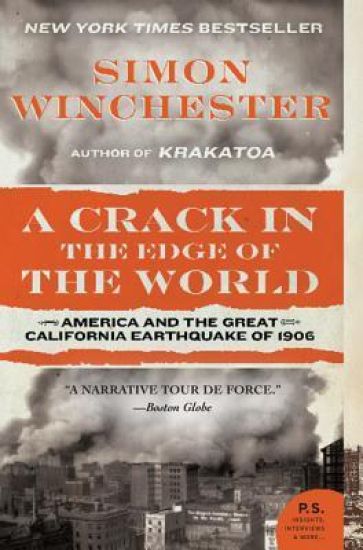
A Crack in the Edge of the World: America and the Great California Earthquake of 1906
Simon Winchester
HARPER PERENNIAL
2006
nidottu
An informative exploration of earthquakes places a particular focus on the San Francisco disaster of 1906, describing how it affected more than two hundred miles of California, triggered a vast firestorm, and destroyed the gold-rush capital, in an account that reveals the geological underpinnings that caused the earthquake. Reader's Guide available. Reprint. 150,000 first printing.
A burgeoning new city is built on the dreams of the American gold rush. It is also built upon a landscape that has been stretching, sliding and breaking apart for millennia. In 1906 the dreams of this city came crashing down beneath the rippling wave of a horrifying earthquake that turned roads into great rippling rivers, that set buildings ablaze for days on end, that made homes collapse upon themselves. Simon Winchester's breathtaking story delves deep beneath the surface of the earth and explains to us why the world moves as it does; and breaks apart with such devastating results. At the same time he never lets us forget the human story: what happened in this new, seemingly blessed city on the 18th April 1906. As he vividly portrays the lives of the people who suffered and survived the devastation he also tells a universal story: the hubris of man as he ignores the warnings of nature and how we respond and try to understand the world around us. Compelling, moving and enlightening, Simon Winchester brings to light the world beneath our feet and through the story of this one terrifying event one hundred years ago, begins to make sense of our world now.
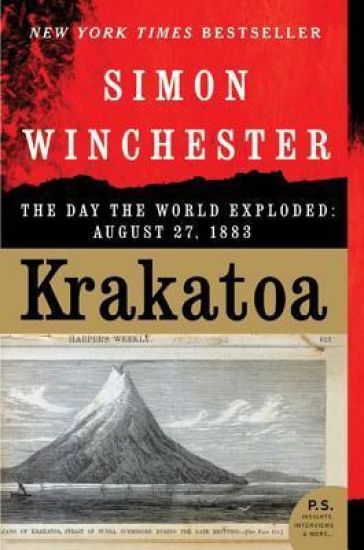
Krakatoa: The Day the World Exploded: August 27, 1883
Simon Winchester
HARPER PERENNIAL
2005
nidottu
The bestselling author of The Professor and the Madman and The Map That Changed the World examines the enduring and world-changing effects of the catastrophic eruption off the coast of Java of the earth's most dangerous volcano -- Krakatoa. The legendary annihilation in 1883 of the volcano-island of Krakatoa -- the name has since become a byword for a cataclysmic disaster -- was followed by an immense tsunami that killed nearly forty thousand people. Beyond the purely physical horrors of an event that has only very recently been properly understood, the eruption changed the world in more ways than could possibly be imagined. Dust swirled round die planet for years, causing temperatures to plummet and sunsets to turn vivid with lurid and unsettling displays of light. The effects of the immense waves were felt as far away as France. Barometers in Bogot and Washington, D. C., went haywire. Bodies were washed up in Zanzibar. The sound of the island's destruction was heard in Australia and India and on islands thousands of miles away. Most significant of all -- in view of today's new political climate -- the eruption helped to trigger in Java a wave of murderous anti-Western militancy among fundamentalist Muslims: one of the first outbreaks of Islamic-inspired killings anywhere. Simon Winchester's long experience in the world wandering as well as his knowledge of history and geology give us an entirely new perspective on this fascinating and iconic event as he brings it telling back to life.
In the late 1980s, New York Times bestselling author Simon Winchester set out on foot to discover the Republic of Korea - from its southern tip to the North Korean border - in order to set the record straight about this enigmatic and elusive land. Fascinating for its vivid presentation of historical and geographic detail, Korea is that rare book that actually defines a nation and its people. Winchester's gift for capturing engaging characters in true, compelling stories provides us with a treasury of enchanting and informed insight on the culture, language, history, and politics of this little-known corner of Asia. With a new introduction by the author, Korea is a beautiful journey through a mysterious country and a memorable addition to the many adventures of Simon Winchester.
'Bracingly apocalyptic stuff: atmospheric, chock-full of information and with a constantly escalating sense of pace and tension' Sunday TelegraphSimon Winchester's brilliant chronicle of the destruction of the Indonesian island of Krakatoa in 1883 charts the birth of our modern world. He tells the story of the unrecognized genius who beat Darwin to the discovery of evolution; of Samuel Morse, his code and how rubber allowed the world to talk; of Alfred Wegener, the crack-pot German explorer and father of geology. In breathtaking detail he describes how one island and its inhabitants were blasted out of existence and how colonial society was turned upside-down in a cataclysm whose echoes are still felt to this day.
Outposts: Journeys to the Surviving Relics of the British Empire
Simon Winchester
HARPER PERENNIAL
2004
nidottu
The author of The Professor and the Madman recounts his experiences traveling to Diego Garcia, Tristan, Gibraltar, Ascension Island, St. Helena, Hong Kong, Bermuda, the British West Indies, the Falklands, and Pitcairn Island, all remnants of the vast British Empire. Reprint.
The River at the Center of the World: A Journey Up the Yangtze, and Back in Chinese Time
Simon Winchester
Picador USA
2004
nidottu
A stunning tour of China, its people, and its history. Chosen as one of the best travel books of 1996 by the New York Times Book Review. Rising in the mountains of the Tibetan border, the Yangtze River, the symbolic heart of China pierces 3,900 miles of rugged country before debouching into the oily swells of the East China Sea. Connecting China's heartland cities with the volatile coastal giant, Shanghai, it has also historically connected China to the outside world through its nearly one thousand miles of navigable waters. To travel those waters is to travel back in history, to sense the soul of China, and Simon Winchester takes us along with him as he encounters the essence of China--its history and politics, its geography and climate as well as engage in its culture, and its people in remote and almost inaccessible places. The River at the Center of the World is travel writing at its best: lively, informative, and thoroughly enchanting.
The reissue of a Simon Winchester classicIn 1985 Simon Winchester, struck by a sudden need to discover exactly what was left of the British Empire travelled 100,000 miles back and forth from Antarctica to the Caribbean to visit the far-flung islands that are all that remain of what once made Britain great. His adventures in these distant and forgotten ends of the earth make compelling and often funny reading. With a new introduction and additional material in many of the chapters, this revised edition tells us what has happened while the author's been away.
The Map That Changed the World
Simon Winchester
Penguin Books Ltd
2002
pokkari
Halvin toimitettuna 18,70 €
THE EXTRAORDINARY TALE OF THE FATHER OF MODERN GEOLOGYHidden behind velvet curtains above a stairway in a house in London's Piccadilly is an enormous and beautiful hand-coloured map - the first geological map of anywhere in the world. Its maker was a farmer's son named William Smith. Born in 1769 his life was troubled: he was imprisoned for debt, turned out of his home, his work was plagiarised, his wife went insane and the scientific establishment shunned him. It was not until 1829, when a Yorkshire aristocrat recognised his genius, that he was returned to London in triumph: The Map That Changed the World is his story.'For a geologist, this is a must read' Amazon Reviewer'It serves to lift a genius from academic semi-obscurity and to award him the acknowledgement he undoubtedly deserves' Amazon Reviewer'Never realised how seminal this map was' Amazon Reviewer
Terrible things have been going on in the Balkans for centuries, and they are likely to go on for centuries more to come. It is an area of great contrasts -- geographically beautiful, yet the underlying crust of the region is cracked along great tectonic fault lines. These natural fault lines pale in comparison to the borders made by man, which have added further layers of complexity to a region where war is frequent, horrors are unspeakable, and history is unfathomable. It is not an area of the world that many would care to visit -- unless they had been there before. Simon Winchester, a seasoned reporter, visited the region twenty years ago. During the recent Kosovo crisis, he remembered that first trip and the people he met, and he decided that parallel journeys might well be a device for explaining with sympathy the true nature of this fractured region. Two great capitals, Vienna and Istanbul, whose ceaseless imperial rivalries in the past played so profound a role in shaping the savage divisions of the region today, would anchor his second journey to the region. With the war under way, he enlisted the aid of a linguist friend and set off from Vienna on a long, scimitar-shaped adventure through Slovenia, Croatia, Bosnia, Montenegro, Albania, Macedonia, Kosovo, Bulgaria, and Turkey, arriving at the Golden Horn just as the war was officially declared over. With luck, and through valuable personal contacts, Winchester managed to be in Macedonia on the day the NATO forces moved in to assume control of Kosovo -- and because the commanding general was an old friend, he rode in with the liberating columns of troops and armor. This is not a book about the war, but rather an intimate portrait of the region painted while the war was going on. It is also an attempt to understand what has led this region to violence -- now, in the past, and inevitably again in the future. Written with a keen sense of time and place, The Fracture Zone is at once current and timeless. It goes behind the headlines and gives us a true picture of a region that has always been on the brink. Simon Winchester's remarkable journey puts all the elements together -- the faults, the fractures, and the chaos -- and makes sense out of a seemingly senseless place.

The Surgeon of Crowthorne
Simon Winchester
Penguin Books Ltd
1999
pokkari
Halvin toimitettuna 21,90 €
An extraordinary tale of madness, genius and obsession, discover the true story of the two remarkable men that led to the making of the Oxford English Dictionary - and literary history! The compilation of the Oxford English Dictionary, begun in 1857, was one of the most ambitious projects ever undertaken. As definitions were collected, the overseeing committee, led by Professor James Murray, discovered that one man, Dr. W. C. Minor, had submitted more than ten thousand of those words. But when the committee insisted on honouring him, a shocking truth came to light: Dr. Minor, a millionaire and American Civil War veteran, was also an inmate at an asylum for the criminally insane . . . charged with murder!_____________________'A weird and wonderful story of an eccentric friendship, and a slice of history' Sunday Times'What a revelation. Beautifully told and awe-inspiring' Daily Mail'Simon Winchester could not have told it better . . . a splendid book' Economist 'Masterful . . . one of those rare stories that combine human drama and historical significance' Independent