Kirjojen hintavertailu – 12 903 725 kirjaa ja 27 kauppaa

Kirjailija

Simone Scacchi

Kirjat ja teokset yhdessä paikassa: 4 kirjaa, julkaisuja vuosilta 2014–2025, suosituimpiin kuuluu Mathematical Modeling and Control in Life and Environmental Sciences. Vertaile teosten hintoja ja tarkista saatavuus suomalaisista kirjakaupoista.

4 kirjaa

Kirjojen julkaisuvuodet: 2014–2025.

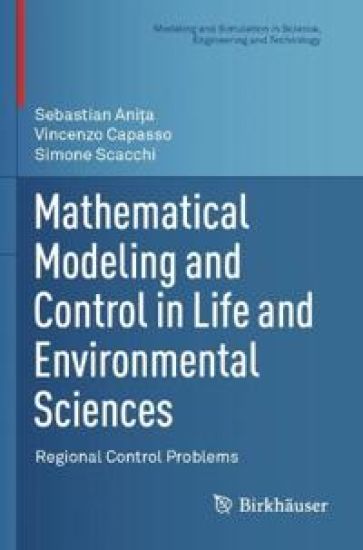
Mathematical Modeling and Control in Life and Environmental Sciences

Mathematical Modeling and Control in Life and Environmental Sciences

Sebastian Anita; Vincenzo Capasso; Simone Scacchi

BIRKHAUSER VERLAG AG
2025
nidottu
This monograph explores the use of mathematical modeling and control theory in a variety of contemporary challenges in mathematical biology and environmental sciences. Emphasizing an approach of learning by doing, the authors focus on a set of significant case studies emerging from real-world problems and illustrate how mathematical techniques and computational experiments can be employed in the search for sustainable solutions. The following topics are extensively discussed:Eradicability and control of a paradigmatic epidemic model, with a view to the existence of endemic states, their stability, and the existence of travelling wavesA spatially structured epidemic model concerning malaria as an example of vector-borne epidemicsOptimal harvesting problems for space-structured and age-structured population dynamicsControlling epidemics in agriculture due to pest insectsThe role of predators as a possible biocontrol agent of epidemics in agricultureControl by taxation of the environmental pollution produced by human activitiesThe originality of this text is in its leitmotif – regional control – along the principle of “Think Globally, Act Locally.” Indeed, for example, in many real spatially structured ecosystems, it is practically impossible to control the relevant system by global interventions in the whole habitat. Proofs are given whenever they may serve as a guide to the introduction of new concepts. Each chapter includes a comprehensive description of the numerical methods used for the computational experiments, and MATLAB© codes for many of the numerical simulations are available for download. Several challenging open problems are also provided to stimulate future research. This text is aimed at mathematicians, engineers, and other scientists working in areas such as biology, medicine, and economics. Graduate and advanced undergraduate students of a quantitative subject related to the analysis and applications of dynamical systems and their control will also find it to be a valuable resource.

Mathematical Modeling and Control in Life and Environmental Sciences

Mathematical Modeling and Control in Life and Environmental Sciences

Sebastian Anita; Vincenzo Capasso; Simone Scacchi

BIRKHAUSER VERLAG AG
2024
sidottu
This monograph explores the use of mathematical modeling and control theory in a variety of contemporary challenges in mathematical biology and environmental sciences. Emphasizing an approach of learning by doing, the authors focus on a set of significant case studies emerging from real-world problems and illustrate how mathematical techniques and computational experiments can be employed in the search for sustainable solutions. The following topics are extensively discussed:Eradicability and control of a paradigmatic epidemic model, with a view to the existence of endemic states, their stability, and the existence of travelling wavesA spatially structured epidemic model concerning malaria as an example of vector-borne epidemicsOptimal harvesting problems for space-structured and age-structured population dynamicsControlling epidemics in agriculture due to pest insectsThe role of predators as a possible biocontrol agent of epidemics in agricultureControl by taxation of the environmental pollution produced by human activitiesThe originality of this text is in its leitmotif – regional control – along the principle of “Think Globally, Act Locally.” Indeed, for example, in many real spatially structured ecosystems, it is practically impossible to control the relevant system by global interventions in the whole habitat. Proofs are given whenever they may serve as a guide to the introduction of new concepts. Each chapter includes a comprehensive description of the numerical methods used for the computational experiments, and MATLAB© codes for many of the numerical simulations are available for download. Several challenging open problems are also provided to stimulate future research. This text is aimed at mathematicians, engineers, and other scientists working in areas such as biology, medicine, and economics. Graduate and advanced undergraduate students of a quantitative subject related to the analysis and applications of dynamical systems and their control will also find it to be a valuable resource.

Mathematical Cardiac Electrophysiology

Mathematical Cardiac Electrophysiology

Piero Colli Franzone; Luca Franco Pavarino; Simone Scacchi

Springer International Publishing AG
2016
nidottu
This book covers the main mathematical and numerical models in computational electrocardiology, ranging from microscopic membrane models of cardiac ionic channels to macroscopic bidomain, monodomain, eikonal models and cardiac source representations. These advanced multiscale and nonlinear models describe the cardiac bioelectrical activity from the cell level to the body surface and are employed in both the direct and inverse problems of electrocardiology. The book also covers advanced numerical techniques needed to efficiently carry out large-scale cardiac simulations, including time and space discretizations, decoupling and operator splitting techniques, parallel finite element solvers. These techniques are employed in 3D cardiac simulations illustrating the excitation mechanisms, the anisotropic effects on excitation and repolarization wavefronts, the morphology of electrograms in normal and pathological tissue and some reentry phenomena. The overall aim of the book is to present rigorously the mathematical and numerical foundations of computational electrocardiology, illustrating the current research developments in this fast-growing field lying at the intersection of mathematical physiology, bioengineering and computational biomedicine. This book is addressed to graduate student and researchers in the field of applied mathematics, scientific computing, bioengineering, electrophysiology and cardiology.
Mathematical Cardiac Electrophysiology

Mathematical Cardiac Electrophysiology

Piero Colli Franzone; Luca Franco Pavarino; Simone Scacchi

Springer International Publishing AG
2014
sidottu
This book covers the main mathematical and numerical models in computational electrocardiology, ranging from microscopic membrane models of cardiac ionic channels to macroscopic bidomain, monodomain, eikonal models and cardiac source representations. These advanced multiscale and nonlinear models describe the cardiac bioelectrical activity from the cell level to the body surface and are employed in both the direct and inverse problems of electrocardiology. The book also covers advanced numerical techniques needed to efficiently carry out large-scale cardiac simulations, including time and space discretizations, decoupling and operator splitting techniques, parallel finite element solvers. These techniques are employed in 3D cardiac simulations illustrating the excitation mechanisms, the anisotropic effects on excitation and repolarization wavefronts, the morphology of electrograms in normal and pathological tissue and some reentry phenomena. The overall aim of the book is to present rigorously the mathematical and numerical foundations of computational electrocardiology, illustrating the current research developments in this fast-growing field lying at the intersection of mathematical physiology, bioengineering and computational biomedicine. This book is addressed to graduate student and researchers in the field of applied mathematics, scientific computing, bioengineering, electrophysiology and cardiology.