
Kirjojen hintavertailu – 12 859 828 kirjaa ja 27 kauppaa

Kirjailija

Sona Nadenichek Golder

Kirjat ja teokset yhdessä paikassa: 2 kirjaa, julkaisuja vuosilta 2017–2021, suosituimpiin kuuluu Logic of Preelectoral Coalition Formation. Vertaile teosten hintoja ja tarkista saatavuus suomalaisista kirjakaupoista.

2 kirjaa

Kirjojen julkaisuvuodet: 2017–2021.

Logic of Preelectoral Coalition Formation

Logic of Preelectoral Coalition Formation

Sona Nadenichek Golder

Ohio State University Press
2021
pokkari
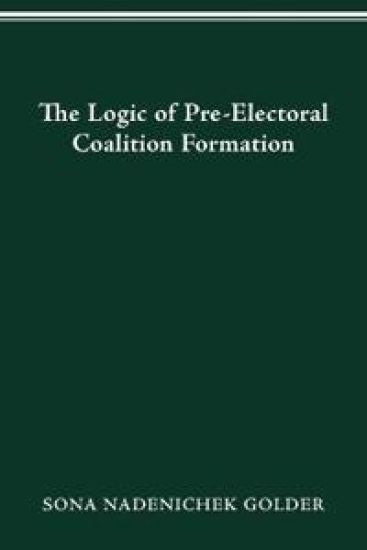
Why do some parties coordinate their electoral strategies as part of a pre-electoral coalition, while others choose to compete independently at election time? Scholars have long ignored pre-electoral coalitions in favor of focusing on the government coalitions that form after parliamentary elections. Yet electoral coalitions are common, they affect electoral outcomes, and they have important implications for democratic policy-making itself. The Logic of Pre-Electoral Coalition Formation by Sona Nadenichek Golder includes a combination of methodological approaches (game theoretic, statistical, and historical) to explain why pre-electoral coalitions form in some instances but not in others. The results indicate that pre-electoral coalitions are more likely to form between ideologically compatible parties. They are also more likely to form when the expected coalition size is large (but not too large) and when the potential coalition partners are similar in size. Ideologically polarized party systems and disproportional electoral rules in combination also increase the likelihood of electoral coalition formation. Golder links the analysis of pre-electoral coalition formation to the larger government coalition literature by showing that pre-electoral agreements increase (a) the likelihood that a party will enter government, (b) the ideological compatibility of governments, and (c) the speed with which governments take office. In addition, pre-electoral coalitions provide an opportunity for combining the best elements of the majoritarian vision of democracy with the best elements of the proportional vision of democracy.
Multi-Level Electoral Politics

Multi-Level Electoral Politics

Sona Nadenichek Golder; Ignacio Lago; Andre Blais; Elisabeth Gidengil; Thomas Gschwend

Oxford University Press
2017
sidottu
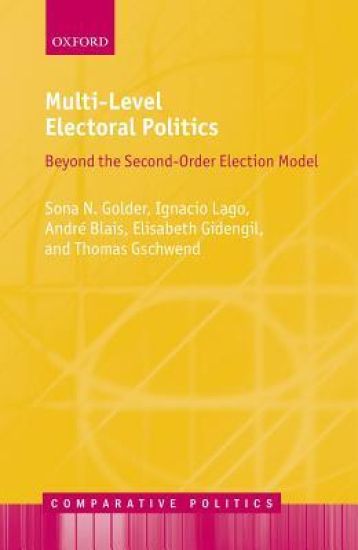
National-level elections receive more attention from scholars and the media than elections at other levels, even though in many European countries the importance of both regional and European levels of government has grown in recent years. The growing importance of multiple electoral arenas suggests that scholars should be cautious about examining single levels in isolation. Taking the multilevel structure of electoral politics seriously requires a re-examination of how the incentives created by electoral institutions affect the behaviour of voters and party elites. The standard approach to analysing multilevel elections is the second-order election (SOE) model, in which national elections are considered to be first-order elections while other elections are second order. However, this model does not provide micro mechanisms that determine how elections in one arena affect those in another, or explain variations in individual voting behaviour. The objective of this book is to explain how party and voter behaviour in a given election is affected by the existence of multiple electoral arenas. It provides original qualitative and quantitative data to examine European, national, and subnational elections in France, Germany, and Spain from 2011-2015. The volume examines party mobilization efforts across multiple electoral arenas, as well as decisions by individual voters with respect to turnout, strategic voting, and accountability. This book provides the first systematic analysis of multilevel electoral politics at three different levels across multiple countries. Comparative Politics is a series for researchers, teachers, and students of political science that deals with contemporary government and politics. Global in scope, books in the series are characterised by a stress on comparative analysis and strong methodological rigour. The series is published in association with the European Consortium for Political Research. For more information visit: www.ecprnet.eu. The series is edited by Emilie van Haute, Professor of Political Science, Université libre de Bruxelles; Ferdinand Müller-Rommel, Director of the Center for the Study of Democracy, Leuphana University; and Susan Scarrow, Chair of the Department of Political Science, University of Houston.