
Kirjojen hintavertailu – 12 903 725 kirjaa ja 27 kauppaa

Kirjailija

Songporn Hansanti

Kirjat ja teokset yhdessä paikassa: 2 kirjaa, julkaisuja vuosilta 2008–2010, suosituimpiin kuuluu International Finance in Emerging Markets. Vertaile teosten hintoja ja tarkista saatavuus suomalaisista kirjakaupoista.

2 kirjaa

Kirjojen julkaisuvuodet: 2008–2010.

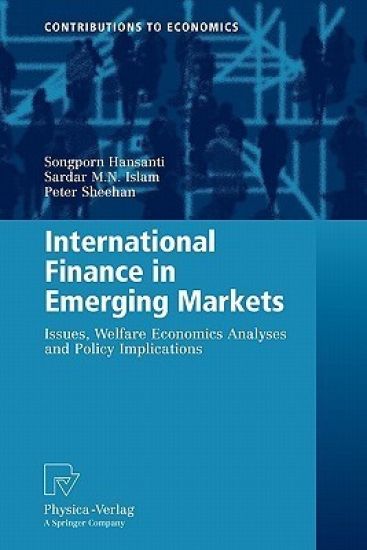
International Finance in Emerging Markets

International Finance in Emerging Markets

Songporn Hansanti; Sardar M. N. Islam; Peter Sheehan

Physica-Verlag GmbH Co
2010
nidottu
This book reviews the contemporary issues in international monetary and financial economics (such as financial liberalisation, crisis, exchange rate determination, capital control, domestic capital market reform, etc.) in an emerging financial market such as Thailand from a welfare economic p- spective, highlighting the social welfare implications of these issues. This 3 book also suggests a normative social approach (as formalised in the new welfare economics paradigm) (see Islam 2001a,b for a discussion of this ; concept) for analysing and addressing these issues and formulating appr- riate policies. Undertaking the above tasks, the asymmetric information paradigm 3 and other elements of the new welfare economics paradigm are adapted in analysing the international financial issues of Thailand, their causes and economic and social welfare consequences. The last two decades have been a critical period for Thailand’s dev- opment. From the mid-1980s to the beginning of the 1990s, the Thai economy performed remarkably well and was a showcase for the world economy. Having achieved a double-digit growth rate for a brief period, Thailand in the late 1980s was regarded as the fastest growing economy in the world by the World Bank and the IMF. With prospects of further rapid economic growth, the Thai government accepted Article VIII of the IMF, which required Thailand to liberalise and deregulate its financial system.
International Finance in Emerging Markets

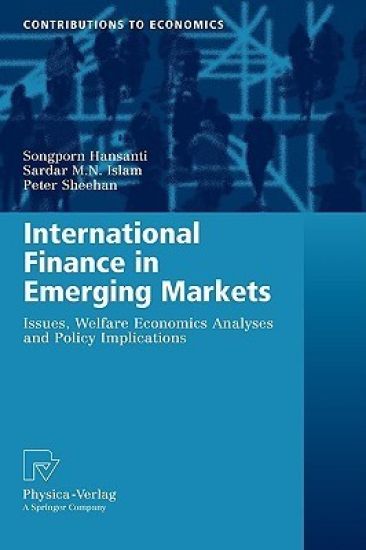
International Finance in Emerging Markets

Songporn Hansanti; Sardar M. N. Islam; Peter Sheehan

Physica-Verlag GmbH Co
2008
sidottu
This book reviews the contemporary issues in international monetary and financial economics (such as financial liberalisation, crisis, exchange rate determination, capital control, domestic capital market reform, etc.) in an emerging financial market such as Thailand from a welfare economic p- spective, highlighting the social welfare implications of these issues. This 3 book also suggests a normative social approach (as formalised in the new welfare economics paradigm) (see Islam 2001a,b for a discussion of this ; concept) for analysing and addressing these issues and formulating appr- riate policies. Undertaking the above tasks, the asymmetric information paradigm 3 and other elements of the new welfare economics paradigm are adapted in analysing the international financial issues of Thailand, their causes and economic and social welfare consequences. The last two decades have been a critical period for Thailand’s dev- opment. From the mid-1980s to the beginning of the 1990s, the Thai economy performed remarkably well and was a showcase for the world economy. Having achieved a double-digit growth rate for a brief period, Thailand in the late 1980s was regarded as the fastest growing economy in the world by the World Bank and the IMF. With prospects of further rapid economic growth, the Thai government accepted Article VIII of the IMF, which required Thailand to liberalise and deregulate its financial system.