Kirjojen hintavertailu – 12 859 827 kirjaa ja 27 kauppaa

Kirjailija

Soon Ang

Kirjat ja teokset yhdessä paikassa: 5 kirjaa, julkaisuja vuosilta 2003–2010, suosituimpiin kuuluu CQ. Vertaile teosten hintoja ja tarkista saatavuus suomalaisista kirjakaupoista.

5 kirjaa

Kirjojen julkaisuvuodet: 2003–2010.

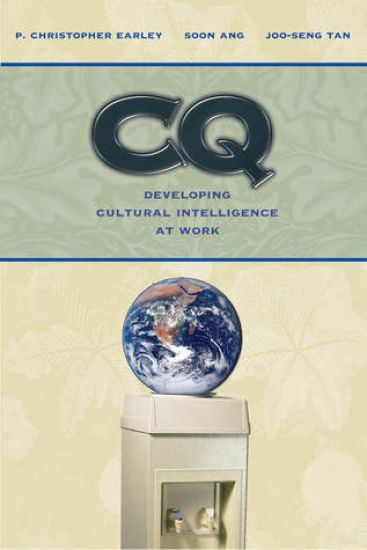
CQ

CQ

P. Christopher Earley; Soon Ang; Joo-Seng Tan

Stanford University Press
2010
pokkari
This book explains to those living and working in another country how to identify and develop their Cultural Intelligence, or CQ. Cultural intelligence is an outsider's natural ability to interpret and respond to unfamiliar cultural signals in an appropriate manner. CQ is distinguished by three core features: the head, or the ability to discover new information about a culture; the heart, or one's motivation and confidence in dealing with a culture; and the body, or the capability to adapt actions and behavior so that they are appropriate in a new culture. A manager with a high CQ can enter into new cultural settings—national, professional, organizational, regional—and immediately understand what is happening and why, confidently interact with people, and engage in the right actions. Filled with real-world examples and case studies, this book explains how to assess one's own skills and improve one's CQ.
Handbook of Cultural Intelligence

Handbook of Cultural Intelligence

Soon Ang; Linn Van Dyne

Routledge
2009
sidottu
Cultural intelligence is defined as an individual's ability to function effectively in situations characterized by cultural diversity. With contributions from eminent scholars worldwide, the "Handbook of Cultural Intelligence" is a 'state-of-the-science' summary of the body of knowledge about cultural intelligence and its relevance for managing diversity both within and across cultures. Because cultural intelligence capabilities can be enhanced through education and experience, this handbook emphasizes individual capabilities - specific characteristics that allow people to function effectively in culturally diverse settings - rather than the approach used by more traditional books of describing and comparing cultures based on national cultural norms, beliefs, habits, and practices. The Handbook covers conceptional and definitional issues, assessment approaches, and application of cultural intelligence in the domains of international and cross-cultural management as well as management of domestic activity. It is an invaluable resource that will stimulate and guide future research on this important topic and its application across a broad range of disciplines, including management, organizational behavior, industrial and organizational psychology, intercultural communication, and more.
CQ

CQ

P. Christopher Earley; Soon Ang; Joo-Seng Tan

Stanford University Press
2006
sidottu
This book explains to those living and working in another country how to identify and develop their Cultural Intelligence, or CQ. Cultural intelligence is an outsider's natural ability to interpret and respond to unfamiliar cultural signals in an appropriate manner. CQ is distinguished by three core features: the head, or the ability to discover new information about a culture; the heart, or one's motivation and confidence in dealing with a culture; and the body, or the capability to adapt actions and behavior so that they are appropriate in a new culture. A manager with a high CQ can enter into new cultural settings—national, professional, organizational, regional—and immediately understand what is happening and why, confidently interact with people, and engage in the right actions. Filled with real-world examples and case studies, this book explains how to assess one's own skills and improve one's CQ.
Cultural Intelligence

Cultural Intelligence

P. Christopher Earley; Soon Ang

Stanford University Press
2003
pokkari
In a global market where international teams, initiatives, and joint ventures are increasingly common, it is extremely important for people to integrate themselves quickly in new cultures. Effective strategies for selecting and training people on global perspectives are critical for managing businesses. Current theories in management and psychology do not provide adequate frameworks to explain the successes or failures of people working and managing in foreign cultures. In this book, the authors develop the idea of cultural intelligence and examine its three essential facets: cognition, the ability to develop patterns from cultural cues; motivation, the desire and ability to engage others; and behavior, the capability to act in accordance with cognition and motivation. In their presentation of this new conceptual framework, the authors provide a critical review of the existing literature. They explore the fundamental nature of cultural intelligence and its relationship to other frameworks of intelligence.
Cultural Intelligence

Cultural Intelligence

P. Christopher Earley; Soon Ang

Stanford University Press
2003
sidottu
In a global market where international teams, initiatives, and joint ventures are increasingly common, it is extremely important for people to integrate themselves quickly in new cultures. Effective strategies for selecting and training people on global perspectives are critical for managing businesses. Current theories in management and psychology do not provide adequate frameworks to explain the successes or failures of people working and managing in foreign cultures. In this book, the authors develop the idea of cultural intelligence and examine its three essential facets: cognition, the ability to develop patterns from cultural cues; motivation, the desire and ability to engage others; and behavior, the capability to act in accordance with cognition and motivation. In their presentation of this new conceptual framework, the authors provide a critical review of the existing literature. They explore the fundamental nature of cultural intelligence and its relationship to other frameworks of intelligence.