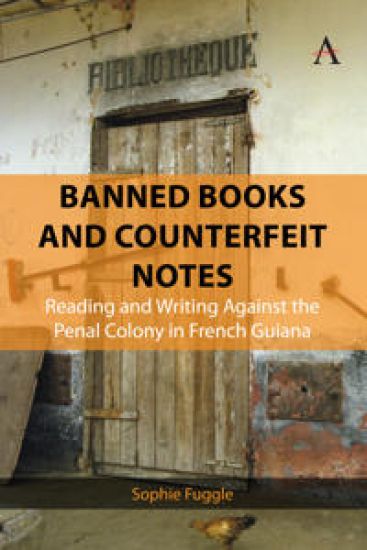
Banned Books and Counterfeit Notes examines how convicts sent to France’s overseas penal colony in French Guiana used the colonial postal system together with other, unofficial means of communication, to document and challenge lived experiences of transportation and forced labour. Identifying a series of ‘counterfeit notes’, the forensic aim of the book is to refocus attention on different forms of writing, and reading (including the ‘banned books’ indicated in the title), which occur inside the penal colony (commonly referred to as the bagne) itself. In doing so, the book deconstructs many of the stories, anecdotes, myths and legends which have come to define and legitimise the bagne in French Guiana. The book’s theoretical framework is indebted to the work of philosopher Jacques Derrida and his extended commentary on writing, reading, paper, postal systems, archives, the death penalty, friendship and hospitality. The anticolonial critique found in the work of Ariella Azoulay (in relation to images and archives) and Ann Laura Stoler (in relation to colonial ruins) are also brought to bear on the visual material and material heritage of the penal colony. Patrick Chamoiseau’s writing on the penal colony as ‘trace-mémoire’ and Françoise Vergès’s concept of the postcolonial museum will offer further engagements with the present-day interpretation of what remains of the bagne today. Connecting histories of reading and writing within the penal colony to contemporary heritage practices and the repurposing of former sites, the book offers wider reflections on decarceration, abolition, education and community. The book is the result of several years of research funded by both the British Academy and the UK Arts and Humanities Research Council. This funding enabled multiple visits to French Guiana and New Caledonia to explore present-day interpretation of penal heritage. Ethnographies of visits and tours to museums and other sites linked to the bagne are interwoven into the book’s narrative. Funding also allowed for archival work to be undertaken at the Archives Nationales d’Outre Mer in Aix-en-Provence and the Archives Territoriales in Cayenne as well as further research at the Musée de la Poste in Paris. The material presented offers new readings of well-known figures such as the forger-artist Francis Lagrange, the anarchist Paul Roussenq and the convict-executioner Isidore Hespel as well as unknown convicts involved in campaigns for reading material and libraries. The book is part of the growing field of scholarship on France’s overseas penal colonies which began in the late 1990s. However, it moves beyond existing historiographical approaches which provide chronological overviews of life in the penal colony. Instead, the book focuses on specific writing and reading practices and the preservation of these within official archives. Such readings develop a closer analysis of forms of writing which include rhetorical strategies alongside the material conditions in which such writing occurs (e.g., access to paper and ink). Alongside this close analysis which draws on literary and cultural theoretical approaches to reading archival material, another key contribution is to show the cumulative and debilitating effect of life in the penal colony via the letters of figures like Roussenq and Hespel. The huge corpus of complaint letters produced and sent to the penal administration (as well as organisations such as the League of Human Rights) demonstrate the mental and physical impact of a decades-long struggle against the penal administration. While there have been a few studies on the history of prison libraries in France (e.g., Collectif, Lectures de prison (Paris: Le Lampadaire, 2018)), these have not included the sustained discussion of penal colonies that this book will provide. Where much scholarship focuses predominantly on archival material, the book will also create links with the built heritage of the penal colony and its contemporary interpretation. These not only include ethnographic accounts of the myths presented about the bagne by tour guides but also emphasise the emancipatory potential at work (if only symbolically) in the repurposing of former camp buildings as libraries and other creative, community spaces. Such links allow greater engagement with contemporary debates around decarceration and abolition as well as initiatives to repurpose built heritage linked to incarceration, an approach which is largely absent from existing histories of the penal colony.