

Kirjojen hintavertailu – 12 859 818 kirjaa ja 27 kauppaa

Kirjailija

Sophie Lecheler

Kirjat ja teokset yhdessä paikassa: 2 kirjaa, julkaisuja vuodelta 2018, suosituimpiin kuuluu News Framing Effects. Vertaile teosten hintoja ja tarkista saatavuus suomalaisista kirjakaupoista.

2 kirjaa

News Framing Effects

News Framing Effects

Sophie Lecheler; Claes H. de Vreese

Routledge
2018
sidottu
News Framing Effects is a guide to framing effects theory, one of the most prominent theories in media and communication science. Rooted in both psychology and sociology, framing effects theory describes the ability of news media to influence people’s attitudes and behaviors by subtle changes to how they report on an issue. The book gives expert commentary on this complex theoretical notion alongside practical instruction on how to apply it to research. The book’s structure mirrors the steps a scholar might take to design a framing study. The first chapter establishes a working definition of news framing effects theory. The following chapters focus on how to identify the independent variable (i.e., the "news frame") and the dependent variable (i.e., the "framing effect"). The book then considers the potential limits or enhancements of the proposed effects (i.e., the "moderators") and how framing effects might emerge (i.e., the "mediators"). Finally, it asks how strong these effects are likely to be. The final chapter considers news framing research in the light of a rapidly and fundamentally changing news and information market, in which technologies, platforms, and changing consumption patterns are forcing assumptions at the core of framing effects theory to be re-evaluated.
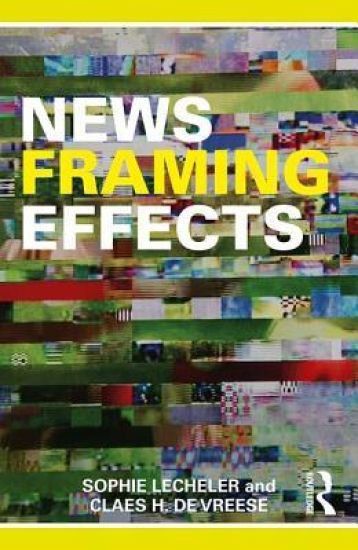
News Framing Effects

News Framing Effects

Sophie Lecheler; Claes H. de Vreese

Routledge
2018
nidottu
News Framing Effects is a guide to framing effects theory, one of the most prominent theories in media and communication science. Rooted in both psychology and sociology, framing effects theory describes the ability of news media to influence people’s attitudes and behaviors by subtle changes to how they report on an issue. The book gives expert commentary on this complex theoretical notion alongside practical instruction on how to apply it to research. The book’s structure mirrors the steps a scholar might take to design a framing study. The first chapter establishes a working definition of news framing effects theory. The following chapters focus on how to identify the independent variable (i.e., the "news frame") and the dependent variable (i.e., the "framing effect"). The book then considers the potential limits or enhancements of the proposed effects (i.e., the "moderators") and how framing effects might emerge (i.e., the "mediators"). Finally, it asks how strong these effects are likely to be. The final chapter considers news framing research in the light of a rapidly and fundamentally changing news and information market, in which technologies, platforms, and changing consumption patterns are forcing assumptions at the core of framing effects theory to be re-evaluated.