Kirjojen hintavertailu – 12 903 724 kirjaa ja 27 kauppaa

Kirjailija

Souptick Chanda

Kirjat ja teokset yhdessä paikassa: 6 kirjaa, julkaisuja vuosilta 2017–2025, suosituimpiin kuuluu Biomechanics of Joints and Implants. Vertaile teosten hintoja ja tarkista saatavuus suomalaisista kirjakaupoista.

6 kirjaa

Kirjojen julkaisuvuodet: 2017–2025.

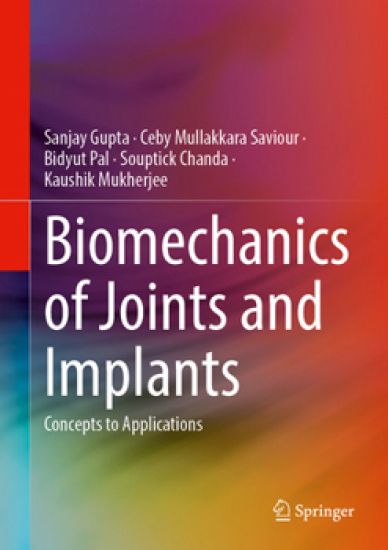
Biomechanics of Joints and Implants

Biomechanics of Joints and Implants

Sanjay Gupta; Ceby Mullakkara Saviour; Bidyut Pal; Souptick Chanda; Kaushik Mukherjee

Springer Nature Switzerland AG
2025
sidottu

Halvin toimitettuna 138,90 €

This textbook serves as a comprehensive resource for readers interested in applying the principles of engineering mechanics to analyse the mechanical and structural functions of the musculoskeletal system. Over the past few decades, orthopaedic practice has strongly been influenced by the contributions from mechanical analysis and design. This book sequentially presents basic concepts and applications necessary for understanding a biomechanical system. The book is specially focussed on analysis and design of orthopaedic implants used to treat skeletal diseases and disorders. The book begins with an introduction to the anatomy, physiology, and movements of human body and its mechanical analogy, followed by chapters on basic biomechanics of various joints and spine. It elaborately discusses the gait analysis and measurement techniques and systematically presents the quantitative estimation of musculoskeletal forces (joint forces and moments, muscle forces) using the fundamental concepts of joint dynamics (kinematics and kinetics), with relevant solved examples and exercises to impart basic understanding and knowledge to the students. It also discusses the basic concepts of mechanics of deformable bodies relevant for bone tissue as well as implanted bone structure, common failure mechanisms of implanted bone structure and biomaterials used in orthopaedic implants, and the steps involved in finite element modelling and analysis of implant-bone structures. Other topics covered include various theories, mathematical formulations, the computational framework of bone remodelling and bone ingrowth, mechanobiology based mathematical models of tissue differentiation, and simulations on tissue ingrowth have been presented along with the outcomes of our research activities, which may help and inspire the students to pursue research in this field.
Optimierung der Form des Femurimplantats in der Hüfttotalendoprothese
Es ist bekannt, dass Versagensmechanismen wie implantatbedingter ung nstiger Knochenumbau, berm ige Spannungen an der Schnittstelle zwischen Implantat und Knochen und mangelnde Prim rstabilit t das Ergebnis der zementfreien H fttotalendoprothese (HTEP) beeintr chtigen. Es wird berichtet, dass diese Versagensmechanismen durch das Design des Femurimplantats beeinflusst werden. Mit Hilfe der Formoptimierung als pr klinisches Designwerkzeug k nnen Schaftgeometrien auf der Grundlage dieser Versagensziele bewertet werden. Diese Ziele k nnen jedoch manchmal miteinander in Konflikt stehen. Daher ist es notwendig, eine multikriterielle Formoptimierung zu implementieren, um den Designkonflikt zu l sen. Anhand eines patientenspezifischen Femurs und eines ersten Designs eines TriLock(R) (DePuy)-Schafts wurde ein vollautomatisches 3D-Formoptimierungsschema entwickelt, das auf der Minimierung des Knochenumbaus und der Schnittstellenspannungen basiert. In der Studie wurde nach weiteren kompromissf higen Designs von Femurimplantaten gesucht, indem ein neuartiges hybrides System zur gleichzeitigen Minimierung aller drei Ziele eingef hrt wurde. In der Studie wurden lateral aufgeweitete Designs mit rechteckigen proximalen Querschnitten und gr eren Schaftgr en zur Verbesserung der Stabilit t bevorzugt. Die endg ltigen Kompromiss-Schaftgeometrien sagten eine g nstige Last bertragung und verbesserte Fixierung voraus.
Ottimizzazione della forma dell'impianto femorale nell'artroplastica totale dell'anca
I meccanismi di fallimento, come il rimodellamento osseo avverso indotto dall'impianto, le sollecitazioni eccessive dell'interfaccia impianto-osso e la mancanza di stabilit primaria, sono noti per influenzare l'esito dell'artroplastica totale d'anca (PTA) non cementata. stato riferito che questi meccanismi di fallimento sono influenzati dal design dell'impianto femorale. Utilizzando l'ottimizzazione della forma come strumento di progettazione pre-clinica, le geometrie degli steli possono essere valutate in base a questi obiettivi di fallimento. Tuttavia, questi obiettivi possono talvolta essere in conflitto tra loro. Pertanto, necessario implementare l'ottimizzazione multi-obiettivo della forma per affrontare il conflitto di progettazione. Utilizzando un femore specifico per il paziente e un progetto iniziale di stelo TriLock(R) (DePuy), stato sviluppato uno schema di ottimizzazione tridimensionale completamente automatizzato basato sulla minimizzazione del rimodellamento osseo e delle sollecitazioni di interfaccia. Nello studio sono stati ricercati ulteriori design compromessi di impianti femorali, introducendo un nuovo schema ibrido per la minimizzazione simultanea di tutti e tre gli obiettivi. Lo studio ha favorito i design con apertura laterale, sezioni trasversali prossimali rettangolari e steli di dimensioni maggiori per migliorare la stabilit . Le geometrie finali dello stelo hanno previsto un trasferimento del carico favorevole e una migliore fissazione.
Otimização da forma do implante femoral na artroplastia total da anca
Sabe-se que os mecanismos de falha, como a remodela o ssea adversa induzida pelo implante, as tens es excessivas na interface implante-osso e a falta de estabilidade prim ria, afectam o resultado da artroplastia total da anca (ATQ) n o cimentada. Estes mecanismos de falha s o alegadamente influenciados pelo desenho do implante femoral. Utilizando a otimiza o da forma como ferramenta de conce o pr -cl nica, as geometrias das hastes podem ser avaliadas com base nestes objectivos de falha. No entanto, estes objectivos podem, por vezes, ser mutuamente conflituosos. Por conseguinte, necess rio implementar a otimiza o da forma com m ltiplos objectivos para resolver o conflito de conce o. Utilizando um f mur espec fico de um doente e um desenho inicial da haste TriLock(R) (DePuy), foi desenvolvido um esquema de otimiza o da forma 3-D totalmente automatizado com base na minimiza o da remodela o ssea e das tens es da interface. No estudo, procurou-se obter mais designs comprometidos de implantes femorais atrav s da introdu o de uma nova estrutura h brida para a minimiza o simult nea dos tr s objectivos. O estudo favoreceu os designs com abertura lateral, com sec es transversais proximais rectangulares e tamanhos de haste maiores para melhorar a estabilidade. As geometrias finais da haste de compensa o previram uma transfer ncia de carga favor vel e uma melhor fixa o.