Kirjojen hintavertailu – 12 859 829 kirjaa ja 27 kauppaa

Kirjailija

Sreevalsa Kolathayar

Kirjat ja teokset yhdessä paikassa: 6 kirjaa, julkaisuja vuosilta 2017–2021, suosituimpiin kuuluu Sustainable Water Resource Development Using Coastal Reservoirs. Vertaile teosten hintoja ja tarkista saatavuus suomalaisista kirjakaupoista.

6 kirjaa

Kirjojen julkaisuvuodet: 2017–2021.

Sustainable Water Resource Development Using Coastal Reservoirs

Sustainable Water Resource Development Using Coastal Reservoirs

T.G. Sitharam; Shu-Qing Yang; Roger Falconer; Muttucumaru Sivakumar; Brian Jones; Sreevalsa Kolathayar; Lim Sinpoh

Butterworth-Heinemann Inc
2020
nidottu
Coastal reservoirs are viewed in many regions of the world as an emerging concept of storing fresh water when the river basin is in flood. Similar reservoirs (or impoundments) can be used to generate tidal renewable energy and/or provide the catalysis for urban regeneration. Constructed near the coast in natural river basins, these reservoirs have a smaller environmental footprint and are less obstructive than inland dams. Written by an international group of Civil, Environmental, and Geotechnical Engineers, Sustainable Water Resource Development using Coastal Reservoirs discusses the latest research and breakthroughs in their use, while offering expert advice into their sustainable design and construction. The perfect reference for researchers exploring the feasibility of this emerging technology or experienced professionals who wish to implement this technology as a water scarcity solution or a tidal renewable energy source or for urban regeneration, Sustainable Water Resource Development using Coastal Reservoirs provides an expert resource to the design, construction and use of coastal reservoirs. The reference begins with a brief but readable examination of water quantity, quality design and geotechnical considerations. The book includes international case studies to clearly illustrate the various uses, design, planning, construction, and operation methods. These case studies include projects such as: Afsluitdijk in the IJsselmeer, (Netherlands), Zuiderzee (Netherlands), Thanneermukkom Bund (India), Sihwa (South Korea), Saemangeum, (South Korea), Chenhang (China), Plover Cove (China), and Marina Barrage (Singapore).
Earthquake Hazard Assessment

Earthquake Hazard Assessment

Sreevalsa Kolathayar; T.G. Sitharam

CRC Press
2021
nidottu
This book represents a significant contribution to the area of earthquake data processing and to the development of region-specific magnitude correlations to create an up-to-date homogeneous earthquake catalogue that is uniform in magnitude scale. The book discusses seismicity analysis and estimation of seismicity parameters of a region at both finer and broader levels using different methodologies. The delineation and characterization of regional seismic source zones which requires reasonable observation and engineering judgement is another subject covered. Considering the complex seismotectonic composition of a region, use of numerous methodologies (DSHA and PSHA) in analyzing the seismic hazard using appropriate instruments such as the logic tree will be elaborated to explicitly account for epistemic uncertainties considering alternative models (for Source model, Mmax estimation and Ground motion prediction equations) to estimate the PGA value at bedrock level. Further, VS30 characterization based on the topographic gradient, to facilitate the development of surface level PGA maps using appropriate amplification factors, is discussed. Evaluation of probabilistic liquefaction potential is also explained in the book. Necessary backgrounds and contexts of the aforementioned topics are elaborated through a case study specific to India which features spatiotemporally varied and complex tectonics. The methodology and outcomes presented in this book will be beneficial to practising engineers and researchers working in the fields of seismology and geotechnical engineering in particular and to society in general.
Comprehensive Seismic Zonation Schemes for Regions at Different Scales

Comprehensive Seismic Zonation Schemes for Regions at Different Scales

T. G. Sitharam; Naveen James; Sreevalsa Kolathayar

Springer Nature Switzerland AG
2019
nidottu
This book reviews and assesses the various methodologies for site characterization and site effect estimation to carry out seismic zonation at micro and macro levels. Readers will learn about the suitability of these methodologies for each level of zoning that needs to be assessed in order to optimize the resources for carrying out seismic zonation. The Indian sub-continent is highly vulnerable to earthquake hazards, and past studies have focused primarily on the Himalayan region (inter-plate zone) and the northeast region (subduction zone). The book improves understanding of the Peninsular India that also has significantly high seismicity and is prone to earthquakes of sizeable magnitude. Particular attention is given to the various methodologies for assessing seismic hazards, the scales at which site characterizations are carried out, and optimal methods for zonation practices using site data and hazard indexes. Aimed at students, this book will beof use to post-graduates and doctoral students researching seismic zonation, hazard assessment and mitigation, and spatial data in earth sciences.
Comprehensive Seismic Zonation Schemes for Regions at Different Scales

Comprehensive Seismic Zonation Schemes for Regions at Different Scales

T. G. Sitharam; Naveen James; Sreevalsa Kolathayar

Springer International Publishing AG
2018
sidottu
This book reviews and assesses the various methodologies for site characterization and site effect estimation to carry out seismic zonation at micro and macro levels. Readers will learn about the suitability of these methodologies for each level of zoning that needs to be assessed in order to optimize the resources for carrying out seismic zonation. The Indian sub-continent is highly vulnerable to earthquake hazards, and past studies have focused primarily on the Himalayan region (inter-plate zone) and the northeast region (subduction zone). The book improves understanding of the Peninsular India that also has significantly high seismicity and is prone to earthquakes of sizeable magnitude. Particular attention is given to the various methodologies for assessing seismic hazards, the scales at which site characterizations are carried out, and optimal methods for zonation practices using site data and hazard indexes. Aimed at students, this book will beof use to post-graduates and doctoral students researching seismic zonation, hazard assessment and mitigation, and spatial data in earth sciences.
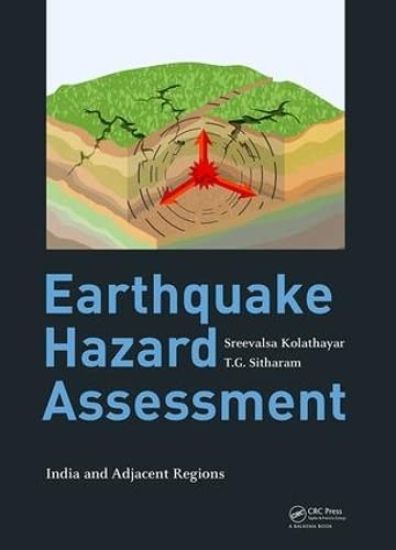
Earthquake Hazard Assessment

Earthquake Hazard Assessment

Sreevalsa Kolathayar; T.G. Sitharam

CRC Press
2018
sidottu
This book represents a significant contribution to the area of earthquake data processing and to the development of region-specific magnitude correlations to create an up-to-date homogeneous earthquake catalogue that is uniform in magnitude scale. The book discusses seismicity analysis and estimation of seismicity parameters of a region at both finer and broader levels using different methodologies. The delineation and characterization of regional seismic source zones which requires reasonable observation and engineering judgement is another subject covered. Considering the complex seismotectonic composition of a region, use of numerous methodologies (DSHA and PSHA) in analyzing the seismic hazard using appropriate instruments such as the logic tree will be elaborated to explicitly account for epistemic uncertainties considering alternative models (for Source model, Mmax estimation and Ground motion prediction equations) to estimate the PGA value at bedrock level. Further, VS30 characterization based on the topographic gradient, to facilitate the development of surface level PGA maps using appropriate amplification factors, is discussed. Evaluation of probabilistic liquefaction potential is also explained in the book. Necessary backgrounds and contexts of the aforementioned topics are elaborated through a case study specific to India which features spatiotemporally varied and complex tectonics. The methodology and outcomes presented in this book will be beneficial to practising engineers and researchers working in the fields of seismology and geotechnical engineering in particular and to society in general.
Preparing for Earthquakes: Lessons for India

Preparing for Earthquakes: Lessons for India

T. G. Sitharam; Sreevalsa Kolathayar

Springer International Publishing AG
2017
nidottu
The primary goals of this brief are to invoke alertness and solidarity among the public in earthquake prone areas of India, and to empower the community to prepare themselves to face and manage the aftermath of an earthquake. The work presented here sheds new light on the action plans to be taken by the common public and public agencies, before, during and after earthquakes to safeguard lives of people and minimize loss of assets. This carefully presented book articulates various factors related to earthquake preparedness, and develops guidelines and useful tips for communicating them to relevant stakeholders. The book has been divided into three parts: (i) the first providing background which explains earthquakes in general and seismicity of India (ii) the second explores earthquake preparedness intended for individuals, families and various stakeholders, and (iii) the final section which describes various strategies for communities to prepare themselves for a future earthquake.